
Participating Lender Network





How to Finance Radon Mitigation
A radon test that comes back above the EPA action level, a home inspection that flags elevated radon during a sale, or a state that now recommends testing every home can all put radon mitigation on your to-do list. Addressing radon promptly protects your household’s long-term health, since it’s the leading cause of lung cancer in non-smokers, and it clears a common obstacle in a home sale. Radon mitigation costs about $800 to $2,500 for the typical system, and because that’s a relatively small home-repair bill, many homeowners absorb it or put it on a low-interest option rather than take out a loan, financing it mainly when it’s bundled into a larger project or demanded unexpectedly before a closing.
Key Takeaways
- A standard sub-slab depressurization system runs $800 to $2,500 installed, the most common and effective type.
- Cost tracks your foundation: a crawl-space system runs $1,500 to $4,000, a block-wall system $1,800 to $5,000, and each extra suction point adds $500 to $1,500.
- Radon most often comes up during a home sale, where the seller usually pays or credits the buyer at closing.
- At this price, financing isn’t always necessary: many pay cash or use a 0% card, and a loan makes most sense when radon is bundled with other work or is a surprise pre-closing cost.
- The EPA action level is 4 pCi/L, and mitigation typically cuts radon by 80% to 99%, bringing a home well below it.
- Homeowners insurance doesn’t cover radon mitigation, since it’s a voluntary safety upgrade rather than sudden damage.
What Radon Level Requires Mitigation?
Knowing the threshold tells you whether you even need a system and how low to aim. The EPA action level is 4.0 pCi/L, the point at which it recommends installing mitigation, and it suggests considering mitigation between 2.0 and 4.0 pCi/L.
Two things are worth knowing beyond the headline number:
- The WHO recommends a stricter level: the World Health Organization sets its reference level at 2.7 pCi/L (100 Bq/m³), lower than the EPA’s, because it weighs health risk without the same cost-feasibility tradeoff. There’s no level considered fully risk-free.
- Good systems go well below the action level: a properly designed system typically cuts radon by 80% to 99%, commonly bringing a home down to between 1.0 and 2.0 pCi/L, so you’re not just clearing the 4.0 bar but getting well under it.
For a home sale, the 4.0 pCi/L figure is the one that appears in real estate contracts and lender requirements, so it’s the practical benchmark for a transaction even though lower is better for health.
How Much Does Radon Mitigation Cost by System Type?
The system your home needs is set by its foundation, and that’s the main thing that moves the price, not the contractor or your ZIP code. A standard sub-slab depressurization system runs $800 to $2,500 installed, while crawl-space and block-wall systems cost more because they need a vapor barrier or wall-cavity work.
| System Type | Installed Cost | Best For |
|---|---|---|
| Sub-slab depressurization | $800-$2,500 | Basement or slab foundation (most homes) |
| Drain-tile suction | $900-$1,800 | Homes with existing perimeter drain tile |
| Crawl-space (sub-membrane) | $1,500-$4,000 | Crawl-space foundation; needs vapor barrier |
| Block-wall depressurization | $1,800-$5,000 | Hollow block-wall foundations |
Cost ranges from UseCalcPro and HomeGuide.
A few things push a job toward the higher end of these ranges:
- Multiple suction points: large homes or complex foundations may need two or more, at $500 to $1,500 each.
- Very high radon levels: readings above 20 pCi/L can add 30% to 50% for a high-capacity fan and continuous monitoring.
- Mixed foundations: a home that’s part basement and part crawl space may need separate treatment for each section.
- Ongoing cost: the fan runs continuously, adding roughly $30 to $50 a year in electricity.
Systems also run 20% to 30% higher in Northeast and mountain-west metros than in the Midwest.
What Does a Proper Radon System Installation Include?
Knowing what a compliant install involves helps you compare quotes and spot a contractor cutting corners. A proper system follows ASTM E2121, the standard for installing radon systems in homes, and should be installed by a certified professional:
- Certified contractor: hire someone certified through the National Radon Proficiency Program (NRPP) or the National Radon Safety Board (NRSB), plus any state license where it’s required. These credentials are what a lender and a future buyer will expect to see.
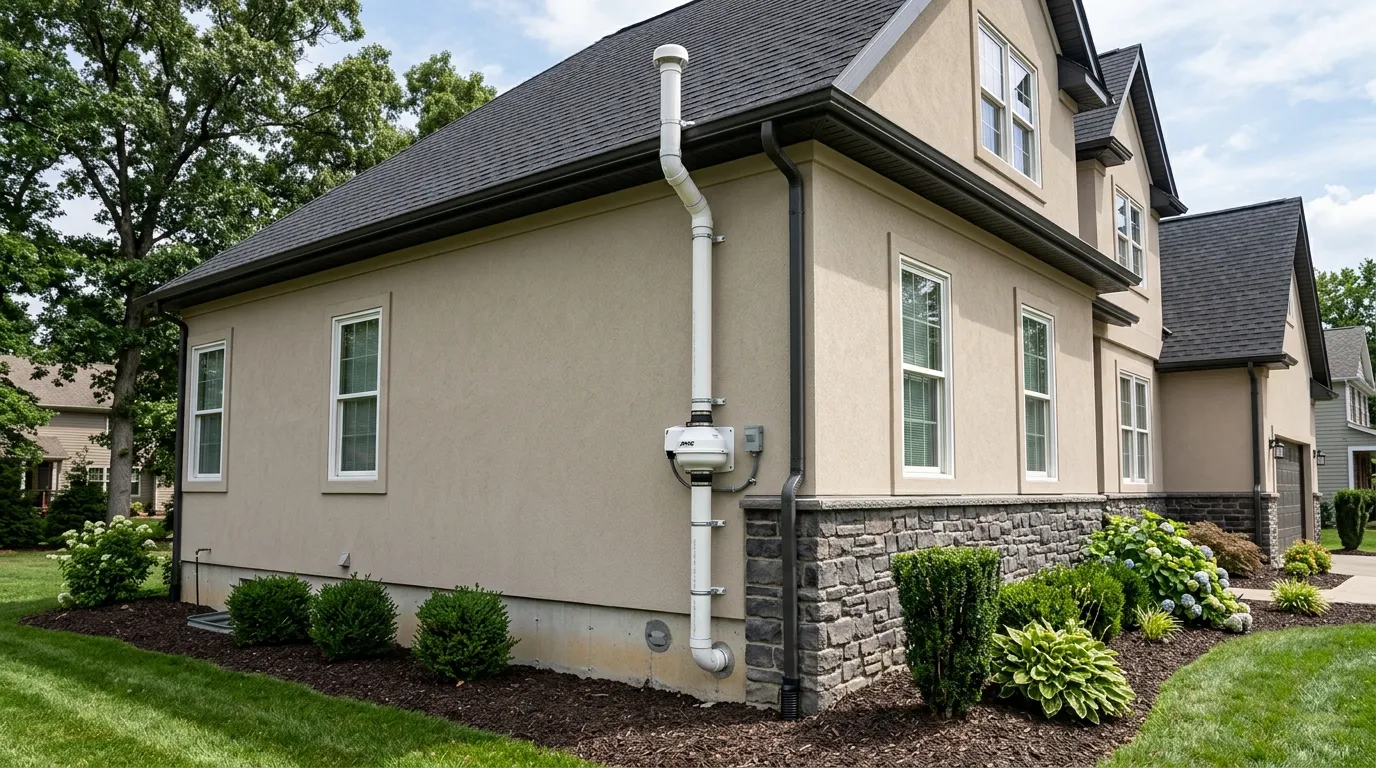
- Roof-line discharge (ASTM E2121): the exhaust pipe must vent above the roofline, at least 10 feet above ground level and at least 10 feet from any operable window or door, so the radon can’t be pulled back into the house.
- A monitoring gauge: the installer adds a U-tube manometer to the suction pipe, a simple gauge that shows vacuum pressure and lets you confirm at a glance that the fan is running. If the fluid levels are even, the fan has failed and needs service.
- Crawl-space vapor barrier: for a crawl-space (sub-membrane) system, the barrier should be a 6-mil to 12-mil cross-laminated polyethylene sheet, sealed airtight to the foundation walls and piers before the suction point goes in, since a loose or thin membrane won’t hold the vacuum.
What If Radon Is Coming From Your Well Water?
Most radon enters through soil gas under the foundation, but if you’re on a private well, it can also come in dissolved in the water and release into the air during showers and laundry. A standard soil-depressurization system won’t fix waterborne radon, since it treats the wrong entry point. Two point-of-entry water treatments handle it instead:
- Granular activated carbon (GAC) filter: filters water through carbon that traps the radon, running about $1,000 to $3,500 installed. It suits lower radon-in-water levels, and the carbon eventually becomes mildly radioactive and needs proper disposal.
- Aeration system: bubbles air through the water to strip the radon out and vent it outside, running roughly $2,000 to $6,000 installed. It’s more effective for high levels and avoids the radioactive-waste issue, but it’s a larger, more complex unit.
If a test shows radon in both your air and water, you may need both a soil system and a water treatment to bring indoor levels down.
Who Pays for Radon Mitigation in a Home Sale?
Radon most often surfaces during a real estate transaction, when a buyer’s inspection turns up a level above the EPA’s 4 pCi/L action level, and that timing creates both urgency and a negotiation. In most home sales the seller pays for the mitigation system, either installing it before closing or giving the buyer a credit to handle it, because radon is treated as a known health defect the seller would then have to disclose to any future buyer.
The situation usually resolves one of these ways:
- Seller installs before closing: the seller hires the contractor and pays out of pocket, keeping control of the work and quality.
- Seller credits the buyer at closing: the seller gives a credit toward closing costs so the buyer arranges their own mitigation after taking ownership.
- Buyer pays: common on as-is listings, estate sales, and new construction, or when the buyer’s lender requires mitigation as a loan condition.
The pressure point is timing: mitigation plus a follow-up test to confirm it worked takes several days, which can squeeze a closing date. If you’re the buyer taking on the cost after closing, or a seller who needs it done fast to keep a deal alive, that’s exactly the moment fast financing matters.
How Do You Finance Radon Mitigation?
Because most radon systems land under $2,500, this is one of the few home-repair projects where borrowing often isn’t the obvious move. It’s worth being honest about when financing helps and when it doesn’t.
- Pay cash or use a 0% card: for a standard $800 to $2,500 system, many homeowners simply absorb the cost or put it on a card with a 0% intro period and pay it off before interest starts.
- Personal loan: makes sense when the system is on the larger end (a block-wall or multi-point job), when it’s an unexpected pre-closing demand you can’t cover from savings, or when your credit card rate is high.
- Bundle into a larger project: if you’re already financing a basement finish, crawl-space encapsulation, or a covered-peril repair, folding radon mitigation into that loan is usually cheaper than a standalone one.
- Contractor financing: some radon companies offer payment plans, but for a bill this size, compare the total against just paying it or using a 0% card first.
Does Insurance Cover Radon Mitigation?
No, and it’s a quick answer. Standard homeowners insurance doesn’t cover radon mitigation, because it’s a voluntary safety improvement rather than sudden, accidental damage from a covered peril.
There’s no equivalent to the burst-pipe exception that applies to mold or asbestos, since radon isn’t caused by a physical event insurance recognizes. What can offset the cost instead: some counties and state health departments run radon programs or modest grants for income-qualified homeowners, and if a doctor documents a medical need, mitigation may count toward an HSA or FSA. The remediation and restoration hub covers how insurance treats the broader hazard cluster.
How Do You Qualify for Radon Mitigation Financing?
Because this is a small, well-defined job, qualifying is simpler than for a big remediation, but a couple of radon-specific steps still matter.
Test first, then get a system-specific quote. Confirm the radon level with a test (a short-term test for a sale, a long-term test for your own home), since the reading and your foundation type determine the system and the price. Don’t finance a number before you know which system you need.
Decide whether you even need to borrow. At $800 to $2,500, compare paying from savings or a 0% card against a loan, and only borrow if the job is large, urgent for a closing, or bundled with other work. A trustworthy answer here is often “you may not need financing.”
If you do borrow, prequalify with a soft pull. Check your credit report for errors and prequalify with a soft credit check to compare offers without affecting your score, then weigh them on total repayment rather than the monthly figure.
The Bottom Line
How you pay for radon mitigation depends mostly on the size of the system and the timing. For a standard sub-slab system under $2,500, paying from savings or a 0% card is often the simplest route, and financing makes sense mainly when the job is a larger block-wall or multi-point system, an unexpected demand before a home closing, or part of a bigger basement or crawl-space project you’re already funding.
Before you borrow, test to confirm the level and get a quote matched to your foundation, then decide honestly whether this is a cost you can absorb or one worth financing, since for many homeowners a radon system is small enough to handle without a loan.
Explore related resources
The information provided by Pasha Funding is for educational and informational purposes only and should not be considered financial, legal, or tax advice. Every homeowner’s financial situation is different, and the financing options discussed may not be suitable for everyone. Before choosing a financing solution, carefully review the lender’s terms and consider consulting a qualified financial professional if needed.
Pasha Funding is a financing marketplace that connects homeowners with financing options offered by participating lending partners. We do not make loans, determine credit eligibility, or guarantee approval or specific loan terms. Pasha Funding is not a direct lender. We may receive compensation from participating lending partners when users submit an application or obtain a loan through our platform. This compensation may affect how and where financing options appear, but it does not influence our editorial evaluations.
Financing offers, rates, terms, and availability are determined solely by participating lenders and may change without notice. Our editorial content is created independently to help consumers better understand home improvement financing. While we strive to keep information accurate and current, financing products, lender requirements, rates, and offers may change over time. Any opinions expressed are those of the author and have not been reviewed, approved, or endorsed by our lending partners.


Frequently Asked Questions
In this guide
- How much does a bathroom remodel cost?
- Should you finance a bathroom remodel or pay cash?
- What are the best ways to finance a bathroom remodel?
- Which bathroom remodel financing option is right for you?
- What do you need to qualify for bathroom remodel financing?
- What do bathroom remodel loan rates look like?
- How to improve your chances of approval for a bathroom remodel loan
- Common costs and fees to consider
- Will a bathroom remodel increase your home’s value?
- The bottom line
how it works
3 Simple steps to
finance your project.
Getting started only takes a minute. Complete one simple application to compare available financing offers from over 18+ lenders, choose the option that fits your budget, and move forward with your home improvement project.
Radon Mitigation Financing Calculator
1. Enter Your Desired Loan Amount
Your Estimate
Monthly Payment
-
This calculator provides estimates for illustrative purposes only and does not constitute an offer of credit or a commitment to lend. Final APRs, loan amounts, and terms depend on credit approval, income verification, and lender underwriting criteria. Minimum and maximum rates/terms vary by state.
Powered by: Pasha Funding
Risk-Free Prequalification
Checking offers won’t impact your credit.
It’s common for homeowners to delay applying because they’re worried about their credit score. With a soft credit check, you can review available financing options without any impact to your credit score.2