Participating Lender Network





How to Finance Accessibility & Aging-in-Place Upgrades
A hospital discharge planner tells you your father can’t go home until there’s a ramp at the door and a way to reach the shower without help, and suddenly you have two weeks, not two years, to figure out how to pay for it. Accessibility upgrades run a wide range, a simple entry ramp costs $1,000 to $3,000, a walk-in tub runs $4,000 to $15,000, a stairlift lands between $2,300 and $24,000, and a home elevator can reach $60,000, and most homeowners cover the cost with a personal loan, a VA housing grant if they or a family member served, or tax-advantaged funds from an HSA or FSA. Which option makes sense depends heavily on whether the need is medical, whether a veteran is involved, and how much of the home you’re modifying at once.
Key Takeaways
- Costs span a wide range by project: ramps run $1,000 to $3,000, walk-in tubs $4,000 to $15,000, stairlifts $2,300 to $24,000, and home elevators $30,000 to $60,000.
- Veterans with qualifying service-connected disabilities may not need to borrow at all: the VA’s SAH grant pays up to $126,526 and the SHA grant up to $25,350 in FY 2026, both without repayment.
- Medically necessary modifications can often be paid for with HSA or FSA funds, or partially deducted as a medical expense if you itemize.
- A letter of medical necessity from a physician strengthens both grant applications and tax documentation, and some lenders ask for one too.
- For non-veterans without enough equity or savings, a personal loan is usually the fastest path, often funding within days of approval.
- Structural projects like a permanent ramp or an elevator shaft usually require a building permit, even though they’re framed around medical need.
What Counts as an Accessibility Upgrade?
Not every aging-in-place change needs financing. Grab bars, lever-style door handles, non-slip flooring treatments, and raised toilet seats typically run under a few hundred dollars and are reasonable to pay for out of pocket. This page and its linked guides focus on the larger structural and mechanical projects that homeowners commonly finance: entry ramps, walk-in tubs, stairlifts, and home elevators. Each involves construction, electrical or mechanical components, and, in most cases, a permit, which is what separates them from a weekend hardware-store fix.
How Much Do Accessibility Upgrades Cost?
The four most commonly financed accessibility projects sit at very different price points, largely because they range from a simple ramp build to installing a small mechanical lift inside your house.
Accessibility Upgrade Cost by Project
Typical total cost by project type.
Bar length reflects the top of each range. Figures from Angi (ramps, tubs, stairlifts) and HomeGuide (elevators).
A ramp is mostly a materials-and-labor build, which is why it’s the cheapest option, though the length a ramp has to be can push it toward the top of that range. A stairlift’s range is wide because a straight single-story rail costs far less than a curved rail custom-fit to a stairway with landings or turns. A home elevator costs the most because it involves cutting a shaft through multiple floors, electrical work, and often structural modifications, closer to a small home addition than a mobility device.
How Long Does a Wheelchair Ramp Need to Be?
The number that catches most homeowners off guard is ramp length, because a safe ramp is far longer than people expect. The ADA slope standard is 1:12, meaning one foot of ramp for every inch of vertical rise. A typical 30-inch entry rise therefore needs 30 feet of ramp, not a short slope up to the door. That length frequently forces a switchback or L-shaped design to fit the ramp in the available yard space, and it’s a common reason homeowners move from a poured or wood ramp to a pre-engineered aluminum modular system that can be configured with turns. The takeaway for budgeting: measure the rise from the ground to the threshold first, multiply by twelve, and you’ll know roughly how much ramp you’re actually financing before you get a single quote.
How Do You Finance Accessibility Upgrades?
Accessibility projects have financing paths that most other home improvements don’t, largely because the underlying need is medical rather than cosmetic. Here’s how the main options compare.
VA Housing Grants for Veterans
Veterans and service members with qualifying service-connected disabilities have grant options that don’t require repayment. The Specially Adapted Housing (SAH) grant provides up to $126,526 in FY 2026 for veterans with severe disabilities, such as loss of use of both legs or blindness, to build, buy, or modify a home. The Special Housing Adaptation (SHA) grant, for a narrower set of qualifying conditions like loss of both hands or severe burns, provides up to $25,350. A separate benefit, the Home Improvements and Structural Alterations (HISA) grant, covers medically necessary modifications for veterans with any service-connected disability rating, up to $6,800, and can be used alongside SAH or SHA. None of these three require repayment, though the application process typically runs several months, so they suit a planned project better than an urgent one.
HSA and FSA Funds
If the modification is primarily for medical care, IRS Publication 502 allows the cost to count as a qualified medical expense, which means you can often pay for it with HSA or FSA funds. A wheelchair ramp, widened doorway, or grab bars are cited directly in Publication 502 as expenses that typically don’t increase a home’s resale value, so the full cost usually counts as medical. A walk-in tub or elevator is more likely to add resale value, and here Publication 502 uses a specific formula: only the amount by which the cost exceeds the increase in your home’s value counts. If a home elevator costs $35,000 and a before-and-after appraisal shows it added $15,000 to your home’s value, only the remaining $20,000 qualifies as a deductible medical expense or HSA reimbursement. Keep contractor invoices, the appraisal, and a physician’s letter of medical necessity, since HSA administrators and the IRS may both ask for documentation.
Personal Loans
For homeowners who don’t qualify for a VA grant and want to move faster than a grant application allows, a personal loan delivers funds in a matter of days without touching home equity. This fits an urgent situation well, a hospital discharge, a fall, a sudden mobility change, since the approval and funding timeline is measured in days rather than the months a VA grant application can take.
Home Equity Loans and HELOCs
For a larger combined project, say a home elevator alongside a bathroom remodel, borrowing against home equity typically carries a lower rate than a personal loan. The tradeoff is a slower closing process, which makes this a better fit for a planned modification than an urgent one.
Does Medicare or Medicaid Cover Home Modifications?
This is the assumption that trips up the most families, so it’s worth stating plainly. Original Medicare (Parts A and B) does not cover structural home modifications: it will not pay for a ramp, a walk-in tub, a stairlift, or an elevator, because it classifies them as home improvements rather than durable medical equipment. There are two narrower paths worth checking. Some Medicare Advantage (Part C) plans have added limited home-modification or safety allowances as supplemental benefits, so if you or your parent is on an Advantage plan, call the plan directly and ask what it covers. And on the Medicaid side, many states run Home and Community-Based Services (HCBS) waiver programs that can cover accessibility modifications for eligible low-income residents, precisely because keeping someone in their home is cheaper for the state than nursing-home care. Waiver rules, waiting lists, and covered items vary widely by state, so contact your state Medicaid office to see what’s available where you live.
State and Local Assistance for Non-Veterans
Homeowners who aren’t veterans and don’t qualify for Medicaid still have options beyond a loan. Every state runs a program under the federal Assistive Technology Act, and many of these offer low-interest financing or device-loan programs that can apply to home-access equipment. Your local Area Agency on Aging (AAA) is the other place to start: AAAs either administer or can point you to grants, sliding-scale programs, and low-interest loans for accessibility work aimed at helping older adults stay in their homes. These programs are income-qualified and vary by locality, but for a lower-income senior they can cover part or all of a project that would otherwise require borrowing.
Which Accessibility Upgrade Do You Need?
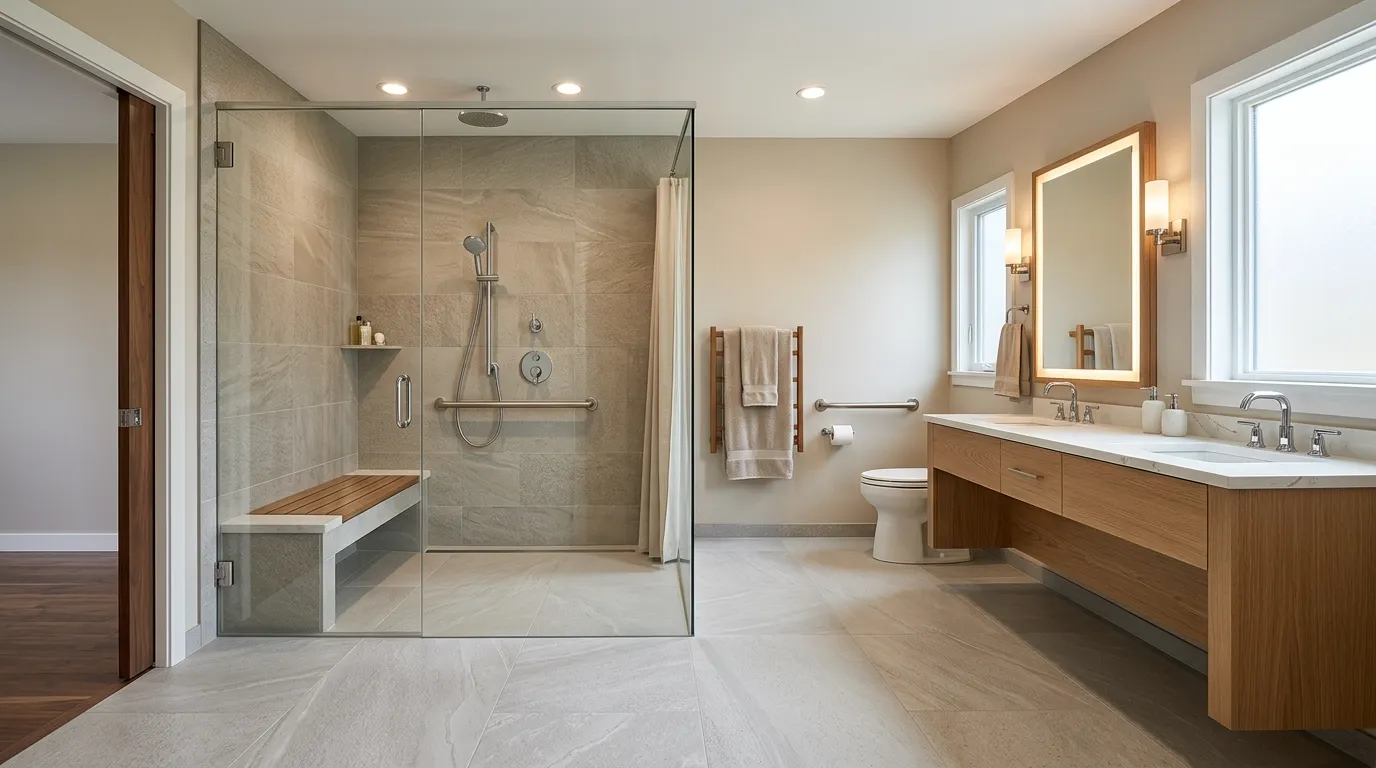
The right project depends on the specific access problem, not on price. A single step at the entry or a threshold that stops a wheelchair or walker calls for a ramp, usually the fastest and least expensive fix. Difficulty getting into a standard tub or shower points to a walk-in tub or a roll-in shower conversion. A staircase that’s become dangerous or impossible to climb calls for a stairlift if the budget is tighter or the need is for one flight, or a home elevator if the home has multiple stories, a wheelchair user needs to move between floors independently, or the modification needs to serve the household long-term rather than one person’s current condition.
Do You Need a Permit for Accessibility Modifications?
Usually, yes, for anything structural. A permanent ramp attached to your home’s entry, a stairlift rail bolted into a staircase, and especially a home elevator shaft cut through floor framing all typically require a building permit and inspection, even though the underlying reason for the project is medical rather than aesthetic. Lifts carry an extra layer of code that general construction doesn’t. Stairlifts and platform lifts are governed by the ASME A18.1 safety standard, while home elevators fall under ASME A17.1 (paired with CSA B44 in jurisdictions that follow the joint U.S.-Canada code). Meeting these standards usually requires sign-off from a licensed state elevator inspector, a specialized inspection a general contractor cannot perform and that is separate from the standard building-permit inspection. Skipping the permit on a structural modification can cause the same problems as any other unpermitted work: trouble at resale, a voided warranty, and potential insurance complications if something fails.
How Do You Qualify for Accessibility Upgrade Financing?
Qualifying starts with documentation, since a written medical basis for the project affects nearly every financing path available.
- Get a letter of medical necessity. Ask the treating physician to document the specific condition and why the modification is required. This letter supports a VA HISA application, HSA/FSA reimbursement, a potential tax deduction, and can also speed up loan approval with lenders who ask about the purpose of the funds.
- Check veteran eligibility first if it applies. If a veteran in the household has a service-connected disability rating, check SAH, SHA, and HISA eligibility before applying for any loan, since a grant that doesn’t require repayment should come before financing options that do.
- Get itemized bids from accessibility specialists and match the loan to the timeline. Get quotes from contractors who have specific experience with accessibility work, ideally someone with a CAPS designation for larger projects, since ramp slope-to-code ratios and elevator shaft framing are specialized skills. Then choose financing based on urgency: a personal loan for a fast need, a home equity loan or HELOC for a larger planned project, or grant funds if you qualify and can wait out the application process.
The Bottom Line
How you pay for an accessibility upgrade depends more on who needs it and how urgent it is than on the size of the project. A veteran with a qualifying service-connected disability should check SAH, SHA, and HISA grant eligibility before financing anything, since those funds don’t need to be repaid. Anyone paying for a medically necessary modification should ask about HSA or FSA eligibility and keep documentation for a possible tax deduction. When the need is urgent or no grant applies, a personal loan gets the work done without waiting on equity or a lengthy application.
Before you borrow, get a letter of medical necessity from your doctor if the project is medically driven, since it strengthens nearly every financing option available to you, then compare quotes from contractors experienced in accessibility-specific work rather than general handymen.
More related financing options
The information provided by Pasha Funding is for educational and informational purposes only and should not be considered financial, legal, or tax advice. Every homeowner’s financial situation is different, and the financing options discussed may not be suitable for everyone. Before choosing a financing solution, carefully review the lender’s terms and consider consulting a qualified financial professional if needed.
Pasha Funding is a financing marketplace that connects homeowners with financing options offered by participating lending partners. We do not make loans, determine credit eligibility, or guarantee approval or specific loan terms. Pasha Funding is not a direct lender. We may receive compensation from participating lending partners when users submit an application or obtain a loan through our platform. This compensation may affect how and where financing options appear, but it does not influence our editorial evaluations.
Financing offers, rates, terms, and availability are determined solely by participating lenders and may change without notice. Our editorial content is created independently to help consumers better understand home improvement financing. While we strive to keep information accurate and current, financing products, lender requirements, rates, and offers may change over time. Any opinions expressed are those of the author and have not been reviewed, approved, or endorsed by our lending partners.


FAQ
In this guide
- What Counts as an Accessibility Upgrade?
- How Much Do Accessibility Upgrades Cost?
- How Long Does a Wheelchair Ramp Need to Be?
- How Do You Finance Accessibility Upgrades?
- Does Medicare or Medicaid Cover Home Modifications?
- Which Accessibility Upgrade Do You Need?
- Do You Need a Permit for Accessibility Modifications?
- How Do You Qualify for Accessibility Upgrade Financing?
- The Bottom Line
how it works
3 Simple steps to
finance your project.
Getting started only takes a minute. Complete one simple application to compare available financing offers from over 18+ lenders, choose the option that fits your budget, and move forward with your home improvement project.
Accessibility Financing Calculator
1. Enter Your Desired Loan Amount
Your Estimate
Monthly Payment
-
This calculator provides estimates for illustrative purposes only and does not constitute an offer of credit or a commitment to lend. Final APRs, loan amounts, and terms depend on credit approval, income verification, and lender underwriting criteria. Minimum and maximum rates/terms vary by state.
Powered by: Pasha Funding
Risk-Free Prequalification
Checking offers won’t impact your credit.
It’s common for homeowners to delay applying because they’re worried about their credit score. With a soft credit check, you can review available financing options without any impact to your credit score.2