
Participating Lender Network





How to Finance major Whole-Home Remodel Projects
A major whole-home remodel is one of the largest projects a homeowner can take on, so financing usually means a mortgage-scale loan rather than a simple personal loan. You can pay for one with a home equity loan or HELOC, a cash-out refinance, or a renovation loan such as an FHA 203(k) or Fannie Mae HomeStyle, with a personal loan filling smaller gaps. With full renovations often running $100,000 to $300,000 or more, the right choice depends on your equity, whether you are doing the work all at once or in phases, and the interest rate you can secure.
Key Takeaways
- Whole-home remodels commonly run $100,000 to $300,000 or more, so financing choices carry real weight.
- A home equity loan or HELOC usually offers the lowest rate if you have built equity.
- Renovation loans like the FHA 203(k) and HomeStyle let you borrow against the home’s value after the remodel, useful when current equity is short.
- On a six-figure project, the interest rate is a major line item, often costing more over the loan than the finishes themselves.
- A HELOC fits a phased, multi-year remodel, while a fixed loan suits an all-at-once project with a firm bid.
- Get preapproved and add a 15% to 20% contingency before signing, since large remodels routinely uncover surprises.
How Much Does a Whole-Home Remodel Cost?
A full remodel varies enormously with scope, from a cosmetic refresh of the whole house to a structural gut renovation. Most land between $100,000 and $300,000, though a smaller home with lighter finishes can come in under that and a large or high-end project well above it.
What a Whole-Home Remodel Costs by Scope
Typical all-in cost range by project type.
Bar length reflects the top of each range. Figures from RL Remodeling and Cost to Renovate.
Your total depends on the size of the home, the depth of the work (cosmetic versus moving walls, plumbing, and electrical), your materials, and local labor rates. Structural changes, older homes with hidden problems, and permit-heavy scopes push costs up fast. Because a whole-home remodel almost always turns up surprises once walls open, budget a 15% to 20% contingency on top of the contractor’s quote.
How Do You Finance a Whole-Home Remodel?
At this scale, the strongest options are secured by your home, since they offer the lowest rates and the highest borrowing limits. Here is how the options compare:
Home Equity Loans
A home equity loan gives you a fixed lump sum at a fixed rate, repaid over a set term. It usually carries one of the lowest rates available for a remodel and makes budgeting simple, since the payment never changes. It fits a project with a firm contractor bid and a defined total. The trade-offs are closing costs, your home as collateral, and the need for existing equity, generally you can borrow up to 80% to 85% of your home’s value, counting your first mortgage.
HELOCs
A home equity line of credit works like a credit line secured by your home: you draw funds as you need them and pay interest only on what you use. That flexibility suits a phased remodel where costs come in stages. The main caution is that most HELOCs carry a variable rate, so your payment can rise if rates do, worth weighing against a fixed loan if you value certainty.
Cash-Out Refinance
A cash-out refinance replaces your mortgage with a larger one and gives you the difference for the remodel. It can make sense if you can improve your mortgage rate at the same time, but rarely if it means giving up a low existing rate on your entire balance to fund the work.
Renovation Loans – FHA 203(k) and HomeStyle
Renovation loans finance the remodel based on the home’s value after the work is done, which is what makes them powerful when you do not have enough current equity. They are covered in detail in the next section, and they are often the answer for a large remodel on a home you have not owned long.
Personal Loans
A personal loan is not the primary tool for a whole-home remodel, since unsecured limits and higher rates rarely suit a six-figure project. It can help at the edges, funding a single phase or a smaller piece under about $25,000, or bridging a gap while a larger loan closes, but for the bulk of the work, a home-secured or renovation loan is the better fit.
0% Credit Cards
A card with a true 0% introductory offer can be interest-free for a small, contained purchase you can repay before the promotion ends, appliances or a single room, for example. For the six-figure whole a full remodel represents, a card is not a realistic financing tool once the standard rate applies.
What Are Renovation Loans and How Do They Work?
Renovation loans are the piece that sets whole-home financing apart from smaller projects. Instead of limiting you to the equity you have today, they let you borrow against the home’s projected value after the remodel is complete. That matters when a big remodel would cost more than your current equity allows.
The two most common are government-backed and conventional. The FHA 203(k) comes in two forms: a Limited 203(k) for non-structural work up to $35,000, and a Standard 203(k) for larger, structural renovations, which requires a HUD-approved consultant to oversee the project. It allows a credit score as low as 580 with 3.5% down (or 500 with 10% down) and requires the home to be your primary residence. The Fannie Mae HomeStyle and Freddie Mac CHOICERenovation loans are the conventional equivalents, typically wanting stronger credit but avoiding FHA mortgage insurance.
A few requirements are common to renovation loans and worth knowing before you apply. The work generally must be done by a licensed contractor, the lender approves the renovation plan and a post-renovation appraisal sets the loan amount, and the renovation funds are held in escrow and released to the contractor in draws as work is completed and inspected. There is more paperwork than a standard mortgage, but in exchange you finance the home and the remodel in a single loan tied to the improved value.
How Much Does the Interest Rate Affect a Remodel’s Total Cost?
On a six-figure remodel, the interest rate is one of the biggest numbers in the whole budget. The difference between a good rate and a mediocre one can cost more than a major part of the renovation itself. A modest rate gap on a large, long-term loan compounds into tens of thousands of dollars over the life of the loan, sometimes exceeding what you spend on cabinets and appliances combined.
That is why chasing a headline offer can backfire. A “zero interest” promotion only applies to small, short balances, not a whole-home remodel, and a low advertised rate can hide points or fees that make it more expensive than a slightly higher rate with no costs. The way to compare fairly is on total cost: add up every payment plus fees over the full term for each offer, rather than reacting to the monthly payment or the headline rate. Because home-secured loans generally price lower than unsecured borrowing, they are usually where the best rates live for a project this size, another reason equity and renovation loans dominate at the top end. Prequalifying with several lenders and comparing those total-cost numbers is the single most valuable step in financing a large remodel.
Should You Finance a Remodel All at Once or in Phases?
How you sequence the work should guide which loan you choose, and this is one of the clearest ways to match the financing to the project. An all-at-once remodel with a firm bid fits a fixed lump-sum loan, while a phased, multi-year remodel fits a revolving line.
If you are gutting and rebuilding the whole house on one timeline, a home equity loan or a renovation loan gives you the full amount at a fixed, predictable payment. If instead you are spreading the work out, kitchen this year, bathrooms next, primary suite the year after, a HELOC lets you draw and pay interest only on what you have used so far, which can cost less than borrowing the entire sum upfront and paying interest on money sitting idle. The trade-off is the HELOC’s variable rate, so phasing works best when you are comfortable with some rate movement or expect to repay each draw fairly quickly.
Can You Finance a Whole-Home Remodel With Bad Credit?
Yes, financing a large remodel with less-than-perfect credit is possible, though your options narrow and the cost rises. A low score limits which lenders will approve you and raises your rate rather than ruling out the project entirely.
Because home-secured loans are backed by collateral, a home equity product may still be within reach even with weaker credit, though the rate will reflect the added risk. Government-backed renovation loans help here too: the FHA 203(k) accepts a 580 score with 3.5% down, and a score as low as 500 with 10% down, which is more flexible than most conventional financing, though individual lenders often set their own floor around 620. Credit unions and community banks can be more flexible than large lenders, and improving your score before you apply will widen your options and, on a six-figure loan, save a meaningful amount.
How Do You Qualify for Whole-Home Remodel Financing?
Qualifying for renovation financing weighs your credit, your income against your debts, your home equity or its after-renovation value, and the renovation plan itself. A few steps improve both your odds and your rate.
- Get itemized bids and a clear scope.
Have contractors price the full project, including a 15% to 20% contingency, so you borrow the right amount once. Renovation loans require a defined plan and licensed contractor, so a detailed scope also speeds approval.
- Check your credit and debt-to-income ratio.
Pull your credit report, dispute errors, and pay down card balances, since utilization moves your score quickly. Most lenders want total monthly debt, including the new payment, at or below 43% of gross monthly income.
- Get preapproved with more than one lender.
Preapproval before you collect bids clarifies your budget and strengthens your position. Compare offers on total cost over the full term, including rate, fees, and any mortgage insurance, not just the monthly payment.
| Qualification Metric | Home Equity Loan / HELOC | FHA 203(k) Renovation |
|---|---|---|
| Minimum credit score | 620 to 680+ | 580 (or 500 with 10% down) |
| Based on | Current home equity | After-renovation value |
| Contractor oversight | Not required | Required (consultant for Standard) |
These are typical benchmarks rather than firm cutoffs, and each lender sets its own bar. A home equity product depends on the equity you already have, while a renovation loan is judged on the home’s improved value, which is what makes it workable when you have not built much equity yet.
The Bottom Line
For a whole-home remodel, the financing usually comes down to how much equity you have and how you plan to run the project. With solid equity and a firm all-at-once bid, a home equity loan offers a low fixed rate and a predictable payment; for a phased, multi-year remodel, a HELOC lets you draw as you go; and when the remodel would cost more than your current equity, a renovation loan tied to the after-renovation value is often the answer. A cash-out refinance can work too, if it does not mean surrendering a low mortgage rate.
Whatever the path, the rate matters as much as the option on a project this size, so the highest-value move is to get itemized bids with a real contingency, get preapproved with a few lenders, and compare their offers on the total you will repay rather than the headline rate or monthly payment.
The information provided by Pasha Funding is for educational and informational purposes only and should not be considered financial, legal, or tax advice. Every homeowner’s financial situation is different, and the financing options discussed may not be suitable for everyone. Before choosing a financing solution, carefully review the lender’s terms and consider consulting a qualified financial professional if needed.
Pasha Funding is a financing marketplace that connects homeowners with financing options offered by participating lending partners. We do not make loans, determine credit eligibility, or guarantee approval or specific loan terms. Pasha Funding is not a direct lender. We may receive compensation from participating lending partners when users submit an application or obtain a loan through our platform. This compensation may affect how and where financing options appear, but it does not influence our editorial evaluations.
Financing offers, rates, terms, and availability are determined solely by participating lenders and may change without notice. Our editorial content is created independently to help consumers better understand home improvement financing. While we strive to keep information accurate and current, financing products, lender requirements, rates, and offers may change over time. Any opinions expressed are those of the author and have not been reviewed, approved, or endorsed by our lending partners.


Frequently Asked Questions
In this guide
- How Much Does a Whole-Home Remodel Cost?
- How Do You Finance a Whole-Home Remodel?
- What Are Renovation Loans and How Do They Work?
- How Much Does the Interest Rate Affect a Remodel’s Total Cost?
- Should You Finance a Remodel All at Once or in Phases?
- Can You Finance a Whole-Home Remodel With Bad Credit?
- How Do You Qualify for Whole-Home Remodel Financing?
- The Bottom Line
how it works
3 Simple steps to
finance your project.
Getting started only takes a minute. Complete one simple application to compare available financing offers from over 18+ lenders, choose the option that fits your budget, and move forward with your home improvement project.
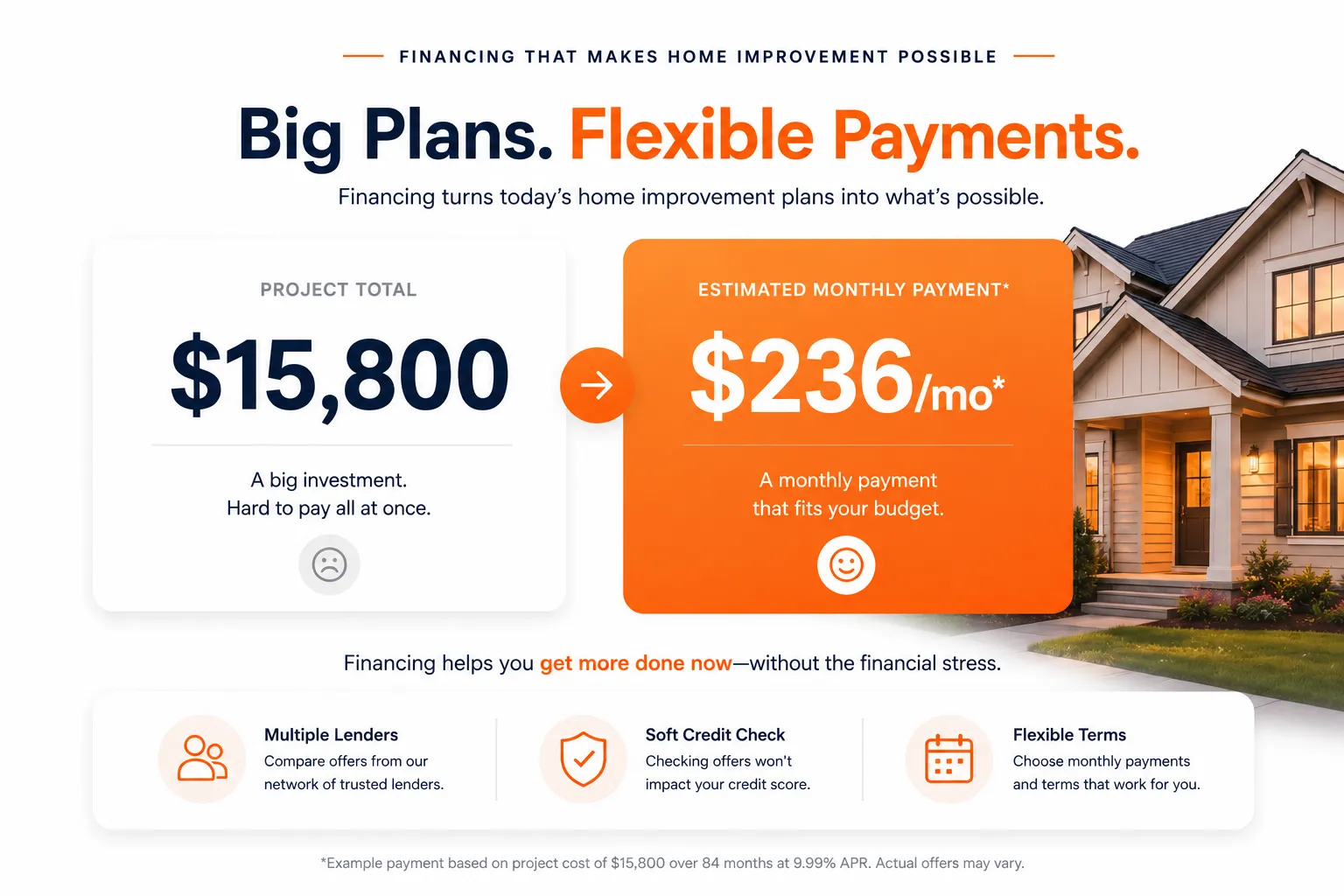
Whole-Home Remodel Financing Calculator
1. Enter Your Desired Loan Amount
Your Estimate
Monthly Payment
-
This calculator provides estimates for illustrative purposes only and does not constitute an offer of credit or a commitment to lend. Final APRs, loan amounts, and terms depend on credit approval, income verification, and lender underwriting criteria. Minimum and maximum rates/terms vary by state.
Powered by: Pasha Funding
Risk-Free Prequalification
Checking offers won’t impact your credit.
It’s common for homeowners to delay applying because they’re worried about their credit score. With a soft credit check, you can review available financing options without any impact to your credit score.2