
Participating Lender Network





Duplex Renovation Financing: Loans & Financing Options
Whether you can finance a duplex renovation with a low-down-payment government loan or need an investor loan with 20% down comes down to one thing: do you live in the building? A duplex renovation runs roughly $10,000 for a light cosmetic refresh of a single unit to $130,000 or more for a full gut of both, and the financing splits along the same line as any two-unit property. If you live in one unit, you can use owner-occupied renovation loans like the FHA 203(k) or Fannie Mae HomeStyle. If both units are rented, you move into investment-property financing, where the property’s income, not just your own, drives the loan.
Key Takeaways
- The biggest financing factor is whether you live in the duplex: owner-occupants get better terms and lower down payments than investors.
- Owner-occupied renovations can use the FHA 203(k) or Fannie Mae HomeStyle, which cover one-to-four-unit properties you live in.
- Investment renovations lean on DSCR loans, conventional investor loans, or bridge financing, usually with 20% to 25% down.
- A duplex remodel is often an income play: you renovate to raise rents, and lenders can underwrite against the property’s income.
- Renovating one unit at a time on turnover keeps the other unit’s rent flowing while work is underway.
- Per-unit budgets run about $5,000 to $7,000 for cosmetic work and $45,000 or more for a gut.
What Does a Duplex Renovation Cost?
Multifamily renovations are usually budgeted per unit, since that is how the work and the payback are measured. Per-unit costs run about $5,000 to $7,000 for a cosmetic refresh, $25,000 to $45,000 for a moderate remodel, and $45,000 or more for a full gut. Here is how the tiers compare for a single unit.
Duplex Renovation Cost per Unit
Typical cost to renovate one unit, by depth of work.
Per-unit ranges. Whole-building gut work runs $60 to $150 per square foot. Figures from HomeGuide and multifamily renovation data.
For a whole duplex, a cosmetic turn of both units might total $10,000 to $50,000, while a full gut of the building runs $60 to $150 per square foot, often $100,000 or more. Cost depends on how deep the work goes: cosmetic covers paint, flooring, fixtures, and hardware, while a gut means new kitchens, baths, and often electrical, plumbing, and HVAC. Older duplexes hide the most risk, since opening walls can reveal outdated wiring, failing plumbing, or code issues, so budget a contingency. Costs also vary sharply by region, with labor and permits far higher in major metros, so treat these as planning ranges and get a line-item bid per unit.
How Duplex Financing Changes for Owners vs. Investors
Before you compare loans, answer one question, because it determines which loans you can even use. If you live in one unit of the duplex, you qualify for owner-occupied financing with the best rates and lowest down payments; if both units are rented, you are an investor and face higher rates and larger down payments.
Living in one unit, often called house hacking, is the single biggest advantage in duplex financing. As an owner-occupant, you can use FHA financing with as little as 3.5% down, and, for renovations, the FHA 203(k) and Fannie Mae HomeStyle programs, which both cover owner-occupied properties of up to four units. You also get the lowest available rates, since lenders price owner-occupied loans below investment loans. Treat the duplex as a pure investment, with both units rented, and the picture changes: government-backed renovation loans are off the table, down payments typically run 20% to 25%, and rates carry an investor premium. The trade-off is real, but so is the upside, since an investment duplex can be financed based on the rent it produces rather than your personal income alone. Decide which category you fall into before you shop, because it defines your entire menu of options.
How Do You Finance a Duplex Renovation?
The right loan follows your occupancy status and the depth of the project. Here is how the main options compare.
FHA 203(k) and Fannie Mae HomeStyle
These renovation loans roll the purchase or refinance and the remodel into one loan based on the home’s after-renovation value, and both cover owner-occupied properties of up to four units. The FHA 203(k) allows lower credit scores and down payments, while Fannie Mae HomeStyle is a conventional option with fewer restrictions on the type of work. Both require you to live in one unit.
Home Equity and Cash-Out Refinance
If you already own the duplex and have equity, a home equity loan, HELOC, or cash-out refinance can fund the remodel. These work whether you occupy the property or rent it, though investment properties face lower borrowing limits and higher rates than a home you live in.
DSCR and Conventional Investor Loans
For a rented duplex, a DSCR loan qualifies you on the property’s rental income rather than your tax returns, and a two-unit building often produces a stronger income ratio than a single-family rental. A conventional investment loan is the alternative, requiring full income documentation and usually 20% to 25% down. Both price above owner-occupied loans.
Bridge and Personal Loans
For a heavy value-add renovation, a short-term bridge or hard-money loan can fund the rehab quickly, with the plan to refinance into a permanent loan once the work raises the property’s value. A personal loan can cover a small cosmetic refresh of a single unit, though its higher rate suits only modest projects.
Can You Use Rental Income to Qualify or Pay for the Remodel?
Often yes, and it is one of the biggest advantages of a two-unit property. Lenders can count the duplex’s rental income toward your qualifying, and a well-chosen renovation raises rents enough to help pay for itself over time.
On the qualifying side, FHA generally lets an owner-occupant count about 75% of the projected rent from the other unit toward their income, which can make approval easier. On a pure investment loan, a DSCR lender qualifies the deal entirely on the property’s income, so the stronger the combined rent covers the payment, the better your terms. Renovations feed directly into this. Industry data shows a cosmetic update of roughly $5,000 to $7,000 per unit can support a rent increase of about $75 to $150 a month, while a fuller $20,000 to $30,000 remodel can command $350 to $600 more. The test to apply is the payback period: divide the renovation cost by the extra annual rent it generates, and favor projects that pay back within about seven years. That keeps the remodel an investment rather than an expense.
Should You Renovate One Unit or Both?
This is a cash-flow decision as much as a construction one. Renovating one unit at a time keeps the other unit’s rent coming in, while doing both at once finishes faster but cuts off all income during the work.
Phasing the project unit by unit, typically as each lease ends and the unit turns over, lets you keep collecting rent on the occupied side, which can help cover the loan payment while the work happens. It takes longer overall and means two rounds of contractor mobilization, but it protects your cash flow and lets you learn from the first unit before starting the second. Renovating both units simultaneously is faster and can be cheaper per unit, since the contractor is already on site, but you lose all rental income for the duration and may need to rehouse tenants, which brings legal and relocation considerations. If your financing depends on rental income to make the payments, phasing is usually the safer path. If the building is vacant or you have the reserves to carry it, doing everything at once gets you to the higher rents sooner.
How Do You Qualify for Duplex Renovation Financing?
Lenders look at your credit, your income and debts, the property’s income, and, for a renovation loan, the after-renovation value. The groundwork about the property comes first. Here is the order that works well:
- Confirm your occupancy status and scope. Decide whether you will live in a unit, since that determines your loan menu, and get a per-unit renovation scope with an after-renovation value estimate, plus a rent roll if the property is tenanted.
- Check your credit and debt load. Review your credit report for errors and total your monthly debts, since most lenders want your total debt, including the new payment, at or below about 43% of your gross income for owner-occupied loans.
- Compare the right lane, then prequalify. For an owner-occupied duplex, compare the FHA 203(k), HomeStyle, and home equity options; for an investment, compare DSCR, conventional investor, and bridge loans. Prequalify and judge offers on total cost over the full term.
| Financing Type | Best For | Qualifies On |
|---|---|---|
| FHA 203(k) / HomeStyle | Owner-occupants living in one unit | Your income + after-reno value |
| DSCR loan | Investors with both units rented | The property’s rental income |
| Bridge / hard money | Heavy value-add, refinance exit | The deal and exit plan |
How you use the duplex can shape your financing options. Live in one unit, and you may qualify for owner-occupied renovation loans. Rent out both units, and financing may depend more heavily on the property’s rental income.
The Bottom Line
The best way to finance a duplex renovation depends on whether you occupy the building, your credit, and how much the project will raise the property’s value and rents. If you live in one unit, an FHA 203(k) or Fannie Mae HomeStyle renovation loan usually offers the best combination of low down payment and rolled-in renovation cost. If you already have equity, a home equity loan or cash-out refinance can work whether you live there or not. For a rented duplex, a DSCR loan lets the property’s income carry the qualifying, while a bridge loan suits a heavy value-add with a refinance exit. Conventional investor financing is the fuller-documentation alternative.
Before you borrow, confirm whether you will occupy the property, since that sets your entire loan menu, and build a per-unit budget with an after-renovation value and a realistic rent projection. Weigh renovating one unit at a time against doing both, based on whether you need the rental income during the work, and compare offers on the total amount you’ll repay, not just the monthly payment. Because investment-property lending is its own world, a lender experienced with multi-unit renovations can help you structure the deal.
The information provided by Pasha Funding is for educational and informational purposes only and should not be considered financial, legal, or tax advice. Every homeowner’s financial situation is different, and the financing options discussed may not be suitable for everyone. Before choosing a financing solution, carefully review the lender’s terms and consider consulting a qualified financial professional if needed.
Pasha Funding is a financing marketplace that connects homeowners with financing options offered by participating lending partners. We do not make loans, determine credit eligibility, or guarantee approval or specific loan terms. Pasha Funding is not a direct lender. We may receive compensation from participating lending partners when users submit an application or obtain a loan through our platform. This compensation may affect how and where financing options appear, but it does not influence our editorial evaluations.
Financing offers, rates, terms, and availability are determined solely by participating lenders and may change without notice. Our editorial content is created independently to help consumers better understand home improvement financing. While we strive to keep information accurate and current, financing products, lender requirements, rates, and offers may change over time. Any opinions expressed are those of the author and have not been reviewed, approved, or endorsed by our lending partners.


Frequently Asked Questions
In this guide
how it works
3 Simple steps to
finance your project.
Getting started only takes a minute. Complete one simple application to compare available financing offers from over 18+ lenders, choose the option that fits your budget, and move forward with your home improvement project.
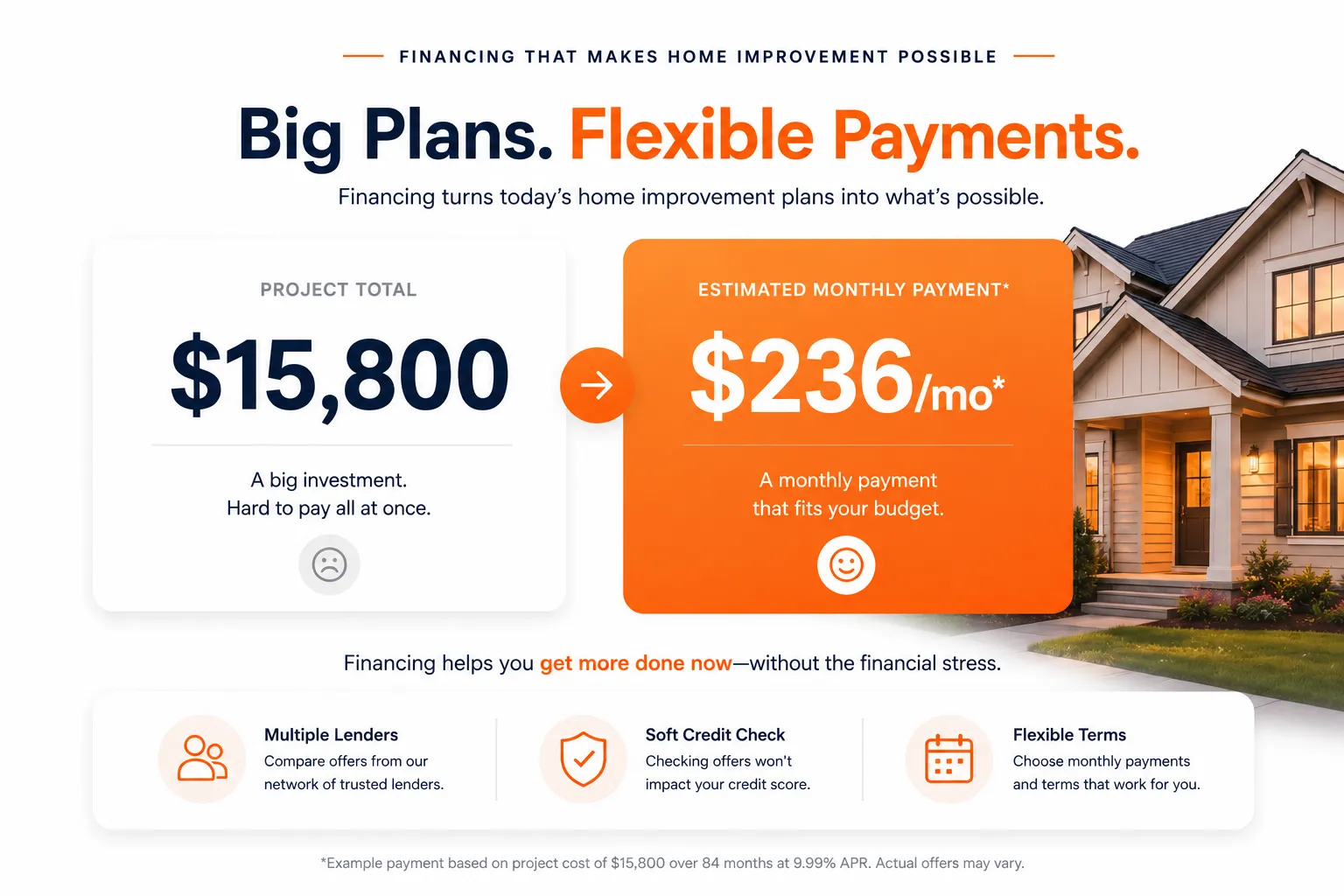
Duplex renovation Financing Calculator
1. Enter Your Desired Loan Amount
Your Estimate
Monthly Payment
-
This calculator provides estimates for illustrative purposes only and does not constitute an offer of credit or a commitment to lend. Final APRs, loan amounts, and terms depend on credit approval, income verification, and lender underwriting criteria. Minimum and maximum rates/terms vary by state.
Powered by: Pasha Funding
Risk-Free Prequalification
Checking offers won’t impact your credit.
It’s common for homeowners to delay applying because they’re worried about their credit score. With a soft credit check, you can review available financing options without any impact to your credit score.2