
Participating Lender Network





How to Pay for Mold Remediation
A persistent musty smell, a dark patch spreading across basement drywall, or a home inspection that uncovers hidden mold behind a wall can quickly turn into a problem that needs attention. Once mold is discovered, addressing it promptly can help protect your home, limit further damage, and reduce potential health concerns. Mold remediation costs about $1,200 to $3,800 for a typical job, though a small surface cleaning can run a few hundred dollars and a whole-home or HVAC contamination can reach $30,000, and how you pay depends on the size of the problem and whether a sudden covered leak caused it. The number most people underestimate isn’t the cleanup itself; it’s fixing the water source that caused the mold, because skipping that means it grows back and you pay twice.
Key Takeaways
- Cost tracks the size and location of the growth: a surface job runs a few hundred to about $1,200, a room with drywall removal $1,500 to $4,500, and HVAC or whole-home contamination $3,000 to $30,000.
- Mold remediation is billed per square foot, roughly $10 to $30, and black mold costs 25% to 50% more because of the extra containment required.
- You often have to finance the moisture source repair too (a roof or plumbing leak), or the mold returns and the money is wasted.
- Insurance covers mold only from a sudden covered leak, not a gradual one, and even then a mold sublimit often caps the payout at $1,000 to $10,000.
- A personal loan funds fast for an urgent health hazard, while a home equity loan may cost less for a large whole-home job.
- Anything over about 10 square feet, behind drywall, or in HVAC needs a professional, since disturbing it without containment spreads spores through the house.
How Much Does Mold Remediation Cost?
The price swings enormously with how far the mold has spread and where it is, which is why scoping the job correctly is the most important budgeting step. Most professional mold remediation runs $10 to $30 per square foot, with a typical job landing between $1,200 and $3,800 and whole-home contamination reaching $10,000 to $30,000.
| Remediation Scope | Typical Cost Range | Containment & Demolition Details |
|---|---|---|
| Surface (under 100 sq ft) | $500-$1,200 | Light containment, surface cleaning and treatment, no demolition |
| Localized (with drywall removal) | $1,500-$4,500 | Sealed containment, negative air, drywall demolition, framing cleaning |
| Multi-room or HVAC | $3,000-$12,000 | System-level containment, duct cleaning or replacement, sanitizing |
| Whole-home / major water event | $10,000-$30,000 | Full demolition of porous materials, framing replacement, rebuild |
Cost ranges from HomeGuide and InspectandTest.
A few things push a job up within these ranges:
- Black mold (25% to 50% more): toxic strains like Stachybotrys need more aggressive containment and disposal than common mold.
- HVAC contamination: once mold is in the ductwork, the system spreads spores through the whole house, so the job jumps to the system level rather than one room.
- Hard-to-reach spaces: crawl spaces and attics cost more per square foot because crews work longer in confined-space protective gear.
- Testing: professional testing runs $200 to $600, and a post-work clearance test on a black-mold job adds $300 to $800.
Costs also run 15% to 25% higher in the Northeast and coastal California than in the Midwest and South.
What Does Professional Mold Remediation Actually Involve?
Knowing what a compliant job includes helps you read a bid and spot a lowball quote that skips steps. Professional remediation follows the IICRC S520 standard, the industry benchmark that insurers and courts treat as the standard of care. It classifies contamination into three conditions that set the scope:
- Condition 1 (normal): the normal fungal ecology of a clean indoor space, no remediation needed.
- Condition 2 (settled spores): surfaces and air with settled spores from a nearby source, requiring cleaning.
- Condition 3 (active growth): actual mold growth, which requires full containment and physical removal.
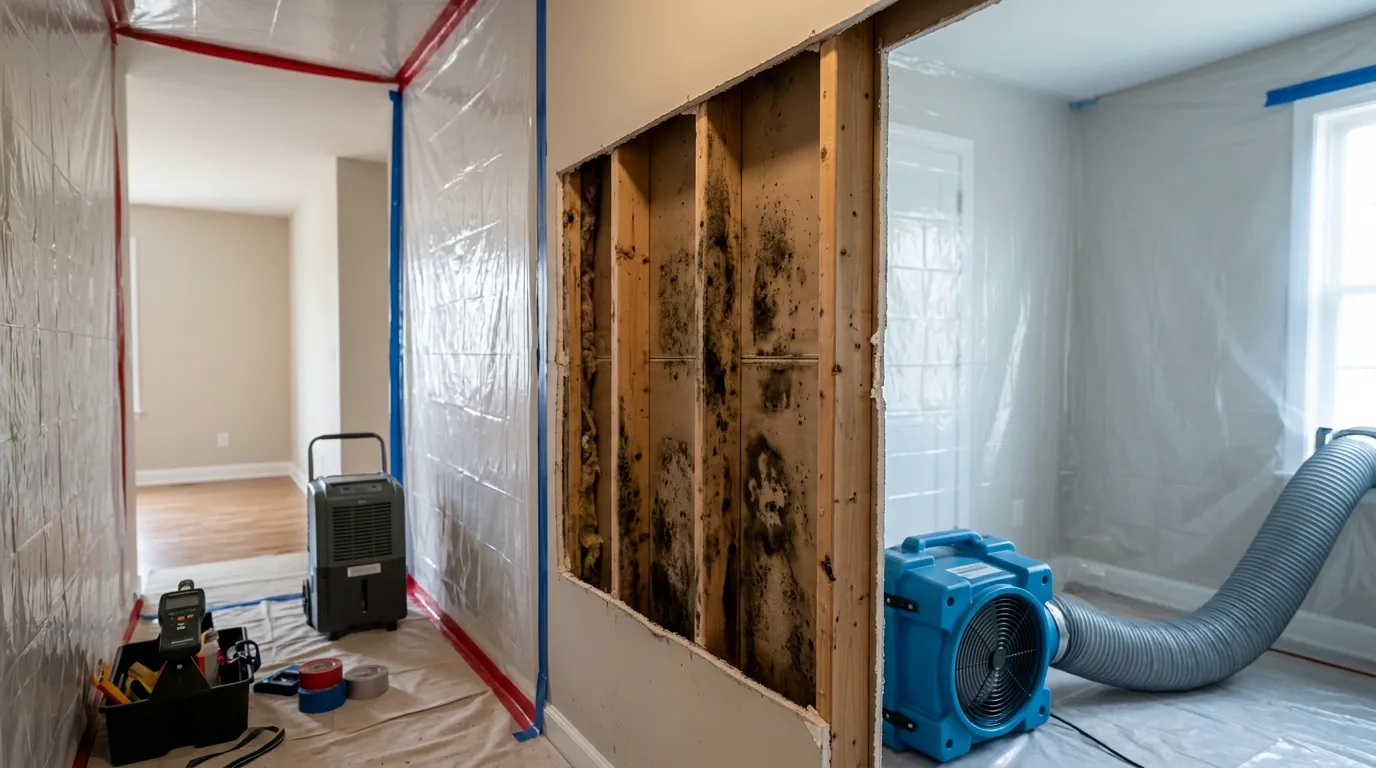
For Condition 3, proper containment is what keeps a contained problem from becoming a whole-house one, and it’s the part unqualified contractors cut corners on:
- Sealed barriers: heavy 6-mil poly sheeting seals the work area off from the rest of the home.
- Negative air pressure: HEPA-filtered negative air machines (air scrubbers) exhaust outdoors, so spores can’t migrate into clean areas.
- Decontamination chamber: a staged entry where technicians remove protective gear so they don’t track spores out.
- Antimicrobial sealing: after porous materials (drywall, carpet, insulation) are removed, the remaining framing (studs, joists) is wire-brushed, HEPA-vacuumed, and coated with an EPA-registered antimicrobial sealant to stop latent spores from regrowing.
What Does HVAC Mold Remediation Require?
Once mold is in the ductwork, the system spreads spores through every room, so remediation has to happen at the system level. Duct remediation should follow the NADCA ACR standard, and one distinction drives the cost: rigid sheet-metal ducts can usually be cleaned and sanitized, but flexible (flex) ducting that’s contaminated with mold cannot be cleaned effectively and has to be torn out and replaced. If your bid involves flex duct, expect replacement rather than cleaning.
Why You Have to Finance the Water Source, Not Just the Mold
This is the mistake that turns one bill into two. Mold is a symptom of a moisture problem, so remediating the visible growth without fixing what’s feeding it means the mold comes back within months and you pay to remove it again. When you budget, treat the underlying repair as part of the project, not a separate afterthought.
The moisture source is usually one of these, and each carries its own repair cost on top of the remediation:
- Roof leak: a small repair runs $150 to $1,000, but a large leak needing structural work can reach $3,000 to $6,000.
- Plumbing leak: fixing a leaking pipe typically runs $150 to $850, more if it’s inside a wall.
- Poor drainage or grading: water pooling against the foundation may call for regrading or drainage work.
- Humidity or ventilation: a bath fan, a dehumidifier, or improved ventilation in a chronically damp space.
Finance the complete job, remediation plus the source repair, so you’re not back in the same spot next year. If the moisture is a chronic basement or crawl-space problem rather than a one-time leak, preventing it long-term is a separate project; see our basement waterproofing financing guide for that side.
Does Insurance Cover Mold Remediation?
Sometimes, and the deciding factor is what caused the moisture, not the mold itself. A standard policy covers mold only when a sudden, accidental covered peril caused it, like a burst pipe or an appliance failure, and excludes mold from a gradual leak, humidity, or neglect.
Two details decide most mold claims:
- Sudden vs. gradual: a pipe that bursts overnight is usually covered; a slow leak behind a vanity that ran for months is treated as a maintenance failure and excluded. Timing is everything, so document the cause and act fast.
- The mold sublimit: even on a covered claim, most policies cap mold payouts at $1,000 to $10,000 (an endorsement can raise it to $25,000+), which often falls short of a serious remediation bill. Check your declarations page for the number.
- Anti-concurrent causation clause: if a covered cause (a burst pipe) and an excluded one (long-term humidity) both contributed, an anti-concurrent causation (ACC) clause in your policy can let the insurer deny the whole claim. Check whether your policy has one, since it changes how a mixed-cause loss plays out.
Flood-related mold is never covered without separate flood insurance, and the policy pays to remove the mold but not to replace what caused it, so a burst-pipe claim covers the mold and the floor, not a new washing machine. If you live in a humid climate, a dedicated mold coverage endorsement typically adds $50 to $100 a year and can raise your sublimit from $1,000 to as much as $25,000 to $50,000, worth pricing before you need it. The remediation and restoration hub covers the broader insurance mechanic across hazard types.
How Do You Finance Mold Remediation?
With mold jobs ranging from a few hundred dollars to $30,000, the right option depends on the size of the uncovered portion and how urgent the health hazard is.
- Personal loan: funds within days with no lien on your home, which fits an urgent hazard or a mid-sized job, and covers a deductible or an uncovered remediation quickly.
- Home equity loan or HELOC: usually the lowest rate for a large whole-home remediation with rebuild, with the tradeoff of closing costs and a few weeks to fund.
- Contractor payment plans: many remediation firms offer them, but the loan comes from a third-party lender, so compare the total against an outside loan before agreeing.
- FHA Title I loan: can finance mold work as a health-and-safety home improvement up to $25,000 without home equity, a reachable option when you lack equity to draw on.
How Do You Qualify for Mold Remediation Financing?
Qualifying comes down to scoping the full job, remediation plus source repair, and confirming what insurance covers, so you finance the right amount once.
Get a professional inspection and the covered-vs-uncovered split first. Have a certified inspector confirm the extent and identify the moisture source, and if a sudden leak caused it, file the insurance claim and get the payout in writing. This tells you the true gap to finance.
Get itemized bids that include the source repair and clearance testing. Insist each quote covers containment, the underlying moisture fix, and post-work clearance testing, since a bid that omits the source repair looks cheaper but leaves you paying again. Finance the complete, tested job.
Match the loan to urgency, then check your credit. A prequalified personal loan funds fast for an urgent hazard; a home equity option costs less for a large job. Review your credit report for errors and prequalify with a soft credit check to compare offers without affecting your score.
The Bottom Line
How you pay for mold remediation depends on the size of the problem and whether a covered leak caused it. If a sudden burst pipe or appliance failure is the source, file the claim first and finance only the gap between your deductible, the mold sublimit, and the total. If it’s a gradual leak or humidity problem, the cost is usually yours: a personal loan funds fast for an urgent hazard, a home equity loan costs less for a large whole-home job, and an FHA Title I loan helps when you lack equity.
Before you borrow, get a certified inspection that identifies the moisture source, and make sure your bids fix that source alongside the mold, since remediation without the repair just means paying to remove the same mold twice.
Explore related resources
The information provided by Pasha Funding is for educational and informational purposes only and should not be considered financial, legal, or tax advice. Every homeowner’s financial situation is different, and the financing options discussed may not be suitable for everyone. Before choosing a financing solution, carefully review the lender’s terms and consider consulting a qualified financial professional if needed.
Pasha Funding is a financing marketplace that connects homeowners with financing options offered by participating lending partners. We do not make loans, determine credit eligibility, or guarantee approval or specific loan terms. Pasha Funding is not a direct lender. We may receive compensation from participating lending partners when users submit an application or obtain a loan through our platform. This compensation may affect how and where financing options appear, but it does not influence our editorial evaluations.
Financing offers, rates, terms, and availability are determined solely by participating lenders and may change without notice. Our editorial content is created independently to help consumers better understand home improvement financing. While we strive to keep information accurate and current, financing products, lender requirements, rates, and offers may change over time. Any opinions expressed are those of the author and have not been reviewed, approved, or endorsed by our lending partners.


Frequently Asked Questions
In this guide
- How much does a bathroom remodel cost?
- Should you finance a bathroom remodel or pay cash?
- What are the best ways to finance a bathroom remodel?
- Which bathroom remodel financing option is right for you?
- What do you need to qualify for bathroom remodel financing?
- What do bathroom remodel loan rates look like?
- How to improve your chances of approval for a bathroom remodel loan
- Common costs and fees to consider
- Will a bathroom remodel increase your home’s value?
- The bottom line
how it works
3 Simple steps to
finance your project.
Getting started only takes a minute. Complete one simple application to compare available financing offers from over 18+ lenders, choose the option that fits your budget, and move forward with your home improvement project.
Mold Remediation Financing Calculator
1. Enter Your Desired Loan Amount
Your Estimate
Monthly Payment
-
This calculator provides estimates for illustrative purposes only and does not constitute an offer of credit or a commitment to lend. Final APRs, loan amounts, and terms depend on credit approval, income verification, and lender underwriting criteria. Minimum and maximum rates/terms vary by state.
Powered by: Pasha Funding

Risk-Free Prequalification
Checking offers won’t impact your credit.
It’s common for homeowners to delay applying because they’re worried about their credit score. With a soft credit check, you can review available financing options without any impact to your credit score.2