
Participating Lender Network






Customer Financing for Concrete Projects
Advertising Disclosure
Concrete Contractor Financing: How to Offer Customers Payment Options Without Risking Your Margins
Concrete contractor financing gives qualified customers another way to pay for their project.
Instead of collecting the full project cost directly from the homeowner, you connect them with a third-party lender. The homeowner applies for financing, the lender makes the credit decision, and, once the lender’s funding requirements are met, you receive payment directly from the lender.
The Cash Flow Challenge Every Concrete Contractor Faces
A concrete contractor often commits money before the homeowner sees much progress. You may reserve a crew, order ready-mix, arrange excavation, schedule a pump, rent forms or equipment, haul away broken concrete and pay for reinforcement before the pour begins.
Once fresh concrete is dispatched, timing becomes unforgiving. The American Concrete Institute explains that project specifications commonly refer to ASTM C94, under which ready-mixed concrete generally must be discharged within a limited period after water is added or before the drum reaches its specified revolution limit. A delayed customer decision, blocked driveway or missing inspection can turn into rejected material, disposal costs and a lost production day.
This is one reason payment timing matters. You aren’t only selling a finished slab. You’re coordinating labor, material and equipment costs that may be difficult to reverse once work starts.
Customer financing can reduce the pressure to collect a large check before mobilization, but only when the lender’s funding process matches that sequence. Some lenders pay after the borrower signs closing documents. Others require proof that work has begun, a completion certificate or final customer authorization. A contractor who assumes “approved” means “funded” can end up paying for a pour out of operating cash.
The wider small-business market faces the same cash-flow problem. The Federal Reserve’s 2026 Report on Employer Firms found that small businesses remained more likely to report declining revenue than rising revenue during the prior year, while expectations for future growth weakened. For concrete companies with payroll, fuel, material and equipment obligations, waiting several extra days for payment can affect the next job, not only the current one.
What is Concrete Contractor Financing?
Concrete contractor financing refers to a loan obtained by the homeowner through a lender or lending marketplace introduced by the contractor. The loan is generally made to the customer, not to the concrete company.
The contractor is not extending credit and usually does not collect monthly payments. The homeowner repays the lender under the loan agreement. The lender pays the contractor once its funding conditions have been met.
Depending on the lender and the customer’s qualifications, available products may include:
- Unsecured installment loans with fixed monthly payments
- Promotional plans with reduced or deferred interest
- Same-as-cash offers that require the balance to be paid within a set period
- Longer-term loans designed to reduce the required monthly payment
- Home-equity financing arranged separately by the homeowner
These products should not be treated as interchangeable. A five-year unsecured loan, a deferred-interest promotion and a home equity line of credit can produce very different borrowing costs and risks.
The Federal Trade Commission advises homeowners not to accept financing through a contractor without comparing alternatives and understanding the loan terms. That guidance does not mean contractors should avoid offering financing. It means the sales process should leave room for an informed decision.
Which Concrete Projects Are Customers Most Likely to Finance?
Financing becomes more useful as the contract price rises, but price is not the only factor. Urgency, project purpose and the homeowner’s available cash also matter.
A customer may finance a smaller driveway replacement because the existing surface is unsafe and the work cannot wait. Another homeowner may pay cash for a larger decorative patio because the project was planned for years. Contractors should avoid assuming that a high-income household has no need for payment options.
Common financed concrete projects include:
- Driveway replacement and expansion
- Stamped or decorative concrete patios
- Pool decks and concrete resurfacing
- Garage floors and larger slabs
- Foundations and structural concrete repairs
- Walkways, steps, landings and accessibility improvements
- Retaining walls and exterior hardscape packages
- Concrete removal followed by a complete repour
- Drainage corrections tied to new flatwork
- Commercial or mixed-use work when the financing program permits it
Financing becomes harder when the estimate contains large allowances, uncertain excavation costs or work that may expand after demolition.
Lenders approve a dollar amount based on the information available during underwriting. They do not automatically increase the loan because the contractor later discovers poor soil, buried debris, inadequate base material or drainage work that was not included in the original proposal.
Avoid Financing Surprises with a Complete Project Estimate
Monthly-payment selling can help a homeowner understand affordability, but it can also pull attention away from an incomplete estimate. It is always best to settle the scope of work first, establish a definitive project price and then discuss ways to pay.
Concrete estimates should address more than square footage and a per-square-foot price. Depending on the job, the written scope may need to cover:
- Demolition and disposal of existing concrete
- Excavation depth and base preparation
- Concrete thickness and specified strength
- Wire mesh, fiber or reinforcing steel
- Forms, grading and drainage corrections
- Access limitations for ready-mix trucks
- Concrete pumping, buggy work or additional labor
- Short-load, waiting-time and weekend charges
- Control joints, expansion material and saw cutting
- Color, stamping, borders and specialty finishes
- Permits, inspections and engineering
- Sealing, curing and return visits
- Restoration of lawns, irrigation or landscaping
A low initial estimate followed by a large financed change order can create three problems. The homeowner may not qualify for more credit. The lender may not permit the approved loan to be increased. The customer may believe the original payment covered work that was never included.
The American Concrete Institute advises construction professionals not to rely on verbal change orders and to obtain written approval before implementing changes. Its guidance on responsibility in concrete construction stresses that material and plan modifications should always be documented.
How Lenders Actually Decide Whether a Homeowner Qualifies
A contractor cannot predict approval from a credit score alone. Lenders may consider the applicant’s credit history, income, existing debts, requested loan amount, repayment term and recent credit activity. Each lender applies its own underwriting standards.
A homeowner with a high credit score may still receive a smaller loan than requested if monthly debt obligations are already heavy. A borrower with a lower score may qualify but receive a higher annual percentage rate, a shorter term or a lower loan limit.
For unsecured financing, the lender is generally relying on the borrower’s promise and credit profile rather than placing a lien on the home. That can make the application faster than property-secured financing, but unsecured loans may carry higher rates because the lender has no real estate collateral.
A contractor should understand four different stages:
- Prequalification: The customer provides basic information to check potential eligibility. Some lenders use a soft credit inquiry at this stage.
- Application: The homeowner chooses an offer and provides additional personal or financial information.
- Final approval: The lender verifies the information, completes underwriting and issues final loan documents.
- Funding: The lender releases money after all required signatures, project documents and funding conditions are satisfied.
These stages are not the same. A prequalified customer can still be declined after verification. An approved customer can delay funding by failing to upload identification, proof of income or other required documents. A funded loan may still require the contractor to submit a completion certificate before receiving the final payment.
Build your production schedule around confirmed funding requirements, not an approval screen shown on a customer’s phone.
The Funding Question Contractors Often Ask Too Late
Before offering any loan program, ask exactly how and when the contractor gets paid.
Helpful questions include:
- Is payment made before work begins, in stages or after completion?
- Who confirms that the project has reached a funding milestone?
- Does the homeowner have to authorize each disbursement?
- What documents must the contractor submit?
- How long does an ordinary disbursement take?
- What happens if the customer stops responding after the work is complete?
- Can a change order be added to the existing loan?
- Does the contractor have any obligation if the borrower later defaults?
- Can funding be reversed after it reaches the contractor’s account?
- Are there dealer, transaction or platform fees deducted from payment?
That last question deserves special attention. Contractor financing programs do not all make money the same way. Some charge the borrower interest and do not deduct a dealer fee from the contractor. Others charge the contractor a percentage of the financed amount, particularly for promotional plans with unusually low advertised rates.
A dealer fee can be large enough to erase the profit on a poorly priced job. The contractor must decide whether the fee will be absorbed, included in general overhead or reflected in pricing where legally permitted. Presenting one price for cash and a higher price only because a customer uses credit may raise contractual, lender-policy or state-law questions, so contractors should obtain guidance applicable to their program and location.
Regulators have already examined hidden financing costs in other home-improvement trades. A CFPB review of solar financing found that some lenders used dealer or finance fees that increased the financed principal well above the cash price. Concrete financing is not identical to solar financing, but the warning carries over – contractors and customers should understand the true project price, the amount financed and any fee built into the transaction.
Why Customer Authorization Must Be More Than a Signature
Contractors should never complete a credit application for a homeowner, guess at income, select an offer without clear permission or ask the customer to sign documents they have not reviewed.
This is not only a matter of customer service. The CFPB previously took action against GreenSky after finding that contractors and other merchants had enabled loans to be created for consumers who had not requested or authorized them. The agency required consumer relief, a civil penalty and stronger procedures.
Homeowner should always be in charge of the application, review the offer and knowingly authorize the loan. Your salesperson can explain where to apply and what happens next. The salesperson should not act as the borrower.
A clean process also protects the contractor. Keep the construction contract separate from the loan agreement. State the total project price clearly. Document approved changes. Avoid making promises about approval, interest rates, tax treatment or whether a specific loan is appropriate for the customer.
Concrete Project Financing Options Explained
The longest loan term is not automatically the best choice. Neither is the lowest advertised rate. The right financing program depends on the project price, how quickly the homeowner expects to repay the balance and whether the contractor must pay a fee to offer the plan.
Fixed-rate installment loans
A fixed-rate installment loan gives the homeowner a set payment schedule. The interest rate and required payment generally remain the same for the life of the loan.
This structure can fit larger projects such as driveway replacements, foundations, retaining walls and complete backyard renovations. The predictable payment is easy to understand, and the homeowner does not face a promotional payoff deadline.
The tradeoff is total interest. Extending repayment over 10, 15 or 20 years can reduce the monthly payment while increasing the amount paid over time. Contractors should never describe a long term as “cheaper” merely because the payment is lower.
Same-as-cash financing
Same-as-cash financing is intended for customers who expect to repay the balance during a promotional period. Depending on the lender, interest may be deferred rather than permanently waived.
That difference matters. With a deferred-interest plan, failing to pay the promotional balance in full by the deadline may cause interest to be charged according to the loan agreement, potentially from the original transaction date.
This type of offer may suit a homeowner waiting for a bonus, insurance payment, property sale or another expected source of funds. It is a poor fit for someone who can only afford the minimum required payment and has no realistic plan to clear the balance before the promotion ends.
Low-payment promotional plans
Some financing companies allow contractors to offer reduced-rate or promotional payment plans in exchange for a dealer fee. The contractor effectively pays part of the financing cost to make the customer’s offer more attractive.
These plans may help with a price-sensitive sale, but the fee must be measured against gross profit. A contractor should know the dollar cost before presenting the plan, not after the customer accepts it.
Home equity financing
A homeowner may independently use a home equity loan or home equity line of credit to pay for concrete work. Because the loan is secured by the property, rates may be lower than those available through an unsecured personal loan. The application can also take longer and may involve an appraisal, closing costs or other requirements.
Plan the Payment Schedule Before Work Begins
Your construction contract and the lender’s disbursement process should not contradict each other.
A concrete project might require payments tied to contract signing, demolition, base preparation, the pour and final completion. A lender, however, may release funds only once or may send the proceeds directly to the homeowner. Another program may require customer authorization after the project is finished.
Review both processes before scheduling labor or ordering concrete. At minimum, confirm:
- Who receives the loan proceeds
- Whether funds are available before work starts
- Whether payments are released in stages
- What proof is required for each stage
- How quickly an authorized payment reaches your account
- Whether the customer can delay or dispute disbursement
Do not use a customer’s prequalification amount as proof that funds are available. Do not schedule a pour based only on verbal confirmation that the loan is “good to go.” Wait until the lender’s conditions are clear and your contract requirements have been satisfied.
What Happens When the Scope Changes After Approval?
A concrete change order should answer four questions: What changed? Why was it necessary? What does it cost? How will it be paid?
Suppose demolition reveals that the old driveway was poured over unstable fill. The homeowner now needs additional excavation, imported base material and compaction work. The approved loan may cover the original contract but not the added $4,500.
Possible outcomes include:
- The customer pays the difference directly.
- The lender approves a higher amount after another review.
- The customer obtains separate financing.
- The scope is revised to remain within the available budget.
- The project pauses until payment is resolved.
Never assume the lender will increase the loan. Never perform substantial added work based on a homeowner’s promise to “figure it out later.” Get the change order and payment arrangement in writing before proceeding.
It also helps to explain foreseeable uncertainties in the original proposal. You might state that the estimate assumes a specified base condition and that concealed soil, drainage or buried-material problems will require a written change order. That is more useful than a broad disclaimer the customer is unlikely to understand.
When Offering Financing Can Create More Trouble Than It Solves
Financing can help a qualified customer move ahead, but it cannot fix a bad contract, weak estimate or unprofitable job.
Be cautious when:
- The customer is focused only on the payment and ignores the total project price.
- The scope cannot be reasonably defined before demolition.
- The dealer fee would consume too much of the expected profit.
- The customer appears confused about the loan terms.
- The borrower is relying on an uncertain future event to make payments.
- The project would begin before funding requirements are satisfied.
- The salesperson feels pressure to complete the application for the customer.
- The financing provider cannot clearly explain disputes, cancellations or funding reversals.
Financing should support a sound transaction. It should not be used to make an unaffordable project appear affordable or to rush a customer past legitimate concerns.
How to Discuss Concrete Financing Without Acting Like a Financial Adviser
Your role is to make the option available and explain the application process. The lender is responsible for credit decisions and loan disclosures. The homeowner decides whether borrowing makes sense.
A simple introduction might sound like this:
“We offer access to financing for customers who would rather make monthly payments than pay the full project cost upfront. You can check available offers and review the rate, payment, term and total cost before choosing anything. The lenders make all credit decisions, and you’re not required to use financing to hire us.”
Avoid statements such as:
- “Everyone gets approved.”
- “This won’t affect your credit.”
- “You can deduct the interest.”
- “This is the cheapest option.”
- “You can refinance it later.”
- “The project will pay for itself.”
- “Just put down a higher income so it goes through.”
The FTC advises consumers to compare financing offers and understand the terms before agreeing to a contractor-arranged loan. Contractors can support that process by giving customers time to read disclosures and avoiding pressure tactics.
Confirm the Contract Is Final Before Releasing Labor and Materials
Certain sales made in a customer’s home may fall under the FTC’s Cooling-Off Rule, which generally provides three business days to cancel qualifying transactions. State laws may provide separate or broader cancellation rights for home-improvement contracts.
Not every transaction is covered, and exceptions apply. Still, a contractor who sells concrete work during an in-home consultation should know which cancellation rules apply before scheduling demolition, ordering special materials or collecting nonrefundable costs.
Questions to Ask Before Choosing a Concrete Financing Company
- Does the company work with multiple lenders or only one?
- Does checking offers begin with a soft credit inquiry?
- At what point might a hard credit inquiry occur?
- What loan amounts and repayment terms are available?
- Are unsecured loans available?
- What credit profiles does the lender network serve?
- Are there setup, monthly, transaction or dealer fees?
- Who receives the funds, the homeowner or contractor?
- How long does funding normally take after final approval?
- Are completion certificates or customer authorizations required?
- How are change orders handled?
- Can customers repay early without a penalty?
- Who handles questions, disputes and servicing after funding?
- Which states and project types are eligible?
- What training is provided to contractor sales teams?
Be sure to always ask for clear, written answers in a formal document.
Offer Concrete Financing To Your Customers
Pasha Funding helps concrete contractors offer customer financing without becoming the lender, collecting monthly payments, or handling loan servicing. Simply share your custom financing link by text, email, or with your estimate. Qualified homeowners can complete a secure application in less than three minutes and compare multiple loan offers from trusted lending partners instead of being limited to a single financing source.
Homeowners can check available financing options through a soft credit inquiry, allowing them to review offers with no initial impact to their credit score. Once financing is approved and the lender’s funding requirements are met, you receive payment directly from the lender so you can focus on completing the project, not chasing payments.
More contractor financing solutions by project type:
- Accessory Dwelling Unit Contractor Financing
- Artificial Grass & Turf Financing for Contractors
- Bathroom Remodel Contractor Financing
- Custom Closet & Storage Financing for Customers
- Concrete Contractor Financing
- Decks & Patio Financing for Contractors
- Contractor Financing for Electric Services
- Contract Financing for Flooring Contractors
- Gutter Contractor Financing Options
- Garage Door Contractor Financing
- HVAC Financing Solutions for Contractors
- Insulation Contractor Financing for Customers
- Contractor Financing for Landscaping Businesses
- Kitchen Remodel Contractor Financing
- Masonry Contractor Financing
- Financing Options for Plumbing Contractors
- Contractor Financing for Painters
- Roofing Contractor Financing
- Solar Contractor Financing
- Swimming Pool Contractor Financing
- Siding & Exterior Contractor Financing
- Fencing Contractor Financing Options
- Windows & Doors Contractor Financing
- Window Blinds & Shades Financing for Customers
In this guide

For illustrative purposes only
How Contractor Financing Works
3 steps from estimate
to funded.
Offering financing is simple. Homeowners compare offers from third-party lenders using one simple application, while the lender handles underwriting, funding, servicing, and payment collection.
Why Contractors Partner With Us
A smarter way to offer
customer financing.
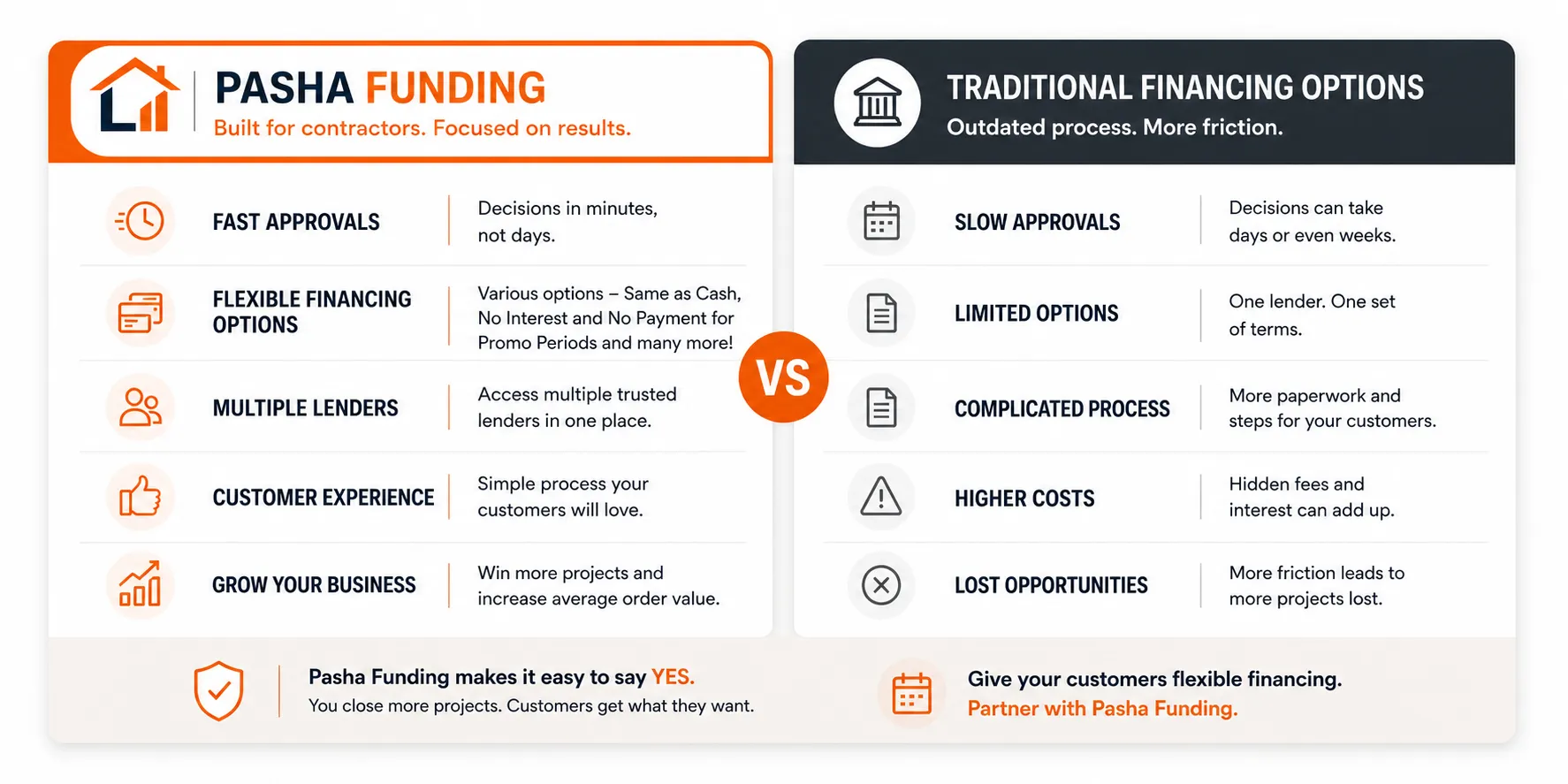
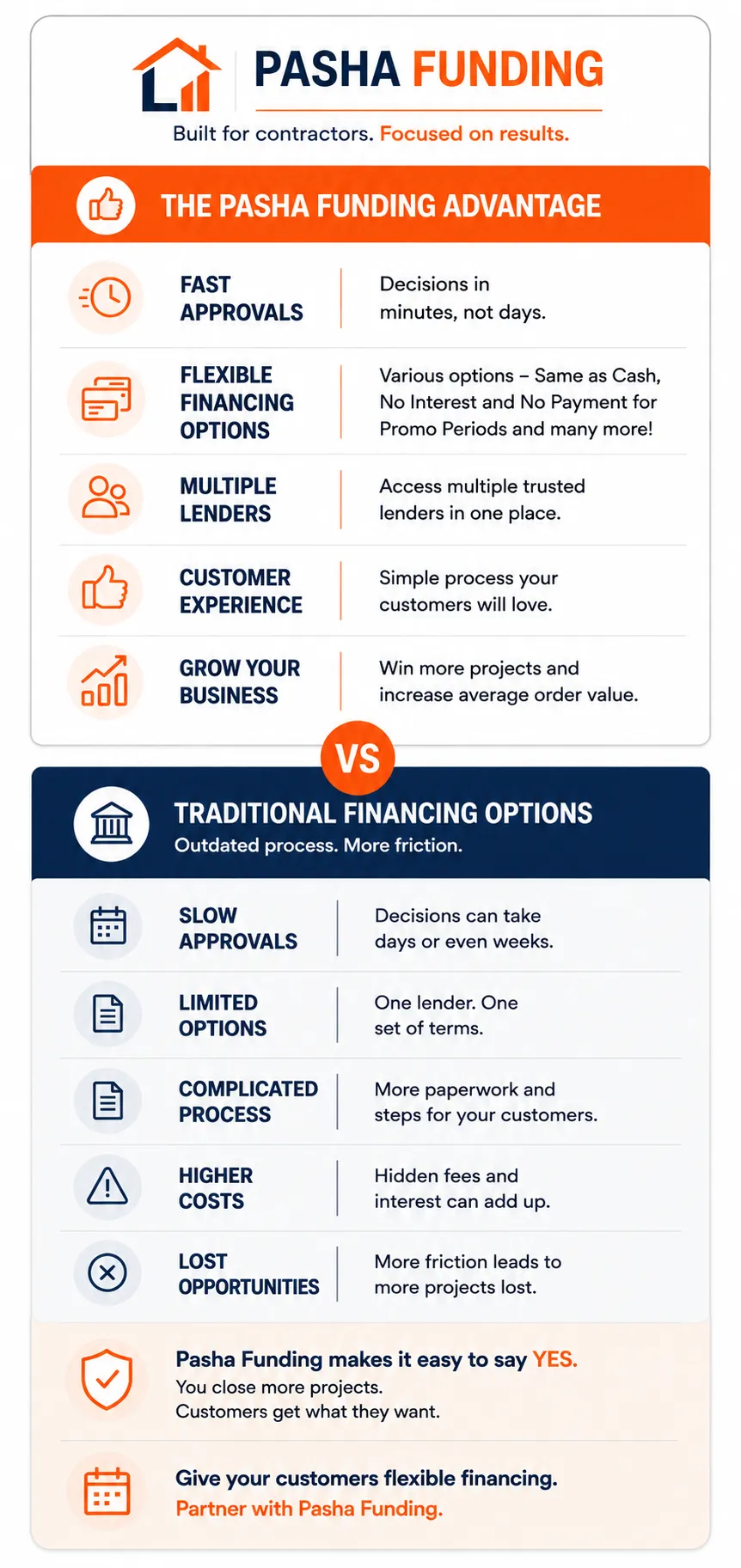
A Smarter Way to Offer Financing
Pasha Funding vs.
traditional programs
Find Home Improvement Contractor Financing for Customers Near You
- Atlanta Contractor Financing
- Austin Contractor Financing
- Boston Contractor Financing
- Charlotte Contractor Financing
- Chicago Contractor Financing
- Cleveland Contractor Financing
- Columbus Contractor Financing
- Connecticut Contractor Financing
- Dallas Contractor Financing
- Denver Contractor Financing
- Detroit Contractor Financing
- Fort Worth Contractor Financing
- Houston Contractor Financing
- Indianapolis Contractor Financing
- Jacksonville Contractor Financing
- Los Angeles Contractor Financing
- Miami Contractor Financing
- Nashville Contractor Financing
- New York City Contractor Financing
- Orlando Contractor Financing
- Philadelphia Contractor Financing
- Phoenix Contractor Financing
- Portland Contractor Financing
- Providence Contractor Financing
- Raleigh Contractor Financing
- Salt Lake City Contractor Financing
- San Antonio Contractor Financing
- San Diego Contractor Financing
- San Jose Contractor Financing
- Seattle Contractor Financing
- St. Paul Contractor Financing
- Tampa Contractor Financing
- Washington Contractor Financing