

Participating Lender Network






How to Pay for Kitchen Remodeling Projects
A kitchen remodel is one of the biggest investments most homeowners make after buying a home. It can improve daily life, increase resale appeal, and replace aging cabinets, appliances, plumbing, and electrical systems that no longer meet your family’s needs.
The challenge is paying for it. Even a modest renovation can cost tens of thousands of dollars, and few homeowners want to empty their savings account to cover the bill.
Fortunately, there are several ways to finance a kitchen remodel. Personal loans, home equity loans, HELOCs, contractor financing, renovation mortgages, and even promotional credit cards all have a place. The best option depends on your budget, available home equity, project timeline, and how much financial flexibility you want during construction.
This guide explains how kitchen remodel financing works, how lenders evaluate applications, what mistakes homeowners commonly make, and how to compare kitchen remodel loans before signing an agreement.
How Much Does a Kitchen Remodel Cost?
Before comparing financing options, it’s important to understand how much you may actually need to borrow.
According to HomeGuide, the average full kitchen remodel costs between $15,000 and $50,000, while major redesigns involving structural changes often cost $50,000 to $70,000 or more. Most professionally remodeled kitchens fall between $150 and $250 per square foot, although premium materials, custom cabinetry, and luxury appliances can push costs considerably higher.
Your final price depends on far more than the size of the kitchen. Some of the biggest cost drivers include:
- Custom versus stock cabinets
- Quartz, granite, butcher block, or laminate countertops
- Moving plumbing or gas lines
- Electrical upgrades to meet current building codes
- New flooring throughout adjoining rooms
- Structural changes such as removing walls
- Permit requirements and local inspection fees
- Labor rates in your area
- Appliance selections
One detail many financing articles overlook is that kitchens rarely stay on budget once demolition begins. Contractors frequently discover outdated wiring, water damage, mold, deteriorated subfloors, or plumbing issues hidden behind walls. Those discoveries can easily add several thousand dollars to the final invoice.
For that reason, many experienced contractors recommend keeping a contingency reserve of roughly 10% to 20% of the project budget instead of borrowing only the exact contract amount.
How Much Should You Borrow for a Kitchen Remodel?
One of the biggest mistakes homeowners make is financing only the contractor’s initial estimate.
A kitchen remodel budget usually extends beyond construction itself. You may also need money for:
- Permit fees
- Engineering or architectural plans
- Temporary dining arrangements during construction
- New appliances purchased separately
- Furniture and bar stools
- Window treatments
- Unexpected code upgrades
- Material price increases after contracts are signed
Another commonly overlooked expense is lender fees. Some personal loans include origination fees that reduce the amount of money you actually receive. A homeowner approved for a $40,000 loan with a 5% origination fee would receive only $38,000 in proceeds while still repaying the full loan balance plus interest.
That is why you should compare the net funds received, not simply the advertised loan amount.
Kitchen Remodel Financing Options Explained
Choosing kitchen remodel financing comes down to your financial situation and the scope of your project. Factors like home equity, credit history, project timing, and the likelihood of cost changes all play a role.
Personal Loans for Kitchen Remodel Financing
Personal loans are one of the most common ways to finance a kitchen renovation because they don’t require you to use your home as collateral.
Instead, lenders evaluate your credit history, income, existing debt, and overall financial profile before approving the loan.
Personal loans generally work well if you:
- Need funding quickly
- Have little or no home equity
- Prefer fixed monthly payments
- Want to avoid refinancing your mortgage
- Have a clearly defined project budget
They may be less attractive if your remodel could expand over time. Once the loan is funded, increasing the loan amount often requires submitting an entirely new application.
Most lenders also offer repayment terms ranging from two to seven years, although some extend longer repayment periods for larger home improvement projects.
Contractor Financing for Kitchen Remodels
Many remodeling companies now offer financing directly during the sales consultation. In most cases, the contractor is not lending you money. Instead, they work with one or more banks or financing marketplaces that provide the loan.
This can make the financing process much faster because you can discuss monthly payment options while reviewing your kitchen design.
Contractor financing may be a good choice if you:
- Want to review financing offers during your estimate
- Need quick approval
- Prefer a simple application process
- Would like to compare multiple loan options in one place
Convenience, however, should never replace comparison shopping.
The FTC recommends obtaining multiple estimates and comparing financing terms before signing any home improvement contract. Financing arranged through a contractor should be evaluated the same way you would compare any other loan.
Ask these questions before accepting contractor financing:
- Who is the actual lender?
- Will checking offers affect my credit score?
- Is the interest rate fixed or variable?
- Are there origination or administrative fees?
- Can I pay the loan off early without penalties?
- When does interest begin?
- Does the contractor receive payment before the project is completed?
- What happens if the project is delayed or canceled?
One question homeowners rarely ask is how financing aligns with the contractor’s payment schedule.
Many kitchen remodels require payments at several milestones rather than one lump sum. Deposits may be due when cabinets are ordered, followed by additional payments after demolition, inspections, countertop installation, and project completion. Before choosing any financing product, ask the contractor for a written payment schedule so you know exactly when funds will be needed.
There are consumer discussions frequently seen on Reddit that mention that homeowners who obtained financing before finalizing contractor estimates ended up increasing their budgets mid-project because of layout changes or upgraded finishes. Starting with a detailed design and multiple contractor quotes before applying for financing often leads to more accurate borrowing decisions.
Home Equity Loans for Kitchen Remodel Financing
If you’ve built equity in your home, a home equity loan may offer lower borrowing costs than an unsecured personal loan. Because your house serves as collateral, lenders often provide lower interest rates and longer repayment terms than they would for unsecured financing.
A home equity loan provides a lump sum that you repay with fixed monthly payments over a set period. That predictability makes budgeting easier, especially when your contractor has provided a detailed estimate and the project scope is unlikely to change.
A home equity loan may be a good fit if you:
- Know your total remodeling budget before construction begins.
- Want a fixed interest rate and predictable monthly payments.
- Have sufficient equity after accounting for your existing mortgage.
- Plan to stay in the home long enough to benefit from lower borrowing costs.
It may not be the best option if your remodeling plans are still evolving. Once the loan closes, increasing the amount generally requires applying for another loan.
Most lenders evaluate your combined loan-to-value (CLTV) ratio, debt-to-income ratio, credit history, income, and available home equity before approving a home equity loan.
Many homeowners focus only on the interest rate, but closing costs can also affect the total borrowing cost. Depending on the lender, you may encounter appraisal fees, title work, recording fees, or other closing expenses.
Cash Out Refinance
During periods of very low mortgage rates, cash-out refinancing became one of the most popular ways to finance major renovations. The idea is simple. You replace your current mortgage with a larger one and receive the difference in cash.
Today, the decision requires more careful analysis.
If your existing mortgage carries a much lower interest rate than current market rates, replacing the entire loan could increase the interest you pay over time, even if the cash-out portion helps finance your kitchen.
A cash-out refinance may make sense if:
- Your current mortgage rate is similar to today’s rates.
- You need a substantial amount for multiple home improvements.
- You also want to consolidate higher-interest debt.
- You expect to remain in the home for many years.
On the other hand, homeowners with mortgages locked in at historically low rates often discover that a home equity loan or HELOC costs less overall because it leaves the original mortgage untouched.
Freddie Mac provides educational resources explaining how cash-out refinancing works and when homeowners should carefully compare alternatives.
FHA 203(k) Loans
Not every kitchen remodel happens after you’ve lived in the home for years.
Some buyers purchase older homes specifically because they intend to renovate them.
An FHA 203(k) loan allows eligible borrowers to finance both the home’s purchase price and qualified renovation costs within one mortgage. Rather than applying for separate financing after closing, the renovation funds become part of the mortgage itself.
HUD states that eligible improvements may include kitchen remodeling, flooring, plumbing, electrical work, roofing, structural repairs, accessibility improvements, and numerous other upgrades.
These loans involve more documentation than a personal loan or home equity product. Contractors generally must meet program requirements, and funds are typically released in stages as work progresses.
That additional oversight can feel cumbersome, but it also provides safeguards because funds aren’t usually distributed all at once before work is completed.
Financing a Kitchen Remodel Using a Credit Card
Credit cards usually aren’t the first financing option homeowners think about, but they can work well for certain purchases.
If you’re replacing appliances, buying lighting fixtures, or purchasing hardware separately from the contractor, a promotional 0% introductory APR offer may provide short-term financing without interest.
This approach works best when:
- The purchase amount is relatively small.
- You already have enough cash to repay the balance before the promotional period expires.
- You won’t carry a balance after the introductory rate ends.
Credit cards become far more expensive if the balance remains after the promotional period, particularly because standard purchase APRs are often much higher than rates available through home improvement loans.
Paying with Cash/Savings
Many financial experts suggest paying cash whenever possible, but kitchen remodels present a different calculation than smaller household purchases.
Using all of your savings to avoid interest could leave you without an emergency fund if your HVAC system fails or your roof begins leaking a few months later.
Many homeowners instead use a blended approach.
For example, they may:
- Pay the initial deposit from savings.
- Finance cabinets and labor.
- Purchase appliances separately during seasonal sales.
- Keep emergency savings intact for unexpected repairs.
This strategy reduces the total amount borrowed while preserving financial flexibility.
Another overlooked benefit is negotiating power. Contractors sometimes offer discounts for partial cash payments while allowing financing for the remaining balance. It never hurts to ask whether pricing changes based on how the project is funded.
What Credit Score Do You Need for Kitchen Remodel Financing?
One of the most common misconceptions is that a specific credit score guarantees approval.
It doesn’t.
Every lender uses its own underwriting guidelines. Some place greater weight on credit history, while others focus more heavily on income, debt obligations, employment stability, or available home equity.
Although minimum requirements vary, lenders commonly evaluate several factors together rather than relying on a single credit score.
These often include:
- Your payment history.
- Your debt-to-income ratio.
- Your income stability.
- Your employment history.
- Your available home equity, when applicable.
- The amount you want to borrow.
- The purpose of the loan.
One factor many homeowners overlook is debt-to-income ratio. Even borrowers with excellent credit scores may receive smaller loan offers if their existing monthly obligations leave little room for additional payments.
Before applying, consider reviewing your credit reports for errors, paying down revolving credit balances if possible, avoiding new debt immediately before applying, and gathering proof of income in advance. Small improvements can sometimes increase both approval odds and the financing offers available.
Hidden Kitchen Remodel Financing Costs Most Homeowners Don’t Budget For
Borrowing enough to cover the contractor’s estimate is only part of the equation. The total cost of financing often includes expenses that don’t appear in the contractor’s proposal.
Depending on the lender and loan type, you may encounter:
- Origination fees deducted from the loan proceeds.
- Appraisal fees for home equity products.
- Title and recording fees.
- Late payment fees.
- Interest that begins accruing immediately after funding.
- Variable interest rates that can increase over time.
- Closing costs on mortgage-based financing.
Instead of comparing only monthly payments, ask every lender for the total borrowing cost over the time you expect to keep the loan. A loan with a slightly higher monthly payment but fewer fees may cost less overall.
Common Kitchen Remodel Financing Mistakes to Avoid
After reviewing consumer discussions, lender guidance, and homeowner experiences, several mistakes appear repeatedly.
- Borrowing before finalizing the kitchen design.
- Accepting the first financing offer without comparison shopping.
- Choosing the lowest monthly payment instead of the lowest total borrowing cost.
- Ignoring lender fees deducted from the loan proceeds.
- Using emergency savings to avoid financing, then having no reserve for unexpected repairs.
- Financing luxury upgrades that don’t fit the household budget.
- Forgetting to include permits, appliances, or contingency funds.
- Not understanding whether promotional financing uses deferred interest.
Homeowners we talk to mention wishing they had finalized cabinet selections, appliance packages, and layout changes before applying for financing because the project budget increased after construction began.
Having a complete design before borrowing often leads to more accurate loan amounts and fewer surprises.
How to Compare Kitchen Remodel Loans
Comparing financing offers isn’t just about finding the lowest advertised interest rate.
Review each offer using the same checklist.
- Annual Percentage Rate (APR), not just the interest rate.
- Total amount received after fees.
- Monthly payment.
- Total repayment cost.
- Loan term.
- Fixed versus variable interest rate.
- Origination fees.
- Closing costs.
- Prepayment penalties.
- Funding speed.
- Customer service and lender reputation.
Two loans with nearly identical monthly payments can differ by thousands of dollars over the life of the loan once fees and repayment terms are considered.
When Kitchen Remodel Financing May Not Be the Best Choice
Financing isn’t always the best solution.
You may want to postpone the project if:
- Your income is currently unstable.
- You already carry significant high-interest debt.
- The remodel is primarily cosmetic and not time-sensitive.
- You have little room in your monthly budget for another payment.
- You expect to move in the near future and are unlikely to recover much of the renovation cost.
Likewise, replacing perfectly functional cabinets or appliances simply because they’re outdated may not provide the same financial value as addressing structural problems, failing plumbing, electrical issues, or water damage.
Compare Kitchen Remodel Loan Rates with Pasha Funding
If you’re planning a kitchen remodel, taking time to compare financing offers can help you find a loan that better matches your budget, repayment goals, and project timeline instead of accepting the first offer you receive.
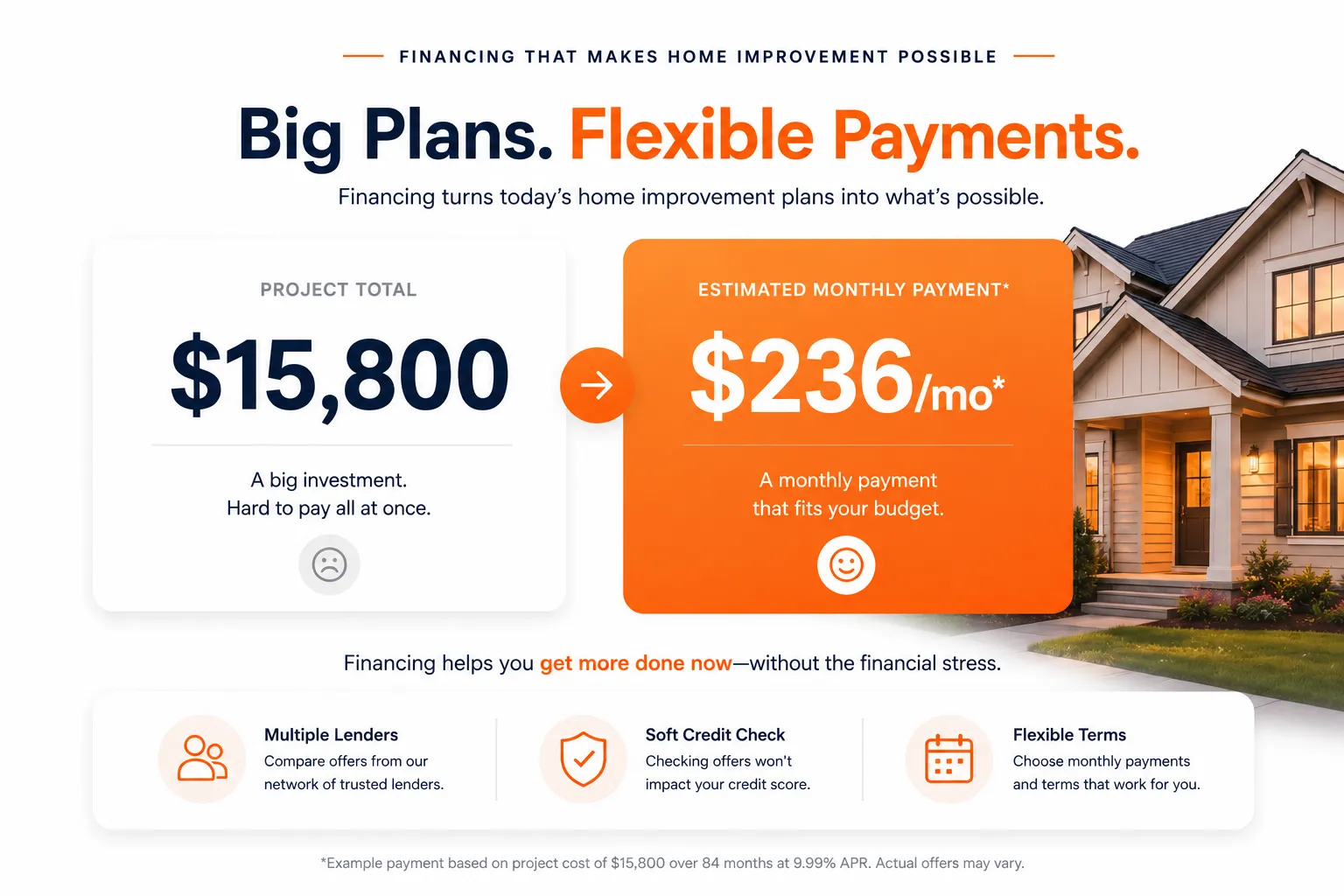
Pasha Funding makes that process simpler by allowing qualified homeowners to complete a single application and compare financing offers from a network of trusted lending partners. For many applicants, checking available offers begins with a soft credit inquiry that does not affect their credit score.
Whether you’re updating a small kitchen or planning a complete renovation, comparing multiple financing options in one place can make it easier to evaluate interest rates, monthly payments, repayment terms, and loan features before making a decision.
Finding the right financing can help you move forward with greater confidence while keeping your remodeling budget on track.
The information provided by Pasha Funding is for educational and informational purposes only and should not be considered financial, legal, or tax advice. Every homeowner’s financial situation is different, and the financing options discussed may not be suitable for everyone. Before choosing a financing solution, carefully review the lender’s terms and consider consulting a qualified financial professional if needed.
Pasha Funding is a financing marketplace that connects homeowners with financing options offered by participating lending partners. We do not make loans, determine credit eligibility, or guarantee approval or specific loan terms. Pasha Funding is not a direct lender. We may receive compensation from participating lending partners when users submit an application or obtain a loan through our platform. This compensation may affect how and where financing options appear, but it does not influence our editorial evaluations.
Financing offers, rates, terms, and availability are determined solely by participating lenders and may change without notice. Our editorial content is created independently to help consumers better understand home improvement financing. While we strive to keep information accurate and current, financing products, lender requirements, rates, and offers may change over time. Any opinions expressed are those of the author and have not been reviewed, approved, or endorsed by our lending partners.

FAQs
In this guide
- How to Pay for Kitchen Remodeling Projects
- How Much Does a Kitchen Remodel Cost?
- How Much Should You Borrow for a Kitchen Remodel?
- Kitchen Remodel Financing Options Explained
- What Credit Score Do You Need for Kitchen Remodel Financing?
- Hidden Kitchen Remodel Financing Costs Most Homeowners Don’t Budget For
- Common Kitchen Remodel Financing Mistakes to Avoid
- How to Compare Kitchen Remodel Loans
- When Kitchen Remodel Financing May Not Be the Best Choice
- Compare Kitchen Remodel Loan Rates with Pasha Funding
- Kitchen Remodel Financing Calculator
- $270
Kitchen Remodel Financing Calculator
1. Enter Your Desired Loan Amount
Your Estimate
Monthly Payment
-
This calculator provides estimates for illustrative purposes only and does not constitute an offer of credit or a commitment to lend. Final APRs, loan amounts, and terms depend on credit approval, income verification, and lender underwriting criteria. Minimum and maximum rates/terms vary by state.
Powered by: Pasha Funding
how it works
3 Simple steps to
finance your project.
Getting started only takes a minute. Complete one simple application to compare available financing offers from over 18+ lenders, choose the option that fits your budget, and move forward with your home improvement project.
Risk-Free Prequalification
Checking offers won’t impact your credit.
It’s common for homeowners to delay applying because they’re worried about their credit score. With a soft credit check, you can review available financing options without any impact to your credit score.2