
Participating Lender Network





How to Finance Lead Paint Removal Projects
Lead paint removal can cost a few thousand dollars for a single room and climb to around $10,000 or more for a whole-home project. Because that can be a significant expense to take on at once, homeowners may be able to combine public assistance, such as HUD-funded local programs or state deleading loans, with a home improvement loan or home equity line of credit to cover the remaining cost.
Key Takeaways
- Grants come first: Income-eligible owners of pre-1978 homes can often get local, HUD-funded lead programs to cover most or all of the work, so you borrow only for the gap.
- Sealing paint in place costs a fraction of stripping and replacing it, and that choice decides how much you actually need to finance.
- Insurance rarely pays: A standard policy covers lead removal only when it is part of repairing a covered loss (like a fire), not when you remove it on your own.
- A tax deduction may apply: If a child in the home has or had lead poisoning, the IRS lets you count qualifying removal as a medical expense.
- Personal loans fill the gap: When grants fall short and you would rather not put a lien on the house, a fixed-payment personal loan covers the balance.
How Much Does Lead Paint Removal Cost?
Expect to pay $6 to $17 per square foot. A single room often lands in the low four figures, while a whole-home removal reaches the low five figures. The cost range is wide because it depends heavily on the removal method. Sealing or encapsulating intact lead paint is typically the least expensive approach, while stripping paint or replacing contaminated surfaces can push costs significantly higher. Testing adds to the total before any removal starts. A lead inspection usually costs $300 to $700, and a full risk assessment (which maps hazards using an XRF analyzer and dust-wipe samples) runs $500 to $1,500, with hazardous-waste disposal adding another $3 to $5 per square foot on jobs where it is billed separately.
Where you live changes these numbers too. Dense metro areas and states with strict deleading rules (parts of the Northeast, for example) tend to price above the national range, while rural markets often come in lower.
What Grants and Low-Cost Loans Pay for Lead Paint Removal?
Lead is the one home hazard with a deep public funding network behind it, so the first dollars you spend should almost never be your own. Federal money flows through the HUD Office of Lead Hazard Control, which routes hundreds of millions of dollars to city and county programs that then pay for abatement in qualifying homes. Many states layer their own deleading loans on top. Massachusetts, for one, offers no- and low-interest loans up to $30,000 to $45,000 through its Get the Lead Out program, with deferred payments for owner-occupants.
- Local HUD-funded grants: Administered by your city or county, these often cover most or all of the work for income-eligible owners of pre-1978 homes, with no repayment.
- State deleading loans: Zero- or low-interest programs (sometimes deferred until you sell) that stretch further than a market-rate loan.
- Home improvement personal loan: Covers whatever grants and state programs do not, without putting a lien on your home.
- Home equity loan or HELOC: Lower rates than an unsecured loan, useful for larger removal jobs, but your house backs the debt.
Encapsulation or Full Removal: Which Costs Less to Finance?
The scope of the work you approve will have the biggest impact on how much you ultimately need to finance. Encapsulation seals intact paint with a specialized coating and sits at the low end of the range, which can keep a room-by-room project inside what a small personal loan or even cash flow can handle. Full removal and component replacement land at the top of the range and are what push a project into HELOC territory. A certified risk assessment tells you which surfaces genuinely need removal versus which can be safely encapsulated, so you are not financing a gut job when a seal would pass. Friction surfaces (window sashes and door jambs) and impact surfaces (baseboards and stair treads) usually call for enclosure or replacement rather than encapsulation, because everyday use grinds their paint into lead dust that a coating cannot hold.
Why Must Lead Paint Removal Be Done by a Certified Firm?
Deleading a pre-1978 home is regulated, and the rules exist because careless removal creates more lead dust than it clears. Here are the federal law regulations to be aware of:
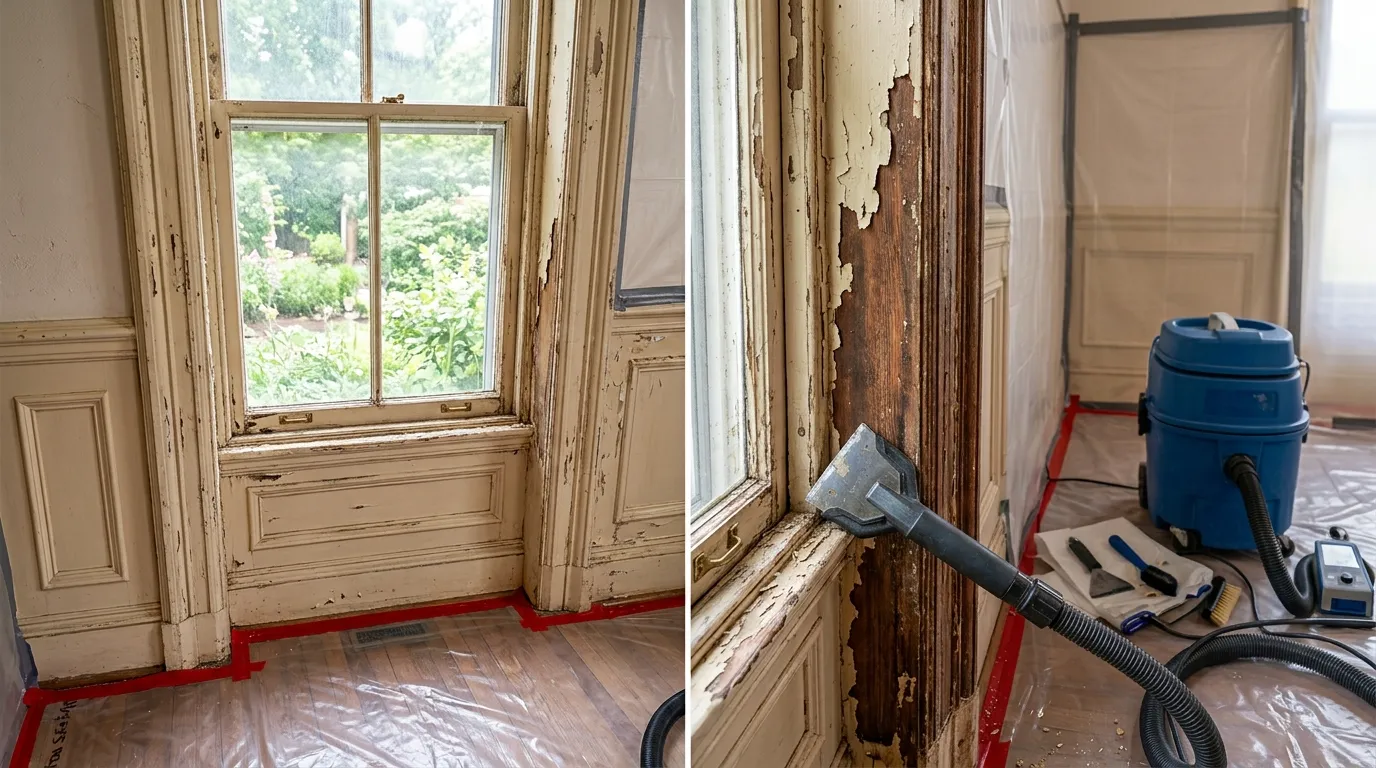
- EPA Lead-Safe certification: The EPA Renovation, Repair, and Painting Rule (40 CFR Part 745), which carries out the Residential Lead-Based Paint Hazard Reduction Act of 1992 (Title X), requires any contractor paid to disturb paint in a pre-1978 home to be certified and to use contained work areas, HEPA vacuuming, and wet cleanup.
- Testing with an XRF analyzer: A certified risk assessor reads lead through layers of paint with an X-ray fluorescence (XRF) analyzer that leaves the surface intact, then collects dust-wipe samples from floors, sills, and troughs for lab analysis.
- Hazardous waste disposal: Stripped paint, old windows, and cleanup residue can qualify as hazardous waste under the Resource Conservation and Recovery Act (RCRA), which may require manifested transport and disposal at a permitted facility.
- Mandatory clearance testing: No project is finished until an independent certified party runs a dust-wipe clearance test after the final cleaning, with results below EPA’s current clearance levels of 5 µg/ft² on floors, 40 on window sills, and 100 in window troughs.
These steps carry real cost, and they are also what lets the job count as a completed abatement when you sell the home or claim a grant reimbursement.
How Can You Lower What You Borrow for Lead Paint Removal?
The less you need to spend on the project, the less you need to borrow. A few decisions can make a meaningful difference in the final cost:
- Exhaust grants and state programs first: Local HUD-funded aid and state deleading loans cost less than any market-rate credit, so apply before you borrow.
- Get multiple certified quotes: Prices vary widely between EPA Lead-Safe Certified firms, and competing bids often move the total more than any financing choice does.
- Encapsulate what can be sealed: Reserve full removal for surfaces that truly need it, and seal stable painted surfaces instead of stripping them.
- Bundle with planned work: Windows are a common lead hazard, so pairing removal with a window replacement or a remodel you already intended can share containment costs and fold into one loan (or a renovation mortgage).
- Do the non-paint prep yourself: You can clear furniture and belongings, but leave any surface that disturbs paint to the certified firm, since paid DIY abatement in a pre-1978 home is not permitted and spreads lead dust.
- Phase to the highest-risk areas first: If you are spreading cost over time, treat children’s bedrooms and play areas before lower-traffic rooms.
Should You Replace Old Windows to Remove Lead Paint?
Old double-hung wood windows are the leading source of lead dust in a pre-1978 home, because the sashes grind against the frame every time they open and close. Replacing them with new vinyl or aluminum units does two jobs at once: it eliminates that hazard, and it lowers heating and cooling bills. That combination makes window replacement a strong fit for an energy-efficiency loan or a HUD-funded grant, and it often earns priority in state deleading programs. When a tight budget forces a phased approach, windows are usually the first component worth financing.
Can You Deduct Lead Paint Removal on Your Taxes?
Sometimes, and it can offset part of what you borrow. The IRS treats removing lead-based paint from surfaces a child can reach as a deductible medical expense when a child in the home has or previously had lead poisoning, per IRS Publication 502. Covering the surface with wallboard or paneling counts as a repair rather than a permanent home improvement, which affects how much you can claim. This is a narrow provision tied to a diagnosis, not a general write-off for any deleading project, so confirm your situation with a tax professional before counting on it.
Does Homeowners Insurance Cover Lead Paint Removal?
A standard HO-3 policy insures your home against all perils except those the policy names as excluded, and that structure is why voluntary lead removal usually is not covered. Finding lead paint is not a “peril” that damaged your home, so choosing to remove it falls outside the policy. On top of that, most policies carry a pollution exclusion, and lead is treated as a pollutant, as state insurance regulators have explained in guidance. Coverage does show up in one situation: when a covered loss (a fire or a burst pipe, say) damages a painted structure, the insurer pays to rebuild that area, and any lead removal needed to complete that repair rides along with the covered claim.
How Do You Qualify for Lead Paint Removal Financing?
Before applying for a loan, work through your options in order. Grants, insurance, or other assistance may cover part of the cost, leaving you with less to finance.
- Check program eligibility first: Confirm your home predates 1978 and see whether your household income clears the limits for a local HUD-funded grant or a state deleading loan. This step alone can shrink or erase what you finance.
- Get a certified risk assessment: A licensed assessor documents which surfaces are hazards and how they should be treated, which sets the real scope and the amount you need.
- Know where your credit stands: Lenders weigh your credit score and history. Strong credit opens up lower-cost options, and softer credit can still qualify, though usually at a higher price.
- Compare financing types: Weigh a personal loan (no home collateral, fixed monthly payments) against a home equity loan or HELOC (lower rate, secured by your house) and any contractor financing on offer.
- Size the loan to the method: Borrow against the scope you actually chose, since an encapsulation job and a full-removal job call for very different amounts.
The Bottom Line on Paying for Lead Paint Removal
The right funding depends on your situation more than on any single “best” loan. If your income qualifies, a local grant is the cheapest money there is, and a state deleading loan is the next best. If you have built up equity and face a large removal job, a home equity loan or HELOC keeps the rate down. If you would rather not attach a lien to your home, or the job is a smaller encapsulation project, a fixed-payment personal loan covers it without touching your equity. Before you borrow, get a certified risk assessment and run your address through your local lead program, because the grant you qualify for changes the size of the loan you actually need.
Explore related resources
The information provided by Pasha Funding is for educational and informational purposes only and should not be considered financial, legal, or tax advice. Every homeowner’s financial situation is different, and the financing options discussed may not be suitable for everyone. Before choosing a financing solution, carefully review the lender’s terms and consider consulting a qualified financial professional if needed.
Pasha Funding is a financing marketplace that connects homeowners with financing options offered by participating lending partners. We do not make loans, determine credit eligibility, or guarantee approval or specific loan terms. Pasha Funding is not a direct lender. We may receive compensation from participating lending partners when users submit an application or obtain a loan through our platform. This compensation may affect how and where financing options appear, but it does not influence our editorial evaluations.
Financing offers, rates, terms, and availability are determined solely by participating lenders and may change without notice. Our editorial content is created independently to help consumers better understand home improvement financing. While we strive to keep information accurate and current, financing products, lender requirements, rates, and offers may change over time. Any opinions expressed are those of the author and have not been reviewed, approved, or endorsed by our lending partners.


In this guide
- How much does a bathroom remodel cost?
- Should you finance a bathroom remodel or pay cash?
- What are the best ways to finance a bathroom remodel?
- Which bathroom remodel financing option is right for you?
- What do you need to qualify for bathroom remodel financing?
- What do bathroom remodel loan rates look like?
- How to improve your chances of approval for a bathroom remodel loan
- Common costs and fees to consider
- Will a bathroom remodel increase your home’s value?
- The bottom line
how it works
3 Simple steps to
finance your project.
Getting started only takes a minute. Complete one simple application to compare available financing offers from over 18+ lenders, choose the option that fits your budget, and move forward with your home improvement project.
Lead Paint Removal Financing Calculator
1. Enter Your Desired Loan Amount
Your Estimate
Monthly Payment
-
This calculator provides estimates for illustrative purposes only and does not constitute an offer of credit or a commitment to lend. Final APRs, loan amounts, and terms depend on credit approval, income verification, and lender underwriting criteria. Minimum and maximum rates/terms vary by state.
Powered by: Pasha Funding

Risk-Free Prequalification
Checking offers won’t impact your credit.
It’s common for homeowners to delay applying because they’re worried about their credit score. With a soft credit check, you can review available financing options without any impact to your credit score.2