

Participating Lender Network





Kitchen Cabinet Financing: A Complete Guide for Homeowners
Kitchen cabinet financing lets you divide the cost of cabinet refacing, replacement, or installation into scheduled payments instead of paying the entire bill upfront. Depending on the contractor and your financial profile, you may be able to use contractor-arranged financing, a personal loan, a HELOC, a home equity loan, a credit card, or promotional financing.
The best option is not necessarily the one advertising the lowest monthly payment. A smaller payment may come from a longer term, a higher total borrowing cost, or a promotional offer with conditions that are easy to overlook. Compare the complete cabinet proposal and the complete financing agreement before signing either one.
Key takeaways:
- Compare the APR, total repayment, fees, and loan term instead of choosing an offer based only on the monthly payment.
- Finalize the cabinet scope before applying because demolition, installation, hardware, countertops, and change orders can increase the amount you need to finance.
- Contractor-arranged financing may be convenient, but comparing it with at least one outside option can reveal meaningful differences in cost and terms.
- HELOCs and home equity loans may suit larger renovations, but they use your home as collateral and can involve a longer approval process.
- “No interest if paid in full” may involve deferred interest, so confirm the payoff deadline and required payment before accepting the promotion.
- Financing approval does not confirm contractor funding, so ask when funds are released and what happens if the final project price changes.
What is kitchen cabinet financing?
Kitchen cabinet financing is a loan, credit line, or promotional payment arrangement used to pay for cabinets and related remodeling work over time. The financing provider pays or authorizes payment for the project according to its funding rules, and the homeowner repays the borrowed amount under the terms of a separate credit agreement.
What cabinet expenses can be financed?
A financing request may cover more than cabinet boxes and doors. Depending on the lender and project contract, the financed amount may include design services, measurements, demolition, debris removal, cabinet delivery, installation, hinges, handles, trim, modifications, and taxes.
Countertops, backsplashes, flooring, lighting, plumbing, and appliances may also be included when they are part of a larger kitchen remodeling contract. Do not assume every cost qualifies. Ask the contractor to identify which expenses appear in the financing request and which expenses you must pay separately.
Why cabinet type matters before you borrow
Stock cabinets usually involve a more predictable purchase price and shorter delivery schedule. Semi-custom and custom cabinets may require larger deposits, longer production times, and stricter cancellation policies because the products are made or modified for your kitchen.
Cabinet refacing can reduce the project amount when the existing cabinet boxes remain structurally sound and the layout does not need to change. However, refacing is not automatically the better value if the boxes are damaged, storage is poor, or the kitchen requires major layout changes.
Once the scope is clear, you can evaluate how the financing application, lender approval, and contractor payment process fit the project timeline.
How does kitchen cabinet financing work?
Kitchen cabinet financing usually begins after a contractor or cabinet company prepares a written proposal. You submit an application or prequalification request, review any available offers, complete the lender’s verification process, and accept the terms you prefer. The lender then releases funds according to its rules and the project agreement.
- Define the cabinet project. Decide whether you are refacing, replacing, or changing the kitchen layout.
- Obtain a detailed proposal. Confirm the cabinet brand, construction, finish, hardware, labor, exclusions, and change-order process.
- Review financing sources. Compare contractor-arranged financing with options from banks, credit unions, and other providers. The FTC contractor guidance recommends reviewing financing terms carefully rather than automatically accepting an offer arranged through a home improvement provider.
- Check available terms. Review the annual percentage rate, payment amount, repayment period, fees, collateral requirements, and total payments.
- Complete lender verification. The provider may request identity, income, employment, housing, or banking information.
- Sign the correct documents. The cabinet contract and the financing agreement are separate obligations and should be reviewed independently.
- Confirm funding conditions. Find out whether payment occurs at approval, cabinet delivery, installation, project completion, or in stages.
Some contractors use a financing marketplace rather than relying on one lender. Pasha Funding is one example of a marketplace that connects homeowner applications with participating lending providers. The marketplace does not make the lending decision, and each provider controls its own approval criteria, offers, disclosures, and funding requirements.
Pro Tip: Ask the contractor to explain what happens if the lender approves less than the contract price. You may need to reduce the scope, make a cash contribution, select another offer, or postpone the project.
What types of kitchen cabinet financing are available?
Homeowners commonly finance cabinets with contractor-arranged loans, unsecured personal loans, HELOCs, home equity loans, credit cards, or promotional credit. The right choice depends on the project amount, funding speed, available home equity, credit qualifications, expected repayment period, and whether you are willing to use your home as collateral.
Each financing method has advantages and tradeoffs. The best choice depends on your project size, available home equity, repayment goals, and how quickly you need funding.
| Option | May Work Well For | Main Issue to Review |
|---|---|---|
| Contractor-Arranged Financing | Homeowners who want to apply during the cabinet consultation | Available lenders, loan terms, and approval requirements vary by the contractor’s financing program. |
| Unsecured Personal Loan | Homeowners who do not want to borrow against home equity | Interest rates, loan amounts, and repayment terms depend on your credit profile, income, and existing debts. |
| HELOC | Larger remodeling projects with costs that occur over time | Most HELOCs have variable interest rates and use your home as collateral. |
| Home Equity Loan | Projects with a defined budget that require a lump-sum payment | Closing costs may apply, and your home secures the loan. |
| Credit Card | Smaller cabinet purchases that can be repaid quickly | Carrying a balance after the billing cycle can become expensive because of higher interest rates. |
| Promotional Financing | Borrowers with a realistic plan to repay the balance within the promotional period | Deferred-interest offers may charge accrued interest if the promotional terms are not fully satisfied. |
A HELOC works more like a reusable credit line than a one-time loan. You can generally borrow, repay, and draw again during the permitted draw period. That flexibility may help with a kitchen remodel whose final cost is uncertain, but the rate and required payment can change.
A home equity loan typically provides a lump sum. It may be easier to budget when the cabinet project has a firm price, but both home equity loans and HELOCs place the property at risk if the borrower cannot meet the repayment obligation.
An unsecured personal loan does not use the home as collateral. It may also fund faster than an equity-based product because it does not usually require an appraisal or real estate closing. The tradeoff is that qualified borrowers may receive different rates, fees, and loan limits based on their financial profiles.
After choosing the most suitable product category, compare the actual cost rather than relying on the financing label.
How much does kitchen cabinet financing cost?
The cost of kitchen cabinet financing depends on the amount financed, APR, repayment term, fees, and payment schedule. Cabinet quality affects the project price, while your financial profile and selected lender affect the borrowing cost. Two homeowners financing the same project may therefore receive very different offers.
The annual percentage rate is generally more useful than the interest rate alone because APR reflects the yearly cost of credit and may include certain finance charges. Still, you should also review the dollar amount of fees and the total of all scheduled payments.
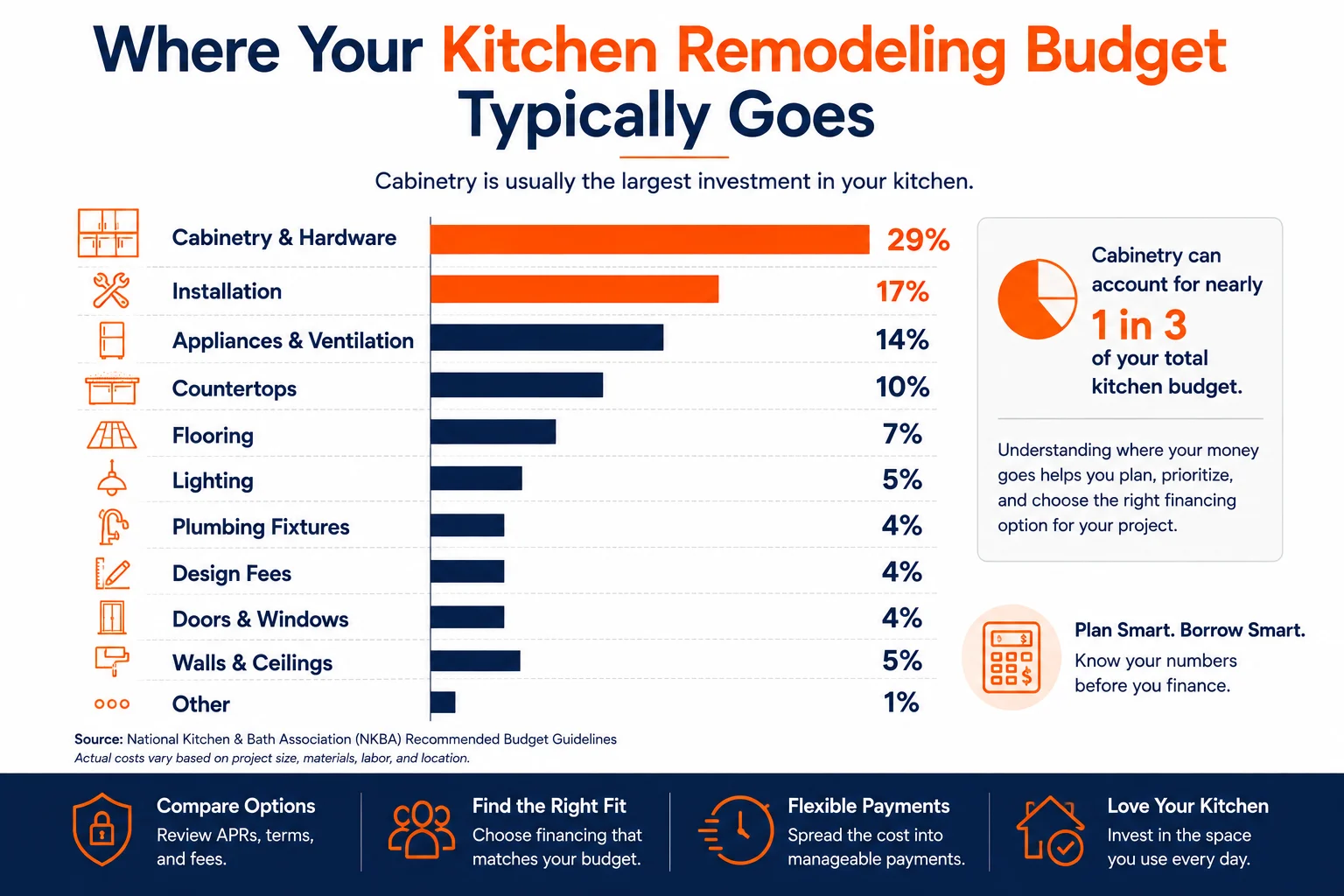
What affects the cabinet project price?
- Kitchen size and number of cabinet boxes
- Stock, semi-custom, or custom construction
- Plywood, engineered wood, or other cabinet materials
- Door style, finish, decorative panels, and trim
- Drawer systems, organizers, and specialty storage
- Demolition, wall repair, plumbing, or electrical work
- Installer experience and local labor costs
Why the lowest payment may cost more
A lender can lower the monthly payment by extending the debt over more years. That may improve short-term affordability, but it usually leaves the balance outstanding longer and may increase the total interest paid.
| Repayment Term | Approximate Monthly Payment | Approximate Total Repaid |
|---|---|---|
| 3 years | $484 | $17,424 |
| 5 years | $319 | $19,122 |
| 7 years | $249 | $20,917 |
These estimates assume a fixed rate, equal monthly payments, and no additional fees. They are educational examples rather than available loan offers. Actual payments may differ because of rounding, lender calculations, fees, payment timing, and borrower qualifications.
What credit score is needed for kitchen cabinet financing?
There is no single credit score required for every kitchen cabinet financing program. Each lender uses its own underwriting standards and may review credit history, income, current debts, recent applications, requested loan amount, housing costs, and other indicators of repayment ability.
A higher credit score may improve your chances of receiving a lower rate or larger loan, but it does not guarantee approval. A lender may decline an applicant with a strong score because of insufficient income or excessive debt, while another lender may approve an applicant with a lower score under different terms.
Can you finance cabinets with fair or lower credit?
Possibly. Some lending networks include providers that consider a wider range of credit profiles. The available APR, loan amount, repayment term, and fees may be less favorable than those offered to a stronger applicant, so approval should not be treated as proof that the loan is affordable.
Before applying, review your credit reports for unfamiliar accounts, incorrect balances, or outdated information. Correcting an error may take time, so start before the contractor asks you to sign a cabinet order.
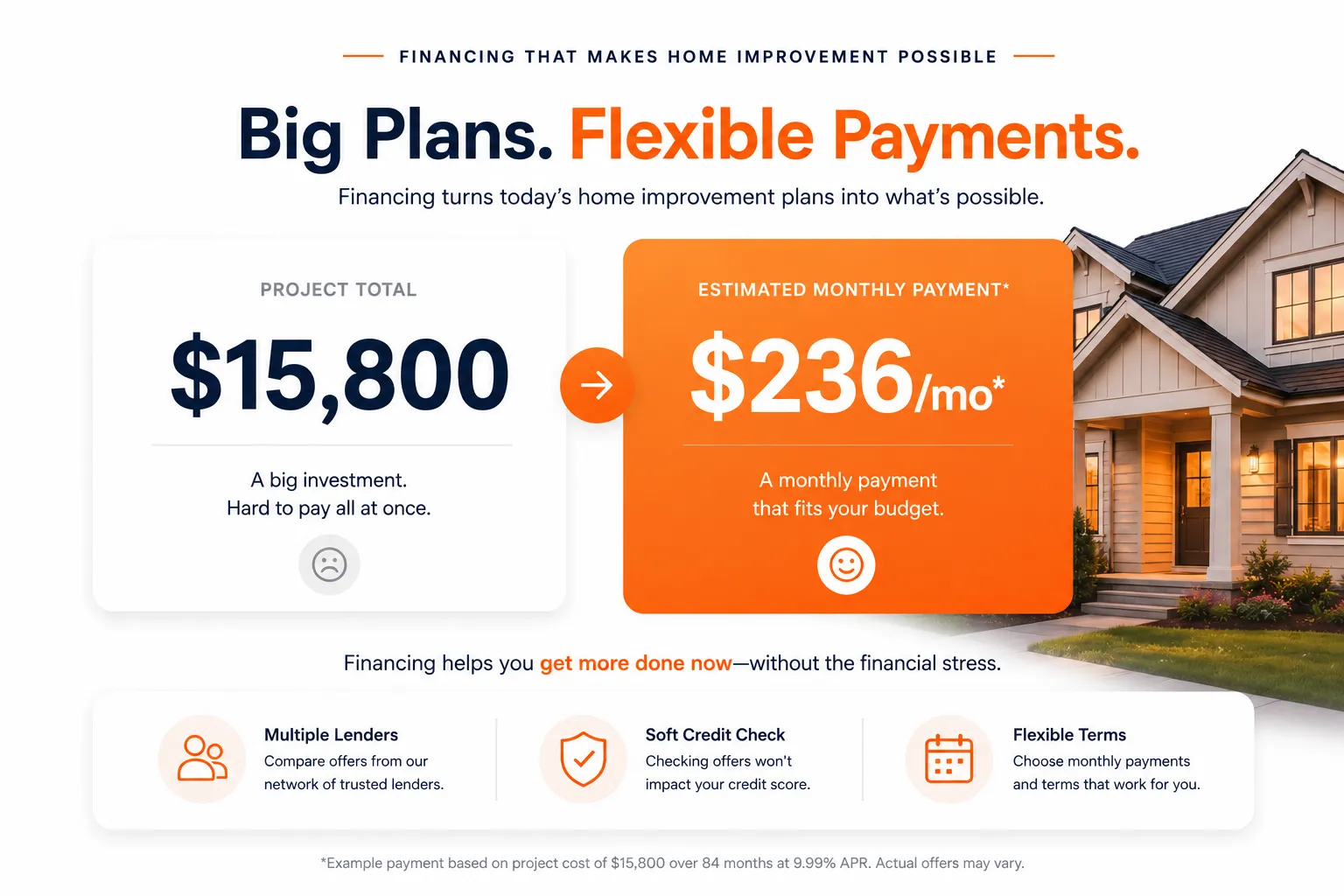
Will checking cabinet financing affect your credit?
A provider may use a soft inquiry to show possible options without affecting your credit score. A hard inquiry may occur when you submit a full credit application or proceed with a particular offer, and it can appear on your credit report and affect your score.
- Ask whether the initial request uses a soft or hard inquiry.
- Confirm whether accepting an offer triggers another credit review.
- Do not assume every marketplace or lender follows the same process.
- Apply only for an amount that fits the completed cabinet budget.
- Evaluate the payment alongside your existing housing and debt obligations.
Once you have actual offers, the quality of your decision depends on comparing more than the approval amount.
What should you compare before accepting a cabinet financing offer?
Compare the APR, amount financed, payment, term, fees, total repayment, interest structure, collateral, and contractor funding rules before accepting cabinet financing. You should also understand what happens if the order changes, the installation is delayed, the contractor stops work, or you decide to cancel.
Cabinet financing offer checklist
- What is the cash price of the cabinet project?
- What exact amount will be financed?
- Does the financed amount include lender-related or contractor-related fees?
- What is the APR?
- Is the interest rate fixed or adjustable?
- How much is each payment and when is the first one due?
- How many payments are required?
- What is the total of all payments?
- Does the lender charge origination, closing, annual, or account fees?
- Is there a penalty for paying the balance early?
- Is the offer true 0% financing or deferred-interest financing?
- Does the loan use your home or another asset as collateral?
- When will the contractor receive the funds?
- Who holds the money if the project is delayed or disputed?
- What happens to the loan if the cabinet contract is canceled?
What to Watch for With “No Interest If Paid in Full” Financing
A true 0% promotion does not charge interest during the stated promotional period. Deferred-interest financing works differently. Interest may accrue in the background and be charged from the original purchase date if you fail to pay the required promotional balance in full or violate other terms.
Do not divide the purchase amount by the number of promotional months and assume the lender’s minimum payment will retire the balance on time. Calculate your own target payment, leave room for rounding or account adjustments, and confirm the payoff amount before the promotional deadline.
The financing may be reasonable, but it still depends on hiring a contractor capable of completing the work described in the estimate.
How should you choose a cabinet contractor before financing the project?
Choose the cabinet contractor based on the quality of the design, products, installation plan, contract, and references before considering financing convenience. An easy application cannot protect you from inaccurate measurements, poor installation, vague warranties, unexpected change orders, or cabinets that do not match the proposal.
Obtain multiple written estimates when practical. Compare the cabinet construction, box material, door style, finish, hardware, accessories, demolition work, installation, trim, warranty, and estimated schedule. A lower bid may simply exclude work included in another contractor’s proposal.
Contractor review checklist
- Verify applicable state and local licensing requirements.
- Ask for current proof of insurance.
- Review completed kitchens with a similar scope and cabinet type.
- Confirm whether employees or subcontractors will install the cabinets.
- Ask who is responsible for final measurements.
- Identify who handles plumbing, electrical, wall, and flooring repairs.
- Review product warranties and the installer’s labor warranty separately.
- Require written approval before any change order increases the price.
- Confirm the deposit, ordering, delivery, and completion payment schedule.
Custom and semi-custom cabinets may become noncancelable once the manufacturer begins production. Before authorizing the order, verify the final layout, appliance dimensions, filler pieces, door clearances, finished side panels, crown molding, and hardware locations.
When the contractor, cabinet plan, and financing terms all withstand review, you can decide whether borrowing is better than paying cash or reducing the project scope.
Is kitchen cabinet financing worth it?
Kitchen cabinet financing may be worthwhile when the work is necessary, the project is well planned, and the payment fits your budget without depending on uncertain future income. It is less attractive when borrowing encourages unnecessary upgrades, extends cosmetic debt for many years, or creates a payment that leaves no room for repairs and emergencies.
Compare three versions of the project before deciding: the preferred cabinet plan, a lower-cost replacement plan, and a refacing or limited-improvement option. Then compare paying cash, financing part of the cost, and financing the full amount.
A good financing offer does not make an overpriced or poorly planned cabinet project worthwhile. The project and the credit terms must both make sense independently.
Final Thoughts
Kitchen cabinet financing can make a remodeling project more affordable by spreading the cost into manageable monthly payments. Before accepting an offer, compare the APR, repayment term, total cost, fees, and whether the financing requires your home as collateral instead of focusing only on the monthly payment.
Pasha Funding gives homeowners access to financing options from participating lending providers through a single application. Available offers, rates, loan amounts, and approval decisions vary by lender and applicant, making it worthwhile to compare your available options and choose the financing that best fits your budget and remodeling goals.
The information provided by Pasha Funding is for educational and informational purposes only and should not be considered financial, legal, or tax advice. Every homeowner’s financial situation is different, and the financing options discussed may not be suitable for everyone. Before choosing a financing solution, carefully review the lender’s terms and consider consulting a qualified financial professional if needed.
Pasha Funding is a financing marketplace that connects homeowners with financing options offered by participating lending partners. We do not make loans, determine credit eligibility, or guarantee approval or specific loan terms. Pasha Funding is not a direct lender. We may receive compensation from participating lending partners when users submit an application or obtain a loan through our platform. This compensation may affect how and where financing options appear, but it does not influence our editorial evaluations.
Financing offers, rates, terms, and availability are determined solely by participating lenders and may change without notice. Our editorial content is created independently to help consumers better understand home improvement financing. While we strive to keep information accurate and current, financing products, lender requirements, rates, and offers may change over time. Any opinions expressed are those of the author and have not been reviewed, approved, or endorsed by our lending partners.


Frequently Asked Questions
Can I finance cabinets and installation together?
Often, yes. A contractor may combine cabinets, delivery, demolition, installation, hardware, and related labor into one project amount. Confirm that the loan request matches the written proposal and identify any expenses that must be paid separately.
Can cabinet refacing be financed?
Cabinet refacing may qualify when the contractor and lender treat it as an eligible home improvement. It may require a smaller loan than full replacement, but it is best suited to kitchens with sound cabinet boxes and a layout the homeowner wants to keep.
Can I finance custom kitchen cabinets?
Custom cabinetry can often be financed subject to lender approval and available loan limits. Review the manufacturer’s deposit, production, change, and cancellation rules carefully because made-to-order cabinets may become nonrefundable before installation begins.
How quickly can kitchen cabinet financing be approved?
Some providers can issue an initial decision quickly, but final approval and funding may require identity, income, banking, or employment verification. Home equity products may take longer because they can involve property-related disclosures, valuations, and closing requirements.
Is contractor financing better than a HELOC?
Neither option is always better. Contractor financing may offer a simpler application and may not require home equity. A HELOC may provide flexibility for a larger remodel, but it commonly has an adjustable rate and uses the home as collateral.
Can I pay off kitchen cabinet financing early?
Many financing agreements permit early repayment, but you should check for prepayment penalties and ask how extra payments are applied. With deferred-interest financing, request the exact promotional payoff amount before the deadline rather than relying only on the statement balance.
Explore more related financing options
In this guide
- What cabinet expenses can be financed?
- Why cabinet type matters before you borrow
- Quick decision guide
- What affects the cabinet project price?
- Why the lowest payment may cost more
- Can you finance cabinets with fair or lower credit?
- Will checking cabinet financing affect your credit?
- Cabinet financing offer checklist
- What to Watch for With “No Interest If Paid in Full” Financing
- Contractor review checklist
- Final decision test
- Can I finance cabinets and installation together?
- Can cabinet refacing be financed?
- Can I finance custom kitchen cabinets?
- How quickly can kitchen cabinet financing be approved?
- Is contractor financing better than a HELOC?
- Can I pay off kitchen cabinet financing early?
- 1. Enter Your Desired Loan Amount
how it works
3 Simple steps to
finance your project.
Getting started only takes a minute. Complete one simple application to compare available financing offers from over 18+ lenders, choose the option that fits your budget, and move forward with your home improvement project.
Kitchen Remodel Financing Calculator
1. Enter Your Desired Loan Amount
Your Estimate
Monthly Payment
-
This calculator provides estimates for illustrative purposes only and does not constitute an offer of credit or a commitment to lend. Final APRs, loan amounts, and terms depend on credit approval, income verification, and lender underwriting criteria. Minimum and maximum rates/terms vary by state.
Powered by: Pasha Funding
Risk-Free Prequalification
Checking offers won’t impact your credit.
It’s common for homeowners to delay applying because they’re worried about their credit score. With a soft credit check, you can review available financing options without any impact to your credit score.2