

Participating Lender Network





Compare Deck Financing Options Before You Build
Building a deck runs anywhere from about $5,000 for a small pressure-treated platform to $25,000 or more for a large composite build, with most homeowners landing between $13,000 and $21,000 for a standard deck. The final number turns on more than size: the material, whether the deck sits at ground level or rises to a second story, and the railings, stairs, and permits all move it. Because a deck is usually too big for pocket cash but too small to justify refinancing, most people pay with a personal loan, a contractor’s financing plan, or a credit card for smaller work, and turn to home equity for the priciest builds.
Key Takeaways
- Decks typically cost $30 to $60 per square foot installed, putting a standard deck around $13,000 to $21,000.
- A personal loan is the most flexible option: it funds fast, needs no equity, and works with any builder or material.
- Deck builders and big-box stores often offer financing, but the terms come from a lender, so compare them against an outside loan.
- “No credit check” deck financing usually means lease-to-own, which can cost far more than the deck itself.
- Cheap wood costs less to build but needs ongoing upkeep, so you may still be repaying the loan when repairs start.
- Most decks need a permit and inspection, and the ledger connection to your house is the part that matters most for safety.
How Much Does a Deck Cost?
Size and material drive the price together. Decks run about $30 to $60 per square foot installed, so material choice can swing a project by thousands. Here is how the common decking materials compare.
What a Standard Deck Costs by Material
Typical installed cost range for a 300-square-foot deck.
Bar length reflects the top of each range. Figures from NerdWallet and HomeGuide.
Height affects the price as much as material. A ground-level deck is the cheapest to build, while raising a deck on posts or extending it to a second story can double the cost because of framing, footings, and stairs. Railings, built-in seating, and a roof or cover add more, and a roof alone can run several thousand dollars. Permits add a small cost and some time. Labor rates and material prices also vary by region, so a quote in a high-cost metro can sit above these national ranges. Ask for an itemized bid that separates decking, framing, railings, stairs, and permits so you can see where the money goes and trim if needed.
Who Offers Deck Financing, and How Do the Options Compare?
Deck financing comes from several places, and the right one depends on the size of the job, your credit, and how fast you want to start. Here is how the main channels stack up.
Personal Loans
A personal loan from a bank, credit union, or online lender gives you a fixed amount in a few days, with no lien on your home and the freedom to hire any builder. That flexibility makes it the most common fit for a deck, which usually costs too much for a card but too little to refinance the house over. Credit unions often carry lower rates than banks, and an online marketplace lets you prequalify with a soft credit check to compare offers without denting your score.
Deck Builder Financing
Many deck builders advertise financing usually through a lending partner like a point-of-sale platform. It is convenient, keeps everything with one company, and sometimes comes with a promotional 0% period. The catch is that the terms are set by a lender the builder works with, and a “0%” or “same as cash” offer can turn into steep deferred interest if you miss the payoff window. Treat it as one quote to compare, not an automatic yes.
Home Improvement Store Financing
Big-box retailers like Home Depot and Lowe’s offer their own financing, through a store credit card for smaller purchases or a project loan for larger amounts. These can work if you are buying materials there or using their installers, but the promotional terms deserve the same scrutiny as any contractor plan, so read how interest applies after any intro period.
Home Equity Loans and HELOCs
For a large or premium deck, borrowing against your equity usually brings the lowest rate. A HELOC also lets you draw in stages, useful if the build runs in phases. The trade-offs are closing costs, a few weeks to fund, and your home as collateral, which is more process than a small deck warrants but sensible for a big one.
Credit Cards
For a small deck or a repair, a card with a real 0% introductory offer can be interest-free if you clear the balance in time. Beyond a small project, the standard rate makes a card an expensive way to carry a deck balance.
Can You Finance a Deck With Bad Credit or No Credit Check?
A deck is discretionary, so weaker credit is a reason to be deliberate rather than rushed, but financing is still possible. Approval will likely come with a higher rate and a smaller loan, so confirm the payment fits your budget, and weigh whether a cheaper material or a smaller deck keeps the project affordable.
For bad credit, credit unions and community banks tend to be the most flexible, a cosigner with stronger credit can lower the rate, and prequalifying with a soft credit check lets you compare real offers safely. The option to approach carefully is “no credit check” financing, which almost always means a lease-to-own or rent-to-own arrangement. These approve nearly everyone because you do not own the deck until it is paid off, and the total can run well above the cash price. If it is your only route, read the full payment total before signing, and treat it as a last resort after a personal loan, a cosigned loan, or simply saving up and building a smaller deck now.
Which Decking Material Offers the Best Long-Term Value?
The cheapest deck to build is not always the cheapest to keep. Pressure-treated wood costs the least upfront but needs regular staining and eventual board replacement, while composite costs more at the start and asks for almost nothing after.
A pressure-treated deck needs cleaning and restaining every two to three years and tends to need serious repair or replacement within 10 to 15 years. Cedar and redwood look better and resist rot longer but still need upkeep. Composite and PVC cost more upfront and can last 25 years or more with only occasional cleaning. This matters directly when you finance, because a five-to-seven-year loan on a cheap wood deck can leave you still making payments while the deck already needs restaining or board work. Matching the material’s lifespan to the loan term keeps you from paying interest and maintenance at the same time, so if you plan to finance and stay in the home, spending more on a lower-maintenance material can cost less over the years you own it.
Do You Need a Permit for a Deck?
Almost always, and the inspection exists for a serious reason. Most decks require a building permit, and the connection between the deck and your house is the single most important safety detail.
Local building departments require a permit for most attached decks and for freestanding decks above a certain size or height, and they inspect the structure before you use it. The part inspectors watch most closely is the ledger board, the beam that fastens the deck to the house. Under the International Code Council’s residential deck provisions, the ledger must be attached with proper lag screws or through-bolts into the home’s framing, not nails, and improper ledger attachment is the leading cause of deck collapses, which can happen suddenly and without warning. Guardrails are required on decks more than 30 inches above grade, standing at least 36 inches tall with balusters no more than four inches apart. Because a permit protects against exactly these failures, skipping one is a genuine safety risk as well as a resale and insurance problem. Confirm the permit scope with your contractor, and fold the fee into your budget.
Does Homeowners Insurance Cover Deck Damage?
Sometimes, depending on the cause. A deck attached to your home is usually covered under your dwelling coverage, and a standard HO-3 policy covers any cause of loss except those it excludes.
Because the standard policy is open-perils for the home and attached structures, a deck damaged by a fire, a fallen tree, or a windstorm is generally covered, minus your deductible, while a freestanding deck falls under other structures coverage. What is not covered is gradual damage: rot, insect damage, and general wear are excluded as maintenance, which is why a deck that fails from age or neglect is yours to replace. A poorly built deck that collapses can also raise coverage questions, another reason to build to code and pull a permit. If a sudden, covered event damages your deck, document the cause and check your deductible before filing.
How Do You Qualify for Deck Financing?
Lenders look at your credit, your income against your debts, and, for a home-secured loan, your equity. Doing a little prep first improves both your odds and your rate. Here is the order that works well:
- Lock down the scope and a permit plan. Get an itemized bid covering decking, framing, railings, stairs, and permits, and confirm who pulls the permit, so you finance the full project rather than a partial number.
- Check your credit and debt load. Review your credit report for errors and total your monthly debts, since most lenders want your total debt, including the new payment, at or below about 43% of your gross income.
- Compare across channels. Prequalify with a personal lender using a soft credit check, then hold that offer against any builder or store financing and judge them on total cost over the full term, not the monthly payment.
| Financing Path | Best For | Funding Speed |
|---|---|---|
| Personal loan | Most standard deck builds | 1 to 5 days |
| Builder or store financing | Convenience, promotional offers | At point of sale |
| Home equity / HELOC | Large or premium decks | 2 to 6 weeks |
The best financing option depends on your project’s scope. Personal loans often work well for mid-sized decks, 0% promotional credit cards can make sense for smaller builds, and home equity financing may offer lower rates for larger, higher-cost projects. Always compare the total cost of borrowing before making a decision.
The Bottom Line
The best financing option depends on your project’s cost, your credit, and whether you have home equity. Personal loans are a common choice for standard deck projects because they fund quickly and don’t require equity. Home equity loans and HELOCs may offer lower rates for larger builds, while a 0% introductory credit card can work for smaller projects if you repay the balance before the promotional period ends. Deck-builder and home-improvement-store financing can be worth considering, but compare them with outside offers first, and be cautious with no-credit-check lease-to-own, which can cost far more than the deck.
If you’re close to paying in cash, waiting a few months could save on interest, although rising lumber prices may offset those savings. Another option is to make a larger down payment and finance only the remaining balance. Whatever you choose, get an itemized bid, compare offers based on the total amount you’ll repay rather than the monthly payment, and pick a material whose lifespan fits how long you’ll be paying for it.
The information provided by Pasha Funding is for educational and informational purposes only and should not be considered financial, legal, or tax advice. Every homeowner’s financial situation is different, and the financing options discussed may not be suitable for everyone. Before choosing a financing solution, carefully review the lender’s terms and consider consulting a qualified financial professional if needed.
Pasha Funding is a financing marketplace that connects homeowners with financing options offered by participating lending partners. We do not make loans, determine credit eligibility, or guarantee approval or specific loan terms. Pasha Funding is not a direct lender. We may receive compensation from participating lending partners when users submit an application or obtain a loan through our platform. This compensation may affect how and where financing options appear, but it does not influence our editorial evaluations.
Financing offers, rates, terms, and availability are determined solely by participating lenders and may change without notice. Our editorial content is created independently to help consumers better understand home improvement financing. While we strive to keep information accurate and current, financing products, lender requirements, rates, and offers may change over time. Any opinions expressed are those of the author and have not been reviewed, approved, or endorsed by our lending partners.


Frequently Asked Questions
In this guide
- How Much Does a Deck Cost?
- Who Offers Deck Financing, and How Do the Options Compare?
- Can You Finance a Deck With Bad Credit or No Credit Check?
- Which Decking Material Offers the Best Long-Term Value?
- Do You Need a Permit for a Deck?
- Does Homeowners Insurance Cover Deck Damage?
- How Do You Qualify for Deck Financing?
- The Bottom Line
how it works
3 Simple steps to
finance your project.
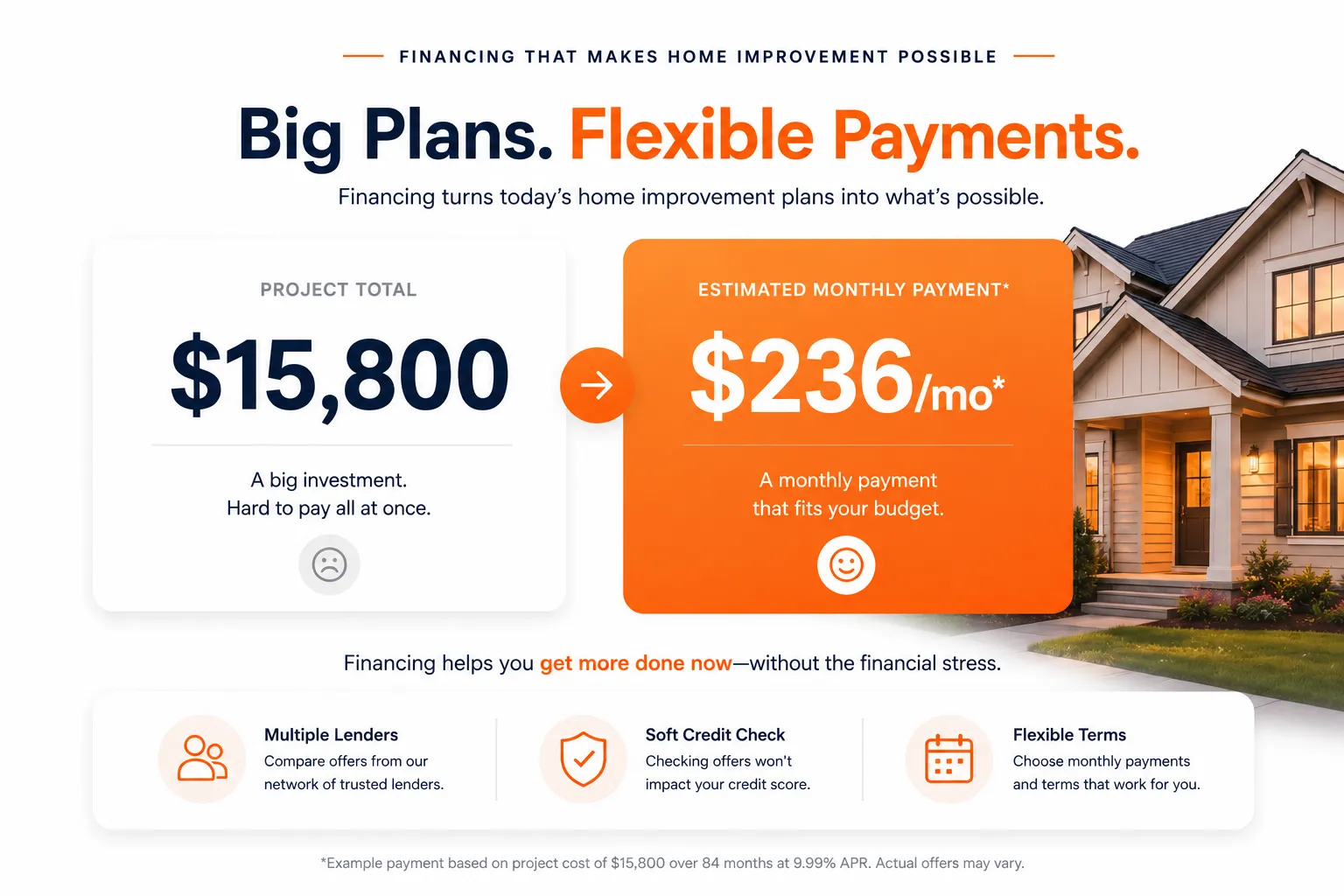
Getting started only takes a minute. Complete one simple application to compare available financing offers from over 18+ lenders, choose the option that fits your budget, and move forward with your home improvement project.
Deck Financing Calculator
1. Enter Your Desired Loan Amount
Your Estimate
Monthly Payment
-
This calculator provides estimates for illustrative purposes only and does not constitute an offer of credit or a commitment to lend. Final APRs, loan amounts, and terms depend on credit approval, income verification, and lender underwriting criteria. Minimum and maximum rates/terms vary by state.
Powered by: Pasha Funding
Risk-Free Prequalification
Checking offers won’t impact your credit.
It’s common for homeowners to delay applying because they’re worried about their credit score. With a soft credit check, you can review available financing options without any impact to your credit score.2