Participating Lender Network






Close More Jobs Without Upfront Cost with Contractor Financing
Advertising Disclosure
Insulation Financing for Customers
Insulation projects can represent a significant investment for homeowners. Smaller jobs may start around $1,200, while the average project costs approximately $4,400 and most homeowners spend between $1,600 and $8,000. Larger whole-home insulation and weatherization projects can reach $45,000 or more. Customer financing helps insulation contractors overcome this upfront cost by giving homeowners the option to divide the project into manageable monthly payments.
Whether your company installs spray foam, blown-in fiberglass, cellulose, batt insulation, or complete weatherization systems, financing can make recommended improvements easier for customers to approve. Homeowners can address comfort and energy-efficiency problems without draining their savings, postponing necessary work, or relying entirely on credit cards.
For contractors, financing creates a smoother sales process. Instead of reducing your price or removing important parts of the project to meet a limited cash budget, your sales team can present the complete solution alongside available monthly payment options.
Benefits of Offering Customer Financing
Customer financing is more than an additional way to pay. When it is built into your normal estimating process, it can help your insulation company overcome price objections, improve the customer experience, and create more opportunities to sell complete energy-efficiency solutions.
Win More Jobs Without Lowering Your Prices
Many homeowners understand why their attic, walls, crawl space, or ductwork needs attention. The hesitation often begins when they see the total cost of completing the work.
Financing allows you to address that hesitation without immediately offering a discount. Instead of asking the homeowner to pay the entire project cost upfront, you can show how the same project may fit into their budget through monthly payments.
This changes the conversation from, “Can I afford this entire amount today?” to, “Does this payment work within my monthly budget?” Your sales team can keep the discussion centered on comfort, efficiency, moisture control, air quality, and long-term performance rather than negotiating solely around price.
Increase Average Project Size
Homeowners paying entirely out of pocket often reduce the scope of work. They may approve attic insulation but postpone air sealing, crawl space encapsulation, duct insulation, or exterior wall improvements.
Financing makes it easier to present a complete solution instead of breaking the work into smaller projects that may be completed months or years apart. A homeowner may be more comfortable approving a broader energy-efficiency package when the cost is distributed over time.
Depending on lender guidelines, financing may be available for:
- Spray foam insulation
- Blown-in fiberglass insulation
- Cellulose insulation
- Batt insulation
- Attic insulation
- Wall insulation
- Crawl space insulation
- Basement insulation
- Garage insulation
- Air sealing
- Duct sealing and insulation
- Crawl space encapsulation
- Whole-home weatherization
- Related energy-efficiency improvements
Offering financing gives your team more room to recommend the work that will produce the best result instead of designing every proposal around the amount of cash the homeowner currently has available.
Improve Cash Flow
Insulation companies must continuously cover payroll, materials, equipment, vehicles, fuel, insurance, advertising, and other operating expenses. Delayed customer payments can make it harder to schedule new projects and invest in growth.
With third-party contractor financing, the homeowner enters into a loan agreement with the lender. After the required project and funding conditions have been met, the lender sends payment directly to your business according to the program terms.
Your company does not need to collect monthly loan payments from the homeowner or carry the balance internally. The homeowner repays the lender, while your team stays focused on completing projects and serving new customers.
Differentiate Your Business From Local Competitors
Some insulation contractors still provide a single lump-sum estimate and expect the homeowner to arrange financing independently. That creates an additional step between the estimate and the signed contract.
Offering financing during the sales appointment provides a more convenient experience. The homeowner can review the project, understand the total investment, and explore possible payment options without leaving to contact several banks or finance companies.
For homeowners comparing similar estimates, a simple financing process may help your company appear more prepared, professional, and easier to work with.
Give Customers More Payment Choices
Homeowners do not all have the same credit profile, income, savings, or repayment preferences. Some prioritize the lowest possible monthly payment. Others prefer a shorter term or want the flexibility to repay the loan earlier.
A financing platform connected to multiple lenders can provide more flexibility than relying on a single loan provider. Participating lenders may offer different qualification requirements, loan amounts, repayment periods, and payment structures.
How Insulation Financing Works
Modern point-of-sale financing platforms are designed to fit into the contractor’s existing sales process. Applications are completed digitally, lenders review the customer’s information, and the contractor continues managing the insulation project rather than the loan.
Step 1: Introduce Financing During the Estimate
Your sales representative presents the recommended insulation work and explains that monthly payment options may be available. Financing should be introduced as a standard payment choice rather than only after a homeowner says the project is too expensive.
Showing the project price alongside estimated monthly payment options gives the homeowner a more complete picture of affordability from the beginning of the conversation.
Step 2: Homeowner Completes One Digital Application
The homeowner completes a secure, paperless application using a phone, tablet, or computer. A streamlined application process reduces paperwork and allows the customer to explore financing while the project details are still fresh.
Through a multi-lender platform, one application may be used to identify available offers from participating lenders. This can be more convenient than asking the customer to complete separate applications with several financial institutions.
Step 3: Participating Lenders Review the Application
Each lender uses its own underwriting criteria to evaluate the application. Depending on the platform and the homeowner’s financial profile, the customer may receive one or more available loan offers.
A lender network can include programs intended for different credit categories. Applicants with strong credit may qualify for more competitive terms, while other lending partners may consider homeowners with less-than-perfect credit. Approval is never guaranteed, and qualification standards vary by lender.
Step 4: Homeowner Compares Available Offers
The homeowner reviews the offers available to them, including the monthly payment, repayment term, interest rate, fees, and other loan conditions.
Your team may explain how the process works, but the homeowner should review the lender’s disclosures carefully and choose the option that best fits their financial situation.
Step 5: Customer Selects Financing
After choosing an offer, the homeowner completes any required identity, income, or documentation checks. The selected lender then completes its final review and issues the financing agreement.
The lender – not the insulation contractor, determines eligibility, approves or denies the application, establishes the loan terms, and services the account.
Step 6: Sign the Contract and Complete the Work
Once financing is approved and the homeowner signs the project contract, your team moves forward with scheduling, material ordering, preparation, installation, inspections, and any remaining project milestones.
The installation process remains largely the same. The primary difference is that the lender provides the project financing rather than the homeowner paying the entire amount directly from personal funds.
Step 7: Contractor Gets Paid
After the lender’s funding requirements have been satisfied, payment is sent directly to your business according to the financing program’s terms.
The homeowner then makes payments directly to the lender. Your company does not need to manage the repayment schedule, send monthly loan statements, or collect the financed balance.
What Types of Insulation Projects Can Be Financed?
Financing is not limited to one insulation material or installation method. Depending on the participating lender’s guidelines, customers may be able to include multiple related services in the same home improvement financing package.
- Spray foam insulation: Open-cell and closed-cell applications for attics, walls, crawl spaces, roof decks, additions, and other areas.
- Blown-in fiberglass insulation: Loose-fill insulation commonly installed in attics and enclosed wall cavities.
- Cellulose insulation: Blown-in material used to improve thermal resistance and reduce air movement.
- Batt and roll insulation: Fiberglass or mineral wool products installed in walls, ceilings, basements, garages, and additions.
- Attic insulation: Removal of damaged material, replacement insulation, ventilation improvements, and related attic work.
- Wall insulation: Insulation for exterior walls, additions, remodels, and previously uninsulated cavities.
- Crawl space insulation and encapsulation: Insulation, vapor barriers, moisture-control measures, and related improvements.
- Basement insulation: Thermal improvements for finished and unfinished basement spaces.
- Air sealing: Sealing gaps, penetrations, bypasses, and other areas that allow conditioned air to escape.
- Duct sealing and insulation: Work designed to reduce air leakage and temperature loss through duct systems.
- Whole-home weatherization: Packages that combine insulation, air sealing, duct improvements, and related energy-efficiency work.
Combining related services into one project may provide better performance than addressing individual problem areas separately. Financing can make these broader packages more accessible to homeowners who might otherwise approve only the most urgent portion of the work.
Customer Financing Options for Insulation Contractors
The financing options available to a homeowner depend on the participating lenders, the amount requested, the applicant’s credit profile, and the project type. A multi-lender platform can help provide access to a wider selection of potential loan structures.
Long-Term Fixed-Payment Loans
Long-term installment loans divide the financed amount into predictable monthly payments over a set repayment period. Longer terms generally reduce the monthly payment, although they may increase the total interest paid over the life of the loan.
These programs may be useful for larger insulation projects, crawl space encapsulation, spray foam installations, and whole-home energy-efficiency packages.
Shorter-Term Installment Loans
Some homeowners prefer a shorter repayment period, even if it results in a higher monthly payment. Shorter terms may allow qualified borrowers to repay the project sooner and potentially reduce their total borrowing cost.
Promotional Financing Programs
Participating lenders may offer promotional programs for qualified borrowers. These could include reduced-interest periods, deferred-interest structures, or other temporary financing incentives.
Promotional financing requires careful review. Homeowners should understand when interest begins, whether deferred interest may be charged retroactively, and what happens if the balance is not paid within the promotional period.
Same-as-Cash Financing
Same-as-cash programs allow qualified homeowners to finance the work and avoid interest when the balance is repaid according to the lender’s promotional terms.
These programs may appeal to customers who have the resources to pay for the project but prefer to preserve their cash temporarily. Customers should review all deadlines and conditions before accepting the offer.
Unsecured Home Improvement Loans
Many point-of-sale contractor financing programs use unsecured personal loans. The homeowner generally does not need to pledge the property as collateral or have a specific amount of home equity.
Approval is based on the lender’s underwriting requirements, which may include credit history, income, existing debt, employment, and identity verification.
Give Every Customer a Better Chance at Approval
A single lender may not be the right fit for every homeowner. Financial institutions have different credit requirements, loan limits, repayment terms, and pricing structures.
A multi-lender platform can route or present an application to participating lenders that serve different borrower profiles. This gives customers a better opportunity to identify an available financing option without completing numerous unrelated applications.
Programs for Different Credit Profiles
Some participating lenders focus primarily on borrowers with excellent or strong credit. Others may consider applicants with fair or less-established credit histories.
Access to prime, near-prime, and broader-credit lending programs may help contractors serve more homeowners. However, not every applicant will qualify, and borrowers with weaker credit may receive higher rates, lower loan amounts, shorter terms, or fewer offers.
More Loan Product Choices
Different homeowners value different features. A multi-lender network may provide access to several combinations of:
- Monthly payment amounts
- Fixed repayment periods
- Loan amounts
- Interest rates
- Promotional programs
- Early repayment options
- Credit qualification criteria
Presenting choices allows homeowners to compare available offers instead of being limited to one lender’s program.
A More Efficient Application Process
Sending homeowners away to contact multiple banks can interrupt the sales process and give the project time to lose momentum. A digital application keeps financing connected to the estimate and allows the customer to explore options while actively considering the work.
A paperless process can also reduce manual data entry, misplaced documents, and unnecessary back-and-forth between the contractor and customer.
Typical Factors Lenders Review
When a homeowner applies for financing, the lender evaluates several indicators to determine eligibility and available loan terms. Exact criteria vary, but lenders commonly review:
- Credit history and current credit profile
- Household or individual income
- Employment or income stability
- Existing monthly debt obligations
- Debt-to-income ratio
- Requested loan amount
- Identity and contact information
- Property ownership or occupancy when required
Some financing platforms begin with a soft credit inquiry, allowing homeowners to check for available offers without initially affecting their credit score. The selected lender may perform a hard inquiry before final approval. The exact credit-check process depends on the lender and loan product.
What Contractors Should Look for in a Financing Platform
The right financing partner should support your sales process without creating unnecessary costs, delays, or administrative work. Before selecting a platform, compare more than the advertised interest rates.
Multiple Participating Lenders
A broader lender network may provide more financing possibilities than a single-lender program. Review whether the platform supports different credit profiles, project sizes, and repayment preferences.
A Simple Digital Application
The application should be easy for homeowners to complete on a phone, tablet, or computer. A confusing or lengthy process can create friction at the exact point when the customer is ready to make a decision.
Transparent Contractor Fees
Some financing programs charge dealer or merchant fees that reduce the amount the contractor receives from a financed project. Review all costs carefully, including transaction fees, platform fees, setup charges, and monthly membership fees.
Clear Funding Requirements
Understand what documentation or project milestones are required before the lender releases payment. The platform should clearly explain when contractors are paid and what could delay funding.
Training and Ongoing Support
A financing platform should provide more than access to a portal. Contractor onboarding, sales training, application support, and clear educational resources can help your team introduce financing naturally and accurately.
Your representatives should understand how to explain the application process without giving financial advice, promising approval, or interpreting loan terms for the customer.
Integration With Your Sales Process
The best platform is one your team will consistently use. Financing links, digital applications, payment examples, and customer instructions should fit into your existing estimates, sales presentations, follow-up messages, and website.
How to Introduce Insulation Financing To Homeowners
Offering financing does not automatically improve sales. Your team must introduce it consistently throughout the sales cycle and at the right point in the conversation.
Present It to Every Qualified Customer
Do not assume which homeowners need financing. A customer with strong income and excellent credit may still prefer to preserve cash or choose monthly payments.
Present financing as one of several standard payment methods rather than as a last resort for customers who cannot afford the project.
Show the Full Project and the Payment Option
Start with the complete insulation solution your company recommends. Then show the total project price and explain that financing may be available.
This allows the homeowner to understand the full scope of work before deciding how to pay for it.
Keep the Explanation Simple
Your sales representative does not need to act as a loan officer. A simple explanation is usually enough:
“You can complete one secure online application to check your financing options through our network of participating lenders. If offers are available, you’ll be able to compare them and decide which monthly payment works best for your budget.”
Avoid Promising Approval or Specific Terms
Never guarantee that a homeowner will qualify or receive a particular interest rate, payment, or loan amount. Offers depend on the lender’s underwriting requirements and the applicant’s financial profile.
Why Contractors Choose Pasha Funding for Insulation Financing Solutions
Not all contractor financing platforms have the same costs, lender access, or application experience. Pasha Funding helps insulation contractors connect customers with financing options from a network of third-party lenders through one streamlined platform.
Your company does not lend the money, make credit decisions, or collect the homeowner’s monthly loan payments. Participating lenders review applications, establish the loan terms, provide funding, and service the account.
Access to Multiple Lending Partners
Every homeowner has a different financial profile. Access to multiple lenders can create more opportunities to match customers with available loan options that fit their credit background, requested project amount, and preferred repayment structure.
One Simple Customer Application
Instead of directing homeowners to apply separately with several institutions, your team can provide access to a streamlined digital application. Customers can complete the process from a phone, tablet, or computer.
Financing for a Range of Credit Profiles
Participating lenders may serve prime, near-prime, and broader-credit borrowers. This can help your business present financing to more customers rather than limiting the program only to applicants with excellent credit.
Approval, rates, loan amounts, and terms depend on the individual lender and applicant.
Soft Credit Prequalification
Homeowners can check for available financing offers without affecting their credit score. Reviewing offers does not guarantee final approval, and individual lenders may complete additional verification before issuing the loan.
Direct Lender Payment
After the applicable funding requirements are satisfied, the lender sends payment directly to your business according to the program terms. The homeowner then repays the lender over time.
Support for Your Sales Team
Financing works best when employees understand how and when to introduce it. Clear onboarding and sales-process guidance can help your representatives confidently explain financing without making promises or providing financial advice.
Grow Your Insulation Business With Customer Financing
Homeowners may understand the value of better insulation but still delay the project because of the upfront cost. Giving them access to monthly payment options can make it easier to approve attic insulation, spray foam, air sealing, crawl space improvements, and complete weatherization packages.
For insulation contractors, financing can support larger project opportunities, reduce pressure to discount estimates, improve the customer experience, and provide a more predictable path to payment.
The lender handles underwriting and repayment. The homeowner receives the insulation improvements they need. Your team remains focused on selling, installing, and growing the business.
Give Your Insulation Customers Flexible Payment Options
Do not let upfront project costs prevent homeowners from improving comfort and energy efficiency. Pasha Funding gives insulation contractors a simple way to offer monthly payment options through a network of participating third-party lenders.
Give your sales team another way to overcome budget objections, help customers complete more comprehensive insulation projects, and receive payment directly after lender funding requirements have been met.
Apply today to become an approved contractor partner and begin offering financing during your next insulation estimate.
More contractor financing solutions by project type:
- Accessory Dwelling Unit Contractor Financing
- Artificial Grass & Turf Financing for Contractors
- Bathroom Remodel Contractor Financing
- Custom Closet & Storage Financing for Customers
- Concrete Contractor Financing
- Decks & Patio Financing for Contractors
- Contractor Financing for Electric Services
- Contract Financing for Flooring Contractors
- Gutter Contractor Financing Options
- Garage Door Contractor Financing
- HVAC Financing Solutions for Contractors
- Insulation Contractor Financing for Customers
- Contractor Financing for Landscaping Businesses
- Kitchen Remodel Contractor Financing
- Masonry Contractor Financing
- Financing Options for Plumbing Contractors
- Contractor Financing for Painters
- Roofing Contractor Financing
- Solar Contractor Financing
- Swimming Pool Contractor Financing
- Siding & Exterior Contractor Financing
- Fencing Contractor Financing Options
- Windows & Doors Contractor Financing
- Window Blinds & Shades Financing for Customers
FAQs
In this guide
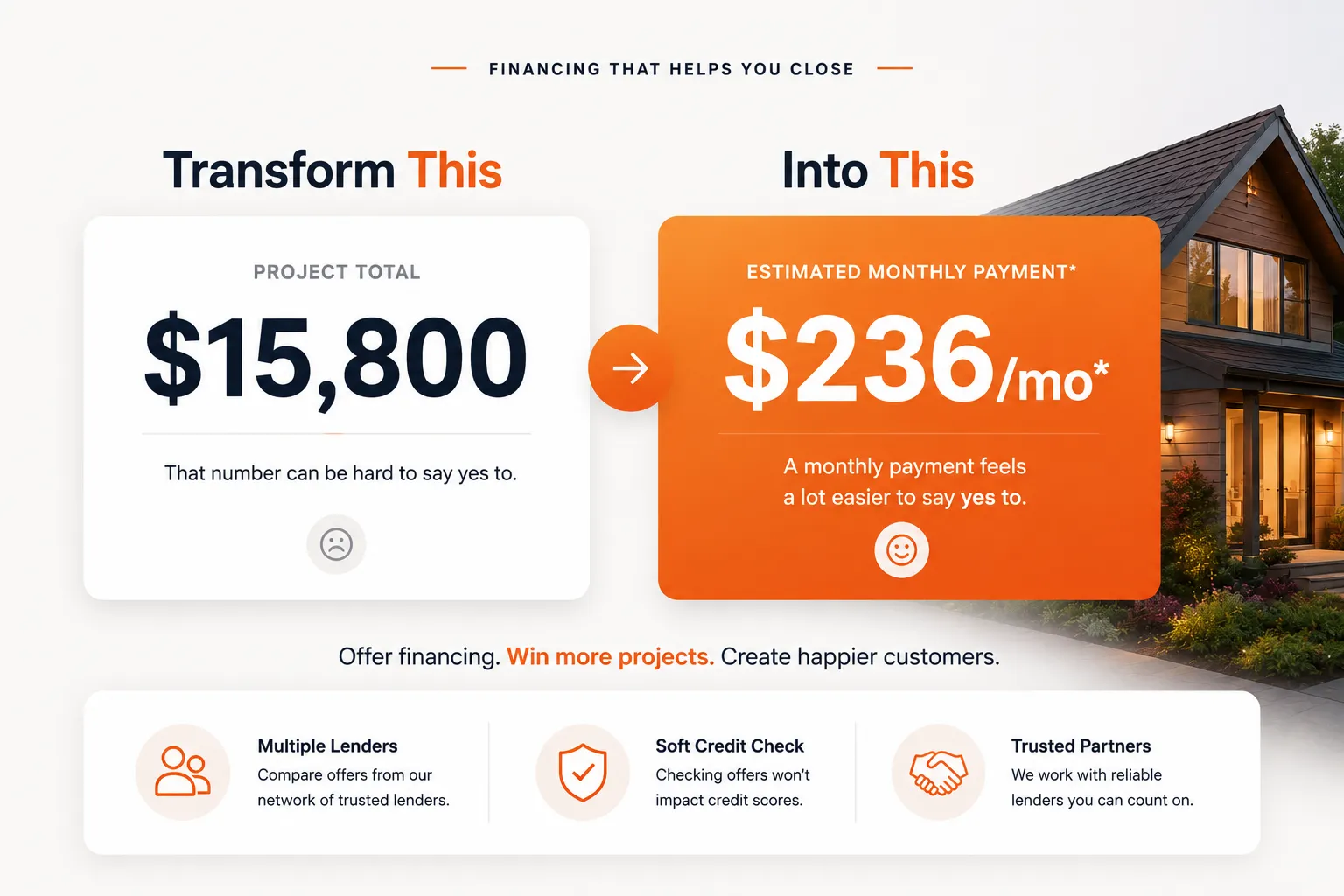
For illustrative purposes only
How Contractor Financing Works
3 steps from estimate
to funded.
Offering financing is simple. Homeowners compare offers from third-party lenders using one simple application, while the lender handles underwriting, funding, servicing, and payment collection.
Why Contractors Partner With Us
A smarter way to offer
customer financing.
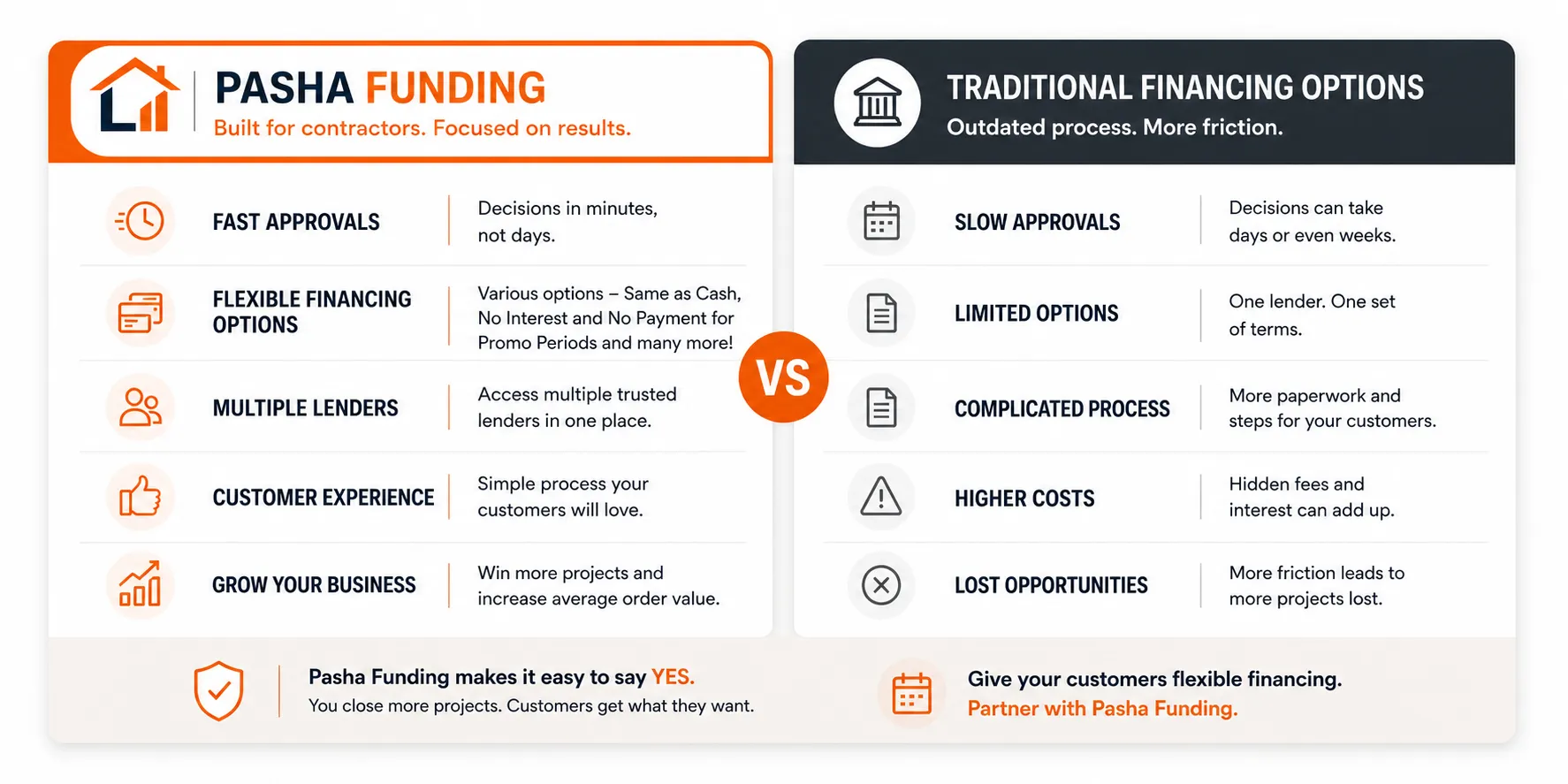
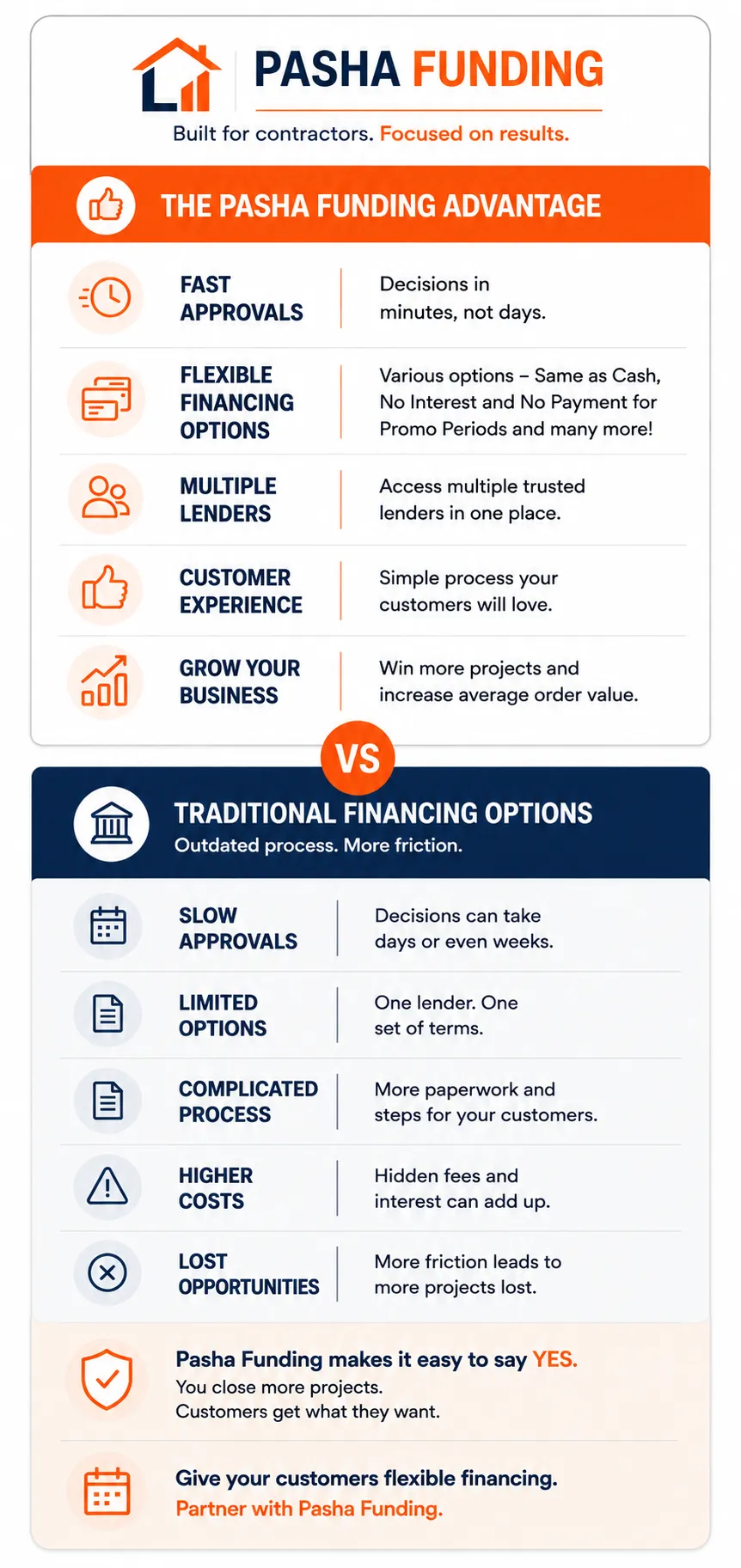
A Smarter Way to Offer Financing
Pasha Funding vs.
traditional programs
Find Home Improvement Contractor Financing for Customers Near You
- Atlanta Contractor Financing
- Austin Contractor Financing
- Boston Contractor Financing
- Charlotte Contractor Financing
- Chicago Contractor Financing
- Cleveland Contractor Financing
- Columbus Contractor Financing
- Connecticut Contractor Financing
- Dallas Contractor Financing
- Denver Contractor Financing
- Detroit Contractor Financing
- Fort Worth Contractor Financing
- Houston Contractor Financing
- Indianapolis Contractor Financing
- Jacksonville Contractor Financing
- Los Angeles Contractor Financing
- Miami Contractor Financing
- Nashville Contractor Financing
- New York City Contractor Financing
- Orlando Contractor Financing
- Philadelphia Contractor Financing
- Phoenix Contractor Financing
- Portland Contractor Financing
- Providence Contractor Financing
- Raleigh Contractor Financing
- Salt Lake City Contractor Financing
- San Antonio Contractor Financing
- San Diego Contractor Financing
- San Jose Contractor Financing
- Seattle Contractor Financing
- St. Paul Contractor Financing
- Tampa Contractor Financing
- Washington Contractor Financing