
Participating Lender Network






Custom Closet & Storage Financing Solutions
Advertising Disclosure
How to Offer Closet and Storage System Financing To your customers
Financing gives qualified homeowners another way to invest in custom closets and storage solutions without paying the entire project cost upfront. But offering financing involves more than placing a monthly payment next to the total price. Closet companies need to understand how the loan is approved, when the contractor gets paid, whether the program charges dealer fees and what happens when the homeowner changes the design after signing.
Those details are important because custom storage systems are built for a specific room and customer. Once panels are cut, drawers are ordered and specialty finishes enter production, cancellation becomes much more expensive than it would be for an off-the-shelf purchase.
Today’s Closet Projects Are Bigger Than Ever
A basic reach-in system may still cost a few thousand dollars. A large walk-in closet with cabinetry, lighting, decorative hardware and enclosed storage can cost far more.
HomeGuide estimates that a custom closet commonly costs about $1,500 to $4,500, including labor and materials, while walk-in systems can range from about $1,000 to $8,000. Brand-specific and luxury projects can reach much higher. Its pricing research places some large walk-in systems at $14,000 or more.
Those averages do not tell the full story. A homeowner may be buying storage for several rooms at once:
- A primary walk-in closet
- Reach-in closets for children or guests
- A pantry system
- Laundry room cabinetry
- Garage cabinets and wall storage
- A home office or media center
- A mudroom or entryway system
- A wall bed with surrounding cabinetry
Bundling these spaces can improve operational efficiency for the installer, but it can also push the total beyond what the homeowner planned to pay in cash. Financing becomes part of the sale because the project has changed from a closet accessory into a broader built-in storage renovation.
Defining the Complete Project Before Discussing Financing
A professionally installed closet price can include design labor, site measurements, renderings, production, freight, installation, project management and warranty support. Premium finishes, doors, lighting and hardware can quickly increase the total.
The proposal may need to account for:
- Removal and disposal of existing shelving
- Wall repairs and painting
- Floor-mounted or wall-mounted construction
- Laminate, veneer, painted or wood finishes
- Drawer boxes, faces and soft-close hardware
- Glass-front doors and enclosed cabinets
- Pull-out hampers, mirrors and jewelry inserts
- Shoe shelving and angled display shelves
- Closet rods, valet rods and accessory hooks
- LED lighting, switches and electrical work
- Crown molding, base trim and filler panels
- Freight, delivery and difficult access
- Permits or building approval when required
That last group of costs is easy to overlook. A company may design and install the cabinetry but exclude painting, flooring, electrical work or wall repair. If the salesperson shows a monthly payment before explaining those exclusions, the homeowner may believe the payment covers the finished room.
Then the electrician, painter or flooring installer submits another bill.
A stronger sales process identifies the complete project first. Show the customer which work is included, which work is optional and which work must be hired separately. Financing should follow the scope. It should not be used to make an incomplete proposal appear affordable.
Agree on the Project Scope Before Discussing Monthly Payments
A monthly payment can make a $15,000 closet feel easier to approve. It can also make the customer pay less attention to the total loan cost.
That creates a disclosure problem and a trust problem. A homeowner comparing “$289 per month” with “$347 per month” may not notice that one offer lasts several years longer or carries thousands of dollars more in interest.
A more effective approach is:
- Confirm the final design and written scope.
- Show the full project price.
- Identify deposits, allowances and excluded work.
- Introduce available ways to pay.
- Let the homeowner review the rate, term, payment and total loan cost.
The Federal Trade Commission tells consumers not to agree to contractor-arranged financing without comparing loan terms and understanding the agreement. A closet company can support that process by making the cash price visible and giving the homeowner time to review the lender’s disclosures. Be sure to check out the FTC’s guidance on home-improvement contracts and financing.
This does not mean a designer must avoid discussing affordability. It means the payment should not replace the price.
Financing Can Change What the Customer Chooses to Build
Homeowners often begin a closet consultation with a rough budget rather than a fixed specification. They may not know the price difference between open shelving and enclosed cabinets, or between a standard drawer bank and a wall of custom storage.
Financing can reduce the immediate pressure of those upgrades. That may allow a customer to choose features they value rather than removing every drawer or accessory to meet a cash limit.
There is a line, though.
The purpose of financing is not to push the homeowner into the most expensive design that produces an approvable payment. A good designer still asks whether the upgrade solves a real problem. A pull-out hamper used every day may be worth keeping. Decorative cabinets above an already tall storage system may add cost while offering little usable space.
Competitors in the closet industry commonly promote interest-free or special financing. Closets by Design currently describes promotional programs that can range from six to 18 months depending on location, while The Container Store advertises financing on qualifying custom-space purchases. These promotions show that financing is already part of the competitive sales environment. They do not mean every customer should use it.
Lock in the Design Before Discussing Financing
Custom closet companies face a problem that many general financing articles miss: the design often changes several times before production.
A homeowner may add drawers after seeing the rendering. A spouse may request another hanging section. A site measurement may reveal an outlet, vent, soffit or access panel that changes the plan. The customer may select a premium finish after initially approving a standard laminate.
Each change can alter the contract price.
Finalize these details before the customer accepts a loan whenever possible:
- Room dimensions and ceiling height
- Wall conditions and obstructions
- Door swing and drawer clearance
- Baseboards and trim treatment
- Floor-mounted or suspended construction
- Finish and edge treatment
- Drawer and door quantities
- Hardware and accessories
- Lighting and electrical responsibility
- Demolition, patching and painting
- Delivery and installation dates
Why does this matter? The lender approves a specific amount. It may not automatically increase the loan when the homeowner adds $3,000 of glass doors and lighting a week later.
Some lenders may allow the borrower to request a higher amount, but that can trigger another review. The customer may not qualify, the available rate may change or the production schedule may be delayed. The written change order should explain how the added work will be paid before materials are ordered.
How Closet and Storage System Financing Usually Works
In most contractor financing arrangements, the homeowner borrows from a third-party lender. The closet company is not lending its own money and does not collect the customer’s monthly payments.
A typical process looks like this:
- The designer completes the consultation and prepares the proposal.
- The homeowner receives a link to check available financing options.
- The lender or lending marketplace collects the customer’s application.
- The homeowner reviews any offers for which they qualify.
- The customer selects an offer and completes the lender’s verification process.
- The loan receives final approval.
- The closet company orders materials and completes the installation according to its contract.
- The lender releases payment after its funding requirements are met.
- The homeowner repays the lender under the loan agreement.
The exact sequence varies. Some lenders send proceeds to the homeowner. Others pay the contractor directly. Some release funds before installation, while others require a completion certificate or customer authorization.
Do not build your operating process around assumptions. Ask the provider what triggers payment and what could delay it.
Prequalification Is Not Final Approval
The word “approved” gets used too loosely during home-improvement sales.
A homeowner may first complete a prequalification process. Depending on the provider, this may use a soft credit inquiry that does not affect the customer’s credit score. Prequalification identifies possible offers based on the information provided. It is not necessarily a commitment to lend.
After the customer selects an offer, the lender may verify identity, income, employment, existing debts and other application information. A hard credit inquiry may occur at this stage. The lender can revise or withdraw an offer if the verified information does not support it.
Contractors should distinguish among four stages:
- Prequalification: The customer checks possible eligibility and offers.
- Application: The homeowner selects a product and submits additional information.
- Final approval: The lender completes underwriting and issues the loan agreement.
- Funding: The lender releases the money after all conditions are met.
A screenshot showing a possible loan amount is not the same as available funds. Do not order nonreturnable materials solely because a customer says the application was approved.
How Lenders Actually Decide Whether a Homeowner Qualifies
There is no single credit score that guarantees approval for a custom closet loan. Each lender uses its own underwriting criteria.
Factors may include:
- Credit score and payment history
- Income and employment
- Monthly housing expenses
- Credit card, auto and student-loan payments
- Requested loan amount
- Repayment term
- Recent applications for credit
- Bankruptcy, collections or late payments
- Whether the application information can be verified
A customer with strong credit may still receive less than requested if existing monthly obligations are high. Another applicant may qualify for the full project but receive a higher annual percentage rate or shorter term.
The designer should not predict approval. Statements such as “everyone qualifies,” “your score is good enough” or “this won’t affect your credit” can create problems if they are not accurate.
Order Custom Materials Only After Funding Requirements Are Clear
Unlike many remodeling projects, custom closet systems often cannot be returned once manufacturing begins.
Panels are cut to specific dimensions. Drawer fronts are matched to selected finishes. Specialty hardware and glass doors may be ordered specifically for one homeowner.
That makes timing especially important.
Before releasing a production order, confirm:
- The homeowner has accepted the final design.
- The contract amount matches the approved financing.
- Required deposits have been received if applicable.
- The lender’s funding requirements are understood.
- Any cancellation period has expired if required.
- Measurements have been verified.
One mistake many financing articles overlook is that “approved” does not always mean the contractor has been paid. Some lenders require signed completion documents before releasing funds. Others fund shortly after final loan execution. Understanding that timeline protects both your schedule and your cash flow.
Don’t Let Monthly Payments Become the Entire Sales Conversation
Monthly payments help customers understand affordability.
They should never replace a discussion about value.
A homeowner choosing between two closet companies should understand:
- Material quality
- Cabinet construction
- Hardware durability
- Warranty coverage
- Installation experience
- Service after installation
- Total project cost
- Total borrowing cost if financing is used
Leading with a payment alone encourages shoppers to compare financing instead of comparing companies.
That often turns a design consultation into a price negotiation.
Know When Financing Is Probably the Wrong Solution
Financing is a useful tool.
It is not appropriate for every customer.
Be cautious if:
- The homeowner cannot explain how they plan to repay the loan.
- The customer only wants the lowest monthly payment regardless of total cost.
- The project scope is still changing substantially.
- The design has not been finalized.
- The financing fee would eliminate too much profit.
- The customer appears confused about loan terms.
- The salesperson feels pressure to complete the application for the homeowner.
Sometimes waiting a few months, completing one room at a time or reducing optional upgrades produces a better outcome than financing the largest possible project.
Help More Homeowners Offer Financing for Custom Storage Solutions
Pasha Funding helps custom closet and storage system companies offer customer financing without becoming the lender, collecting monthly payments or managing loan servicing. Simply share your personalized financing link by text message, email or alongside your proposal. Homeowners can complete a secure application in just minutes and compare loan offers from multiple trusted lending partners instead of relying on a single financing source.
If you’re ready to make financing part of your sales process, Pasha Funding can help you get started. Schedule a free demo to see how our platform works, learn how to share financing with your customers, and discover how offering flexible payment options can help you close more custom closet projects and increase your average job size.
More contractor financing solutions by project type:
- Accessory Dwelling Unit Contractor Financing
- Artificial Grass & Turf Financing for Contractors
- Bathroom Remodel Contractor Financing
- Custom Closet & Storage Financing for Customers
- Concrete Contractor Financing
- Decks & Patio Financing for Contractors
- Contractor Financing for Electric Services
- Contract Financing for Flooring Contractors
- Gutter Contractor Financing Options
- Garage Door Contractor Financing
- HVAC Financing Solutions for Contractors
- Insulation Contractor Financing for Customers
- Contractor Financing for Landscaping Businesses
- Kitchen Remodel Contractor Financing
- Masonry Contractor Financing
- Financing Options for Plumbing Contractors
- Contractor Financing for Painters
- Roofing Contractor Financing
- Solar Contractor Financing
- Swimming Pool Contractor Financing
- Siding & Exterior Contractor Financing
- Fencing Contractor Financing Options
- Windows & Doors Contractor Financing
- Window Blinds & Shades Financing for Customers
In this guide

For illustrative purposes only
How Contractor Financing Works
3 steps from estimate
to funded.
Offering financing is simple. Homeowners compare offers from third-party lenders using one simple application, while the lender handles underwriting, funding, servicing, and payment collection.
Why Contractors Partner With Us
A smarter way to offer
customer financing.
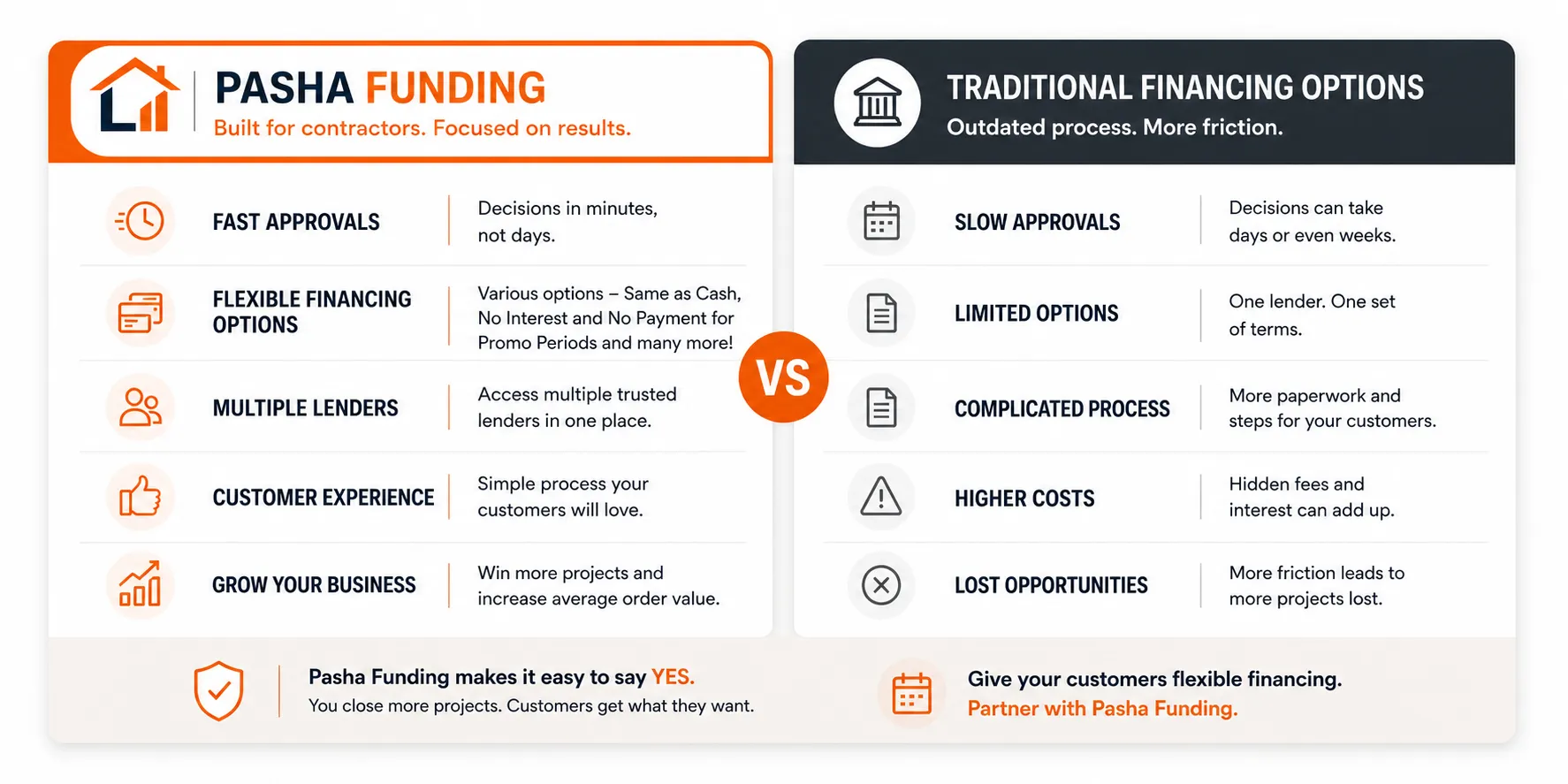
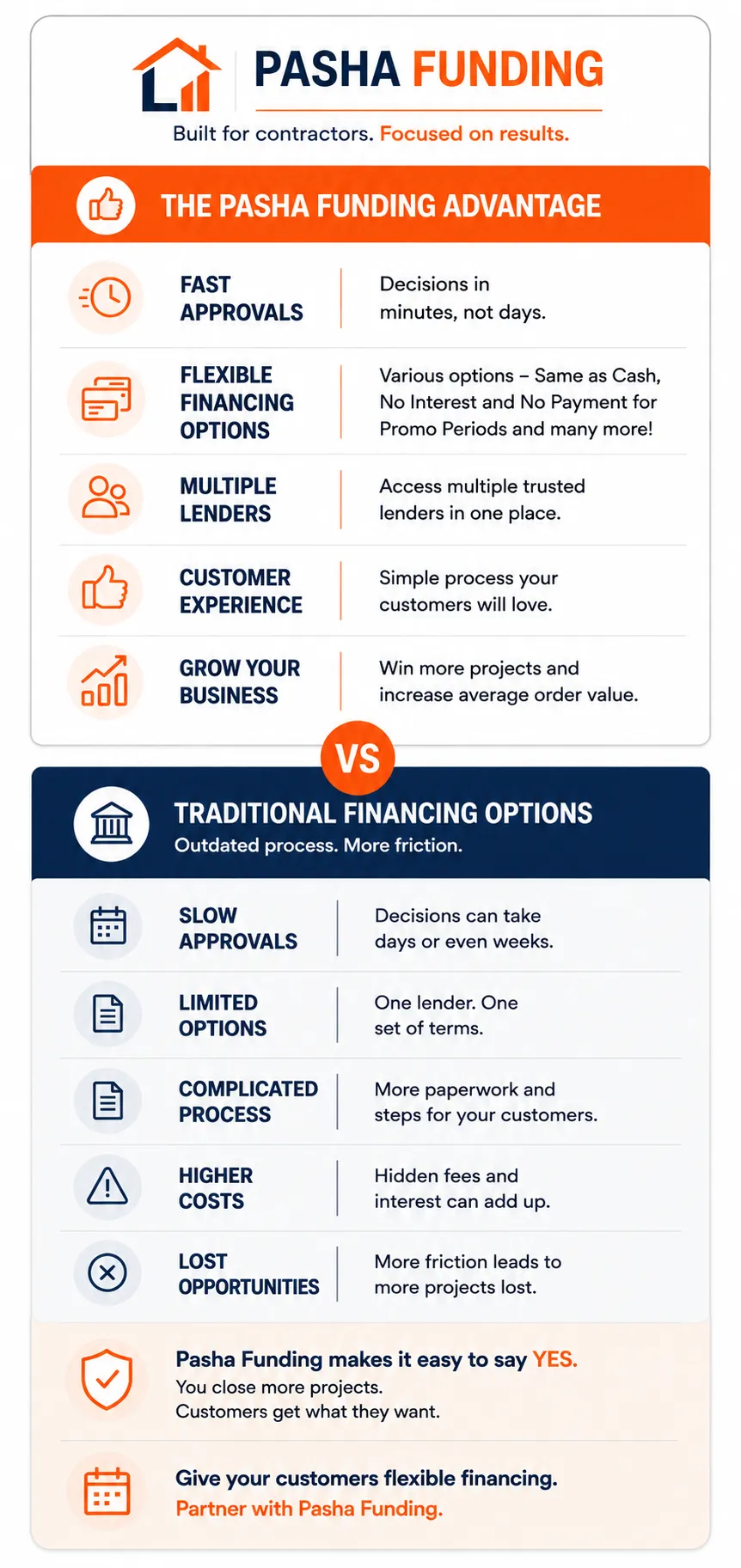
A Smarter Way to Offer Financing
Pasha Funding vs.
traditional programs
Find Home Improvement Contractor Financing for Customers Near You
- Atlanta Contractor Financing
- Austin Contractor Financing
- Boston Contractor Financing
- Charlotte Contractor Financing
- Chicago Contractor Financing
- Cleveland Contractor Financing
- Columbus Contractor Financing
- Connecticut Contractor Financing
- Dallas Contractor Financing
- Denver Contractor Financing
- Detroit Contractor Financing
- Fort Worth Contractor Financing
- Houston Contractor Financing
- Indianapolis Contractor Financing
- Jacksonville Contractor Financing
- Los Angeles Contractor Financing
- Miami Contractor Financing
- Nashville Contractor Financing
- New York City Contractor Financing
- Orlando Contractor Financing
- Philadelphia Contractor Financing
- Phoenix Contractor Financing
- Portland Contractor Financing
- Providence Contractor Financing
- Raleigh Contractor Financing
- Salt Lake City Contractor Financing
- San Antonio Contractor Financing
- San Diego Contractor Financing
- San Jose Contractor Financing
- Seattle Contractor Financing
- St. Paul Contractor Financing
- Tampa Contractor Financing
- Washington Contractor Financing