

Participating Lender Network





How to Finance a New Fence
Installing a fence runs anywhere from about $2,000 to $12,000 for a standard 150-foot boundary, depending mostly on the material you choose. The final number, though, rests on more than chain link versus vinyl: property lines, local building codes, and whether your neighbor shares the expense all move it. Because the total swings so much with length and site prep, the right way to pay does too. A small repair or a short run fits comfortably on a credit card, while a full-yard replacement is usually best handled with a personal loan, a home equity loan, or a HELOC.
Key Takeaways
- Fencing runs roughly $10 to $60 per linear foot installed, so a typical backyard lands between $2,000 and $12,000 depending on material.
- Chain link is cheapest, followed by wood, then aluminum and vinyl, with wrought iron and composite at the top.
- A personal loan suits most fence projects: it funds fast, needs no equity, and works for any material.
- Confirm your property line with a survey before building, since a fence over the line can have to come down.
- In many states, a neighbor who shares a boundary fence can be asked to split the cost, which lowers what you finance.
- Fences over six feet usually need a permit, and pool fences must meet strict safety codes.
What Does a Fence Cost by Material?
Material sets the price more than anything else, and the range is wide. Installed costs run from about $10 per linear foot for chain link to $60 or more for vinyl, composite, or wrought iron. Here is how the common choices compare for a standard backyard.
What 150 Feet of Fence Costs by Material
Typical installed cost range for a standard backyard.
Bar length reflects the top of each range. Figures from HomeGuide and Angi.
A few things move these numbers. Gates are usually priced separately and add $150 to $3,000 depending on size and material, tearing out an old fence runs $3 to $5 per linear foot, and rocky or sloped ground raises labor by 20% to 40%. Height matters too, since a six-foot privacy fence costs more than a four-foot one. It is also worth thinking past the install: a wood fence is cheaper upfront but needs staining and board replacement every few years, while vinyl and aluminum cost more at first and ask almost nothing after, so the cheaper fence today is not always the cheaper fence over twenty years. Prices vary by region as well, with labor rates in high-cost metros pushing quotes above these ranges.
Before You Build: Property Lines, Neighbors, and Who Pays
Fence projects are unique because they often involve your neighbors. Addressing property lines and shared boundaries early can help you avoid unexpected costs, delays, and legal disputes. Confirm exactly where your property line runs before you build, and find out whether your neighbor can be asked to share the cost.
Building even a few inches over the boundary can force you to move or remove the fence later, so a boundary survey, or at least a check of your plat and existing markers, is worth doing before a post goes in. The neighbor question can work in your favor: many states have “good neighbor” fence laws under which an adjoining owner who benefits from a shared boundary fence can be required to contribute to its cost and upkeep. Where that applies, a conversation and a written agreement before you build can cut your share of the bill, sometimes in half, which changes how much you need to finance. Even where the law does not compel it, neighbors often split a boundary fence willingly. Two customs are worth settling up front: the finished side of a fence traditionally faces outward toward the neighbor, and both parties should agree on the line and the design in writing to avoid a dispute later.
How Do You Finance a Fence?
Most fence projects fall in a cost range where a few financing options fit, and the best one depends on the size of the job and whether you have equity.
Personal Loans
For a typical fence, a personal loan is often the cleanest fit. It delivers a fixed amount in a few days, carries no lien on your home, and works with any contractor or material, which suits a project that is usually too small to justify borrowing against your house. The rate is higher than a home-secured loan because nothing backs it, and terms generally run two to seven years.
Home Equity Loans and HELOCs
For a long run of premium fencing, wrought iron around a large property, say, or a fence bundled into a bigger landscaping project, borrowing against your equity can lower the rate. The trade-offs are closing costs, a few weeks to fund, and your home as collateral, which is more process than a modest fence needs but reasonable for a larger spend.
Contractor Financing
Many fence companies offer financing at the point of sale, sometimes with a promotional 0% window. It is convenient and quick, but the terms come from a seller with a stake in the deal, and a “0%” offer can hide deferred interest, so compare it against an outside loan first.
Credit Cards and Cash
A short run of chain link or a small repair can go on a 0% introductory card and be cleared before interest starts. Paying cash, where you can, avoids financing costs entirely.
Do You Need a Permit or HOA Approval for a Fence?
Often, and the rules get strict around pools. Most areas require a permit for fences over six feet, and a fence enclosing a pool must meet specific safety codes that are not optional.
Local zoning sets height limits, which are commonly lower for front yards than back, and taller fences usually trigger a permit. If you belong to a homeowners association, its rules can dictate material, color, height, and placement, and its sign-off is separate from the city’s. Pool fences are their own category. The Consumer Product Safety Commission’s residential pool barrier guidelines call for a fence at least 48 inches high, with no gaps a small child could squeeze through and a self-closing, self-latching gate that swings away from the pool, and many states write these rules into law. A pool fence is a safety requirement rather than a discretionary upgrade, so if yours is the reason for the project, treat it as a need and confirm the exact local code before you build. Check permit and HOA requirements with your local building department first, and budget the permit fee, generally $50 to $500, into the amount you finance.
Does Homeowners Insurance Cover Fence Damage?
Sometimes, depending on what caused the damage. A fence is covered under the “other structures” part of a standard HO-3 policy, which pays for any cause of loss except those the policy excludes.
Your fence sits under Coverage B, other structures, typically insured up to about 10% of your dwelling limit. Because the policy is open-perils for that coverage, a fence flattened by a windstorm, a fallen tree, or a car is generally covered, minus your deductible. What is not covered is the slow stuff: rot, rust, insect damage, and simple age all fall under wear and tear, which every policy excludes. So a storm-wrecked fence may be a claim, while a fence that has quietly reached the end of its life is yours to replace. If a sudden, covered event is the cause, document it before filing, and weigh the repair cost against your deductible.
Can You Finance a Fence With Bad Credit?
A lower credit score raises the cost of a fence loan but rarely blocks it, especially for a smaller project. Expect a higher rate and a lower limit, so check that the payment fits your budget, and consider whether a more affordable material keeps the whole thing manageable.
Credit unions and community banks are frequently the most flexible traditional lenders, and prequalifying through an online marketplace lets you see genuine offers with only a soft credit check. A cosigner with stronger credit can bring the rate down. Choosing chain link or wood over vinyl or wrought iron, or splitting a boundary fence’s cost with a neighbor, also shrinks the amount you need to borrow, which can make approval easier and the payment lighter.
How Do You Qualify for Fence Financing?
Lenders weigh your credit, your income against your debts, and, for a secured loan, your equity. With a fence, though, a little groundwork about the property comes first, because it changes how much you actually need to borrow. Here is the order that works best:
- Settle the property questions first. Confirm your property line, ask whether a neighbor will share a boundary fence’s cost, and check permit and HOA rules, so you finance the real amount rather than the full quote.
- Get itemized bids. Have a couple of contractors break out posts, panels, gates, old-fence removal, and permit fees as separate lines, which makes the quotes comparable and easier to trim.
- Check your credit and debt load. Review your credit report for errors and total your monthly debts, since most lenders want your total debt, including the new payment, at or below about 43% of your gross income.
- Prequalify with a few lenders. Use a soft credit check to compare two or three real offers without denting your score, and judge them on total cost over the full term rather than the monthly payment.
| Financing Path | Best For | Funding Speed |
|---|---|---|
| Personal loan | Most standard fence projects | 1 to 5 days |
| Home equity / HELOC | Long or premium fence runs | 2 to 6 weeks |
| 0% credit card | Small runs or repairs | Immediate |
Match the financing to the size of the job: a short, inexpensive fence is a good fit for an unsecured loan or a card, while a long or premium run is where borrowing against your home starts to pay off through a lower rate.
The Bottom Line
For most fences, a personal loan is the practical way to pay: it funds quickly, needs no equity, and fits the mid-range cost of a typical project. A long run of premium fencing can justify a home equity loan or HELOC, and a small repair or a short run often fits on a 0% card. If the fence is really about pool safety or securing the yard, treat it as a need and move promptly, since the code requirements are not optional.
Before you borrow, two steps can lower the bill: confirm your property line and ask whether a neighbor will share the cost of a boundary fence, which can cut what you finance, and get itemized bids that separate posts, gates, removal, and permits so you can compare them and trim the scope where it makes sense.
The information provided by Pasha Funding is for educational and informational purposes only and should not be considered financial, legal, or tax advice. Every homeowner’s financial situation is different, and the financing options discussed may not be suitable for everyone. Before choosing a financing solution, carefully review the lender’s terms and consider consulting a qualified financial professional if needed.
Pasha Funding is a financing marketplace that connects homeowners with financing options offered by participating lending partners. We do not make loans, determine credit eligibility, or guarantee approval or specific loan terms. Pasha Funding is not a direct lender. We may receive compensation from participating lending partners when users submit an application or obtain a loan through our platform. This compensation may affect how and where financing options appear, but it does not influence our editorial evaluations.
Financing offers, rates, terms, and availability are determined solely by participating lenders and may change without notice. Our editorial content is created independently to help consumers better understand home improvement financing. While we strive to keep information accurate and current, financing products, lender requirements, rates, and offers may change over time. Any opinions expressed are those of the author and have not been reviewed, approved, or endorsed by our lending partners.


Frequently Asked Questions
In this guide
- What Does a Fence Cost by Material?
- Before You Build: Property Lines, Neighbors, and Who Pays
- How Do You Finance a Fence?
- Do You Need a Permit or HOA Approval for a Fence?
- Does Homeowners Insurance Cover Fence Damage?
- Can You Finance a Fence With Bad Credit?
- How Do You Qualify for Fence Financing?
- The Bottom Line
how it works
3 Simple steps to
finance your project.
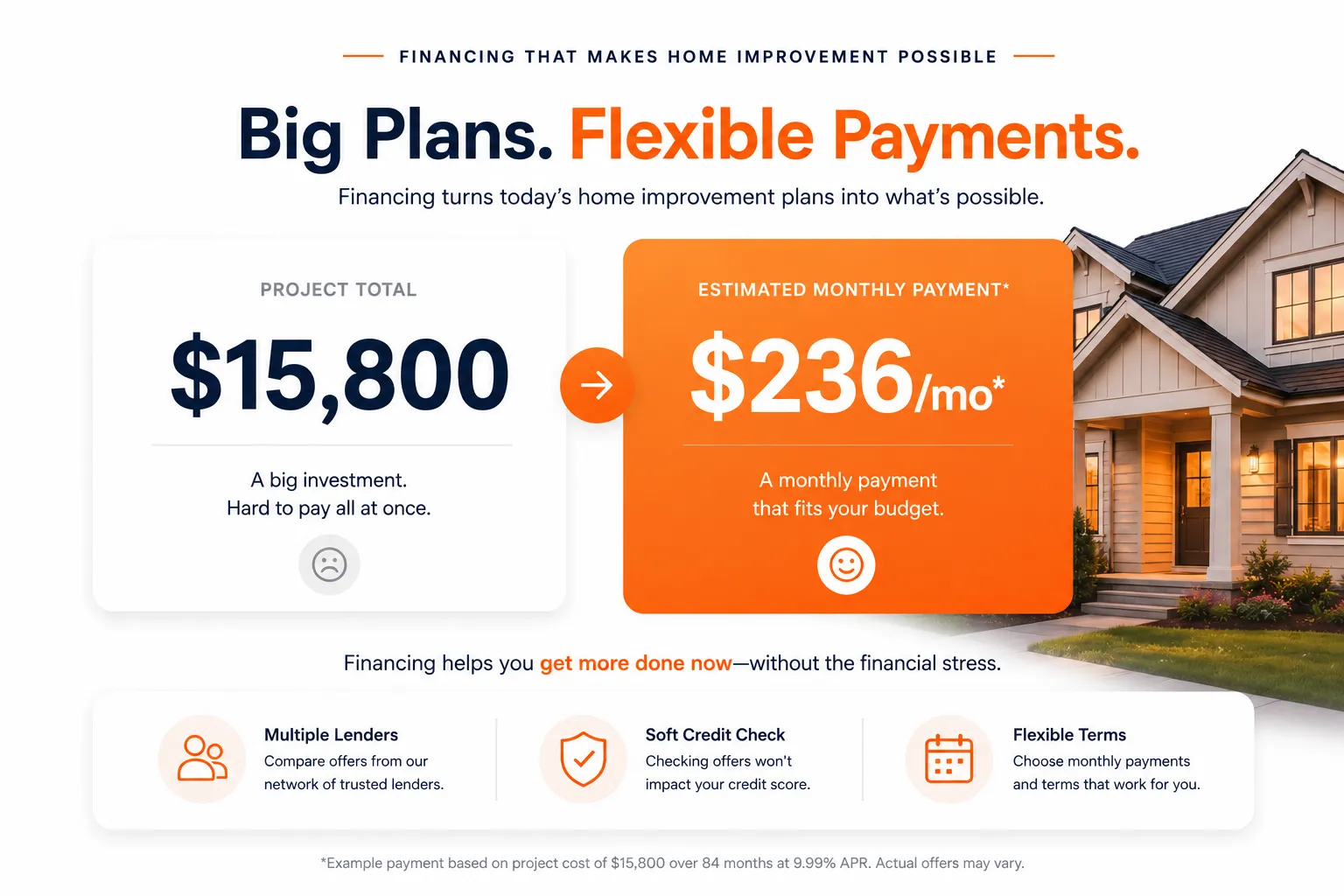
Getting started only takes a minute. Complete one simple application to compare available financing offers from over 18+ lenders, choose the option that fits your budget, and move forward with your home improvement project.
Fence Financing Calculator
1. Enter Your Desired Loan Amount
Your Estimate
Monthly Payment
-
This calculator provides estimates for illustrative purposes only and does not constitute an offer of credit or a commitment to lend. Final APRs, loan amounts, and terms depend on credit approval, income verification, and lender underwriting criteria. Minimum and maximum rates/terms vary by state.
Powered by: Pasha Funding
Risk-Free Prequalification
Checking offers won’t impact your credit.
It’s common for homeowners to delay applying because they’re worried about their credit score. With a soft credit check, you can review available financing options without any impact to your credit score.2