

Participating Lender Network





How to Finance Landscaping Projects
Landscaping is rarely one project. It is usually a mix of hardscaping, new plants, irrigation, and lighting, often spread across several seasons or even years. How you pay should follow that. A full backyard redesign and a modest bed refresh are very different things to borrow for. The common ways to pay are a personal loan, a home equity loan or HELOC, contractor financing, or a credit card for smaller work. Projects range from around $1,200 to $6,000 for a typical yard up to $40,000 or more for a complete transformation. The best fit depends on the scale, your credit, and whether the work happens all at once or in stages.
Key Takeaways
- Landscaping ranges from about $1,200 to $6,000 for a typical yard to $40,000 or more for a full redesign.
- Because most landscaping is discretionary, the guiding question is whether the payment fits your budget, not just whether you can get approved.
- A personal loan works well for a defined, all-at-once project, while a HELOC suits work you plan to phase over seasons.
- The landscaping that recovers the most cost at resale tends to be basic lawn care and simple upgrades, not expensive custom features.
- Home equity interest is only tax deductible when the work substantially improves the home, which most planting does not.
- Drainage and grading problems are the exception to “it can wait,” since standing water can damage your home.
What Landscaping Projects Do Homeowners Finance?
A yard breaks down into three layers, and most financed projects combine them. Each one carries a different price tag and lifespan.
Hardscape
The built elements (patios, walkways, retaining walls, decks, outdoor kitchens, fire features, and fencing) are the most expensive part of most yards and the most permanent. They also make up the bulk of a large financed project.
Softscape and Planting
The living layer (lawn and sod, trees and shrubs, garden beds, and mulch) costs less per project but is where a yard gets its personality and curb appeal. Plants also mature over time, so spending here rewards patience.
Systems
The working parts (irrigation and sprinklers, drainage and grading, and low-voltage lighting) are easy to overlook but often the most practical. Drainage in particular can cross from nice-to-have into necessary when water is pooling near the house.
How Much Does Landscaping Cost?
Pricing tracks the three layers closely, with planting at the low end, systems in the middle, and hardscape driving the big numbers. A common rule of thumb is $4 to $12 per square foot for installed work, though a full redesign is quoted as a whole. Here is roughly where the pieces land.
What Landscaping Projects Cost
Typical installed cost range by project type.
Bar length reflects the top of each range. Figures drawn from the NAR and NALP Remodeling Impact Report and HomeGuide.
The size of your yard, the materials, and how much grading or demolition the site needs all drive up the total. Hardscape materials vary widely in cost: natural stone and pavers run far more than poured concrete or a simple deck, and mature trees and larger plants cost more than young ones that fill in over time. Local labor rates matter too, so a quote in a high-cost metro can run well above these national ranges, especially for labor-heavy hardscape. If the budget feels steep, the three layers are easy places to cut back or postpone without giving up the whole plan.
How Do You Pay for Landscaping?
Landscaping does not have a dedicated loan of its own, so a “landscaping loan” is really one of a few general financing tools put toward your yard. Here is how they compare.
Personal Loans
A personal loan hands you a fixed sum up front and lets you use any contractor you like, with no collateral required. That makes it a comfortable fit for a discretionary project where you would rather not risk your home. Funding is quick, usually within a week, and the fixed monthly payment makes a yard project easy to budget. The rate runs higher than a home-equity option because nothing secures it, so a personal loan works best for a clearly defined, all-at-once job rather than an open-ended one.
Home Equity Loans and HELOCs
Borrowing against your equity usually brings the lowest rate, and a HELOC adds something a personal loan cannot: the ability to draw funds as you go. For landscaping that unfolds across seasons, that matters: you pay interest only on what you have actually drawn, not the whole approved amount. The trade-offs are closing costs, a longer setup, and your home as collateral, which involves more friction and paperwork than a small planting job warrants but suits a large or multi-year plan well.
Contractor Financing
Plenty of landscape companies arrange financing through a lending partner, and you will usually see the offer once the design and estimate are done. It is convenient, but the terms are set by a business with an interest in closing the sale, and a promotional rate may hide deferred interest, so it is worth holding the offer up against an outside loan.
Credit Cards and Saving Ahead
For a modest planting or a single weekend project, a card, ideally one with a real 0% introductory window you can clear in time, can be the simplest route. And since landscaping rarely has to happen all at once, saving toward a phase and financing less of it is often the cheapest approach of all.
How Should You Finance a Phased or Seasonal Project?
Most yards are not built in a weekend, and that affects how you should borrow. When a project naturally spreads across seasons or years, a revolving line or a save-as-you-go approach usually beats borrowing the whole vision at once.
Consider a plan with a patio built this fall, planting and irrigation next spring, and lighting the year after. Financing the entire amount upfront with a lump-sum loan means paying interest from day one on money for work that is still two seasons away. A HELOC avoids that by letting you draw for each phase as it happens, so interest accrues only on what you have spent. Alternatively, treating the phases as separate, smaller purchases, some saved for, some financed briefly, keeps the borrowed balance low throughout. Timing helps too: landscapers are often busiest and priciest in spring and early summer, so scheduling a phase for the shoulder seasons can mean better availability and, sometimes, better pricing. The goal is to match your borrowing schedule to your construction timeline rather than paying to hold money you will not use for a while.
What If the Landscaping Is a Drainage or Water Problem?
Not all landscaping is optional. When the real issue is water pooling near the foundation, a soggy yard, or a slope washing out, the work is a repair, and it should be financed like one: promptly, not phased over years.
Poor grading, a failed drainage line, or a yard that channels rain toward the house can lead to foundation damage, basement seepage, and mold, problems that cost far more to fix than the regrading or drainage work that prevents them. So the calculus flips. Where a decorative patio can wait for a 0% card or a saved-up phase, a drainage fix usually should not, which makes a fast-funding personal loan a natural fit when you lack the cash on hand. If the job is large, tied to foundation work, or part of a broader repair, a home equity loan or HELOC can lower the rate. The key is to separate the urgent, protective part of a project from the cosmetic part, and to treat the water problem with the seriousness of any home repair rather than folding it into a slow, nice-to-have timeline.
Does Landscaping Add Home Value, and Should That Affect How Much You Borrow?
Landscaping does add value, but not evenly, and that should shape how much you finance. The projects that recover the most at resale are generally the least expensive ones, while the big custom features return the least.
According to the National Association of Realtors’ Remodeling Impact Report on outdoor features, everyday lawn care and standard maintenance recover essentially all of their cost or more, and a modest overall landscape upgrade tends to recoup close to its full price. Large personalized features (an outdoor fireplace, elaborate lighting, an in-ground pool) recover a much smaller share, because the next buyer may not share your taste for them. Overall, well-planned landscaping is often credited with lifting a home’s value in the range of 5% to 15%. The takeaway: if resale return influences your decision, the case for financing is strongest on the foundational work and weakest on the expensive custom touches. Those are better treated as things you buy for your own enjoyment, and budget for accordingly, rather than as investments.
There is also a tax angle people often misread. Interest on a home equity loan or HELOC is deductible only when the funds substantially improve the home that secures the loan, which the IRS defines as work that adds value, prolongs the home’s life, or adapts it to new use. Some hardscape can meet that bar (a new driveway, for example), but routine planting and lawn work generally do not, and personal loan interest is never deductible. Because the line is specific to what you build and how you spend, confirm your situation with a tax professional rather than assuming a yard project qualifies.
Can You Finance Landscaping With Bad Credit?
A lower credit score does not close the door on landscaping financing, but it does raise the cost. Expect a higher rate and a smaller loan, so before you sign, check that the monthly payment actually fits your budget. Because the project is optional, there is no reason to rush into an expensive loan.
Credit unions and community banks tend to be the most accommodating traditional lenders, and prequalifying through an online marketplace lets you see real offers with only a soft credit check, no score damage while you compare. A cosigner with stronger credit can improve your rate, and a secured home-equity option may be reachable even with weaker credit, though it puts your home behind the loan. There is also a real advantage to landscaping that most projects do not have: it can usually wait. If your credit is weak and the yard is not urgent, spending a few months rebuilding your score and then borrowing on better terms can save you more than any single offer will.
How Do You Qualify for Landscaping Financing?
Lenders look at the usual things: your credit, your income against your existing debts, and, for a secured loan, your equity. Because the project is optional, you have time to prepare instead of scrambling. A few steps help.
- Nail down the design and a written quote.
A clear scope, ideally broken into phases, tells you how much you actually need to borrow and when, so you are not financing a vague “dream yard” figure. It also lets you compare contractor bids on equal footing.
- Know your numbers before you apply.
Review your credit report for errors, and add up your monthly debts against your income. Most lenders prefer your total debt-to-income ratio, including the new payment, to stay below about 43%. Paying down a card balance first can nudge your rate down.
- Shop offers with soft pulls.
Prequalify with several lenders to compare real rates without denting your score, and weigh any contractor financing against them. Judge offers on the total repaid across the full term, not the size of the monthly payment.
| Financing Path | Best For | Typical Credit |
|---|---|---|
| Personal loan | A defined, all-at-once project | 580 to 640 and up |
| HELOC / home equity | Large or phased work | 620 to 680+ |
| 0% credit card | Small jobs repaid quickly | Good to excellent |
These ranges are starting points, not hard lines, and every lender weighs its own criteria. In short, an unsecured loan costs a bit more but is faster and simpler, while a home-equity option asks for more paperwork in exchange for a lower rate and the freedom to phase the work.
The Bottom Line
With landscaping, the financing question is less about which loan is cheapest and more about matching the borrowing to a project that is usually optional and often gradual. A personal loan is a clean fit for a defined job you want done at once; a HELOC makes more sense for large or multi-season work, since you draw as you go; a card or simply saving toward a phase can be the most economical route for smaller pieces. And if the real problem is drainage or water pooling near the house, treat it as a repair, not a home-improvement project you can put off.
Before you borrow, a couple of simple steps can help keep the cost in check: settle on a design broken into phases so you finance only what you need when you need it, and prequalify with a few lenders to compare the total cost rather than the monthly payment, keeping in mind that the most budget-friendly plan is often to borrow for less of the yard than you first imagined.
More outdoor resources:
The information provided by Pasha Funding is for educational and informational purposes only and should not be considered financial, legal, or tax advice. Every homeowner’s financial situation is different, and the financing options discussed may not be suitable for everyone. Before choosing a financing solution, carefully review the lender’s terms and consider consulting a qualified financial professional if needed.
Pasha Funding is a financing marketplace that connects homeowners with financing options offered by participating lending partners. We do not make loans, determine credit eligibility, or guarantee approval or specific loan terms. Pasha Funding is not a direct lender. We may receive compensation from participating lending partners when users submit an application or obtain a loan through our platform. This compensation may affect how and where financing options appear, but it does not influence our editorial evaluations.
Financing offers, rates, terms, and availability are determined solely by participating lenders and may change without notice. Our editorial content is created independently to help consumers better understand home improvement financing. While we strive to keep information accurate and current, financing products, lender requirements, rates, and offers may change over time. Any opinions expressed are those of the author and have not been reviewed, approved, or endorsed by our lending partners.


Frequently Asked Questions
In this guide
- What Landscaping Projects Do Homeowners Finance?
- How Much Does Landscaping Cost?
- How Do You Pay for Landscaping?
- How Should You Finance a Phased or Seasonal Project?
- What If the Landscaping Is a Drainage or Water Problem?
- Does Landscaping Add Home Value, and Should That Affect How Much You Borrow?
- Can You Finance Landscaping With Bad Credit?
- How Do You Qualify for Landscaping Financing?
- The Bottom Line
how it works
3 Simple steps to
finance your project.
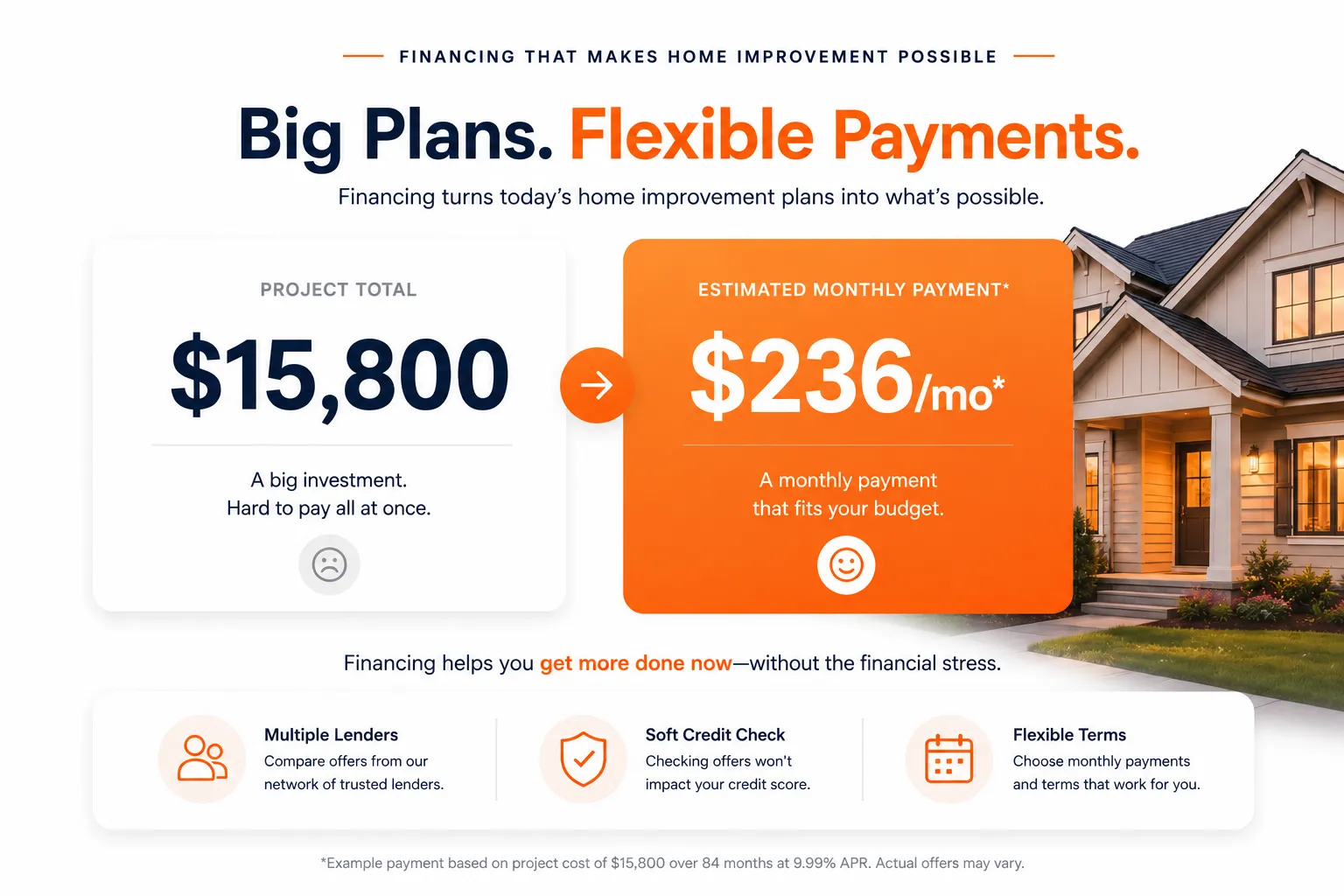
Getting started only takes a minute. Complete one simple application to compare available financing offers from over 18+ lenders, choose the option that fits your budget, and move forward with your home improvement project.
Landscaping Financing Calculator
1. Enter Your Desired Loan Amount
Your Estimate
Monthly Payment
-
This calculator provides estimates for illustrative purposes only and does not constitute an offer of credit or a commitment to lend. Final APRs, loan amounts, and terms depend on credit approval, income verification, and lender underwriting criteria. Minimum and maximum rates/terms vary by state.
Powered by: Pasha Funding
Risk-Free Prequalification
Checking offers won’t impact your credit.
It’s common for homeowners to delay applying because they’re worried about their credit score. With a soft credit check, you can review available financing options without any impact to your credit score.2