
Participating Lender Network





How to Finance Fire & Smoke Restoration Projects
Fire damage restoration costs about $3,000 to $52,000 for most projects and reaches six figures for a severe structural loss, but here’s what sets fire apart from most home repairs: it’s a covered peril under virtually every homeowners policy, so insurance usually pays the bulk of it, and your real financing question is how to cover the deductible and any gap between what the policy pays and what the rebuild actually costs.
Key Takeaways
- Fire is a covered peril on nearly every homeowners policy, so insurance usually pays the majority, and your out-of-pocket is typically the deductible unless damage exceeds your limits.
- Cost tracks severity: light smoke cleanup can run under $10,000, a room-level fire $8,000 to $25,000, and a major structural fire $51,000 into six figures.
- The gap that catches people is replacement cost vs. actual cash value: an ACV policy pays depreciated value, leaving a shortfall you may need to finance.
- Additional living expenses (ALE) coverage pays for temporary housing while the home is uninhabitable, so factor that into your cash-flow plan.
- A personal loan or HELOC often bridges the timing gap between paying contractors and the insurance checks arriving, or covers the deductible and any uncovered amount.
- Smoke and soot cleanup alone can be 30% to 50% of the total, and hidden smoke in HVAC and insulation is what pushes a mid-range job higher.
Does Homeowners Insurance Cover Fire Damage?
Yes, and this is the defining fact of financing a fire loss. Fire and smoke damage are covered perils on essentially every standard homeowners and renters policy, so cleanup, drying, deodorizing, and rebuilding are generally part of the claim, and your out-of-pocket is typically limited to the deductible unless the damage exceeds your coverage limits.
That covered status shifts the financing question away from “how do I pay for all of this” toward three narrower issues:
- Replacement cost vs. actual cash value: an RCV policy pays what it costs to rebuild with new materials; an ACV policy subtracts depreciation first and pays the depreciated value, which can leave a five-figure shortfall on a big loss. Check your declarations page for which one you have.
- Recoverable depreciation: RCV policies often pay in two checks, the depreciated value first, then the rest once you complete repairs and submit receipts. That means you may have to front repair costs before the second check arrives.
- Coverage limits: a severe fire can exceed your dwelling limit, especially if code upgrades are required during the rebuild. Anything above the limit is yours.
- Ordinance or law coverage: a standard policy pays to rebuild what was there before, but if current codes now require upgraded wiring, arc-fault breakers, or fire sprinklers, you need an ordinance or law endorsement to cover those mandatory upgrades. Without it, the code-required work is out of pocket. The endorsement (commonly 10% to 50% of your dwelling limit) runs only about $50 to $80 a year.
For a large or complex loss, especially a six-figure structural fire, you can hire an independent, licensed public adjuster who works only for you, not the insurer, to document and negotiate the scope of loss. They typically charge 5% to 15% of the settlement, which can be worth it when the covered amount is large enough that a fuller settlement more than offsets the fee. For a small claim, the fee usually isn’t worth it.
How Much Does Fire Damage Restoration Cost?
Fire “damage” is really several jobs stacked together, which is why estimates swing so widely. A single number hides the real structure. Most fire damage restoration falls between $3,083 and $52,031, averaging around $27,000, or roughly $4 to $7 per square foot for standard smoke and soot cleanup before any major rebuild.
Fire Restoration Cost by Severity and Scope
Severity ranges from Angi and Palm Build. Major structural fires can exceed six figures.
The scopes that make up a fire bill each carry their own cost:
- Emergency mitigation: board-up and tarping run $250 to $2,500, and water extraction from firefighting adds $1,000 to $6,000.
- Smoke and soot cleanup: 30% to 50% of the total, and oily soot from a grease fire costs more than dry soot because it smears and requires more work.
- Hidden smoke in HVAC and insulation: smoke travels into ductwork and insulation, and cleaning or replacing it is the driver that pushes a moderate job toward the high end.
- Structural rebuild: once framing, wiring, or load-bearing walls are damaged, reconstruction becomes the biggest line, ranging from $50 per square foot for partial repairs to $180 or more for a total-loss rebuild.
- Contents pack-out and cleaning: salvageable belongings are itemized, packed, and moved to a secure facility for ultrasonic cleaning (for hard, non-porous items), specialized dry cleaning for textiles, or ozone-chamber deodorization. Pack-out runs $1,000 to $3,000 depending on volume, and 70% to 85% of packed-out contents are typically restored.
Costs also run higher in expensive metro markets and where code upgrades are required during the rebuild.
What Standards Should a Fire Restoration Contractor Follow?
Knowing the industry standards helps you tell a qualified restorer from one cutting corners, and insurers treat these as the standard of care. Professional fire restoration follows the ANSI/IICRC S700 standard for fire and smoke damage restoration, which governs structural cleaning, contents, and odor control. Two companion standards come into play on most fire jobs:
- Water damage (IICRC S500): firefighting introduces hundreds or thousands of gallons of water, turning a fire into a Category 2 or 3 water intrusion. Extraction and drying must follow the S500 standard to prevent secondary mold, which can start within 24 to 48 hours, so a fire loss doesn’t become a fire-plus-mold loss.
- HVAC assessment (IICRC S590): smoke travels through the duct system, so the HVAC should be assessed under the S590 standard to determine what can be cleaned versus what must be replaced before the system is run again.
A contractor certified through the IICRC Fire and Smoke Restoration Technician (FSRT) program is trained on these standards, which matters both for the quality of the work and for insurance documentation.
How Do Restorers Remove Smoke Odor?
Smoke odor is the hardest part to eliminate, because odor molecules bond deep into porous materials, and surface masking or air freshener won’t hold. Proper deodorizing uses molecular methods matched to how deep the smoke penetrated:
- Thermal fogging ($200 to $600 per treatment): heats a solvent-based deodorant into microscopic particles that follow the same paths the smoke took, reaching into pores that surface cleaning can’t. Odor treatment pricing varies by room size and method.
- Hydroxyl generators ($175 to $325 per day): produce reactive radicals that neutralize odor and are safe to run in an occupied home and around electronics, though they work slower than ozone.
- Ozone treatment: oxidizes odor molecules quickly but requires the space to be vacated, so it’s used for empty rooms and off-site contents chambers.
- Sealing the framing: after char and soot are physically cleaned off structural wood, a shellac-based primer (such as BIN or Kilz) is applied to the framing to lock in residual odor before drywall goes back up, running roughly $1.25 to $2.85 per square foot on charred framing.
Why the First 24 to 48 Hours Matter After a Fire
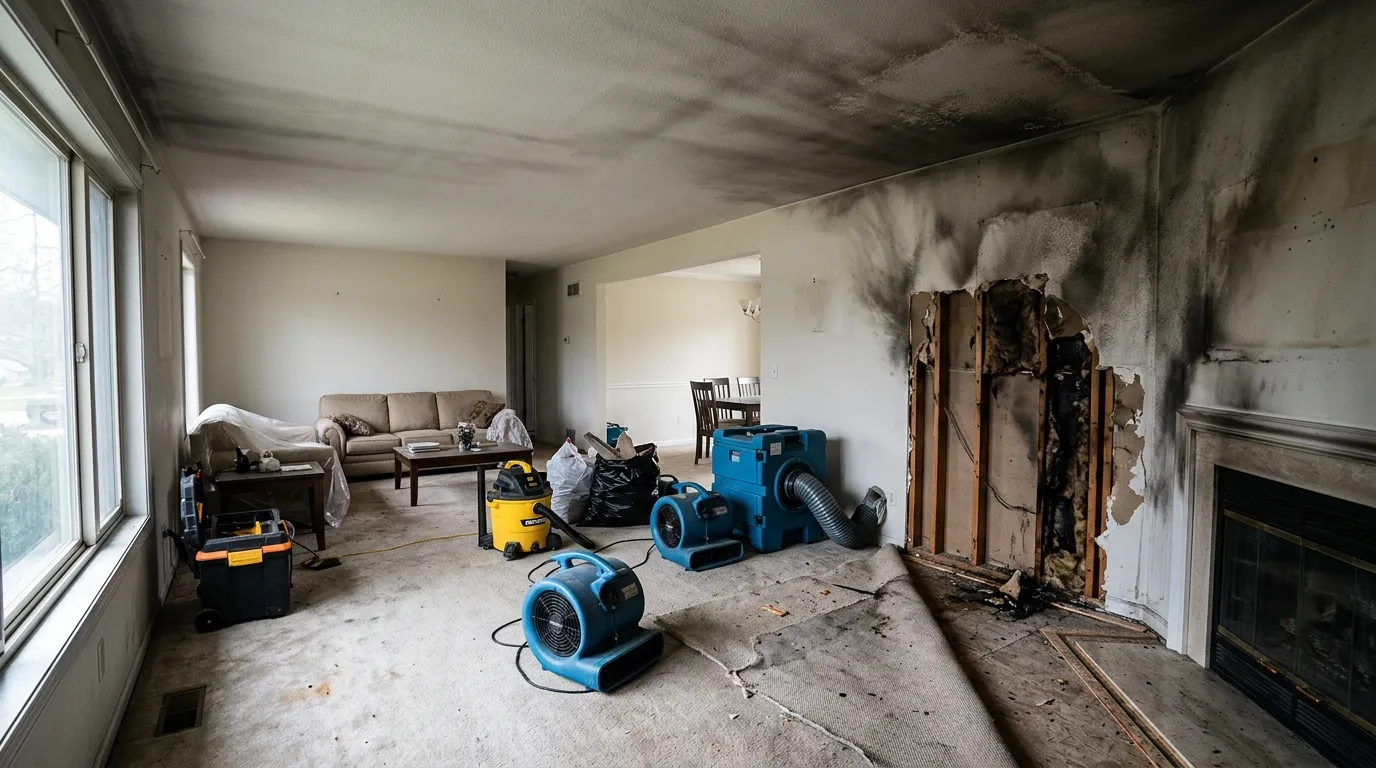
Fire damage keeps getting worse after the fire is out, which is why the immediate response affects both your cost and your claim. Soot is acidic and etches into surfaces, water from firefighting soaks into materials, and mold can begin growing on wet materials within a day or two. Restoration follows a sequence, and the early steps protect against secondary damage:
- Emergency stabilization (day 1): board-up, roof tarping, and water extraction secure the home and stop further loss. This is also when you should notify your insurer.
- Drying and soot removal (days 2 to 7): structural drying equipment runs continuously, and initial soot and debris removal begins before it sets further.
- Cleaning and deodorizing: full smoke and soot remediation, HVAC cleaning, and odor treatment. Smaller jobs may finish here.
- Reconstruction: drywall, flooring, paint, and any structural rebuild, which can run months on a major loss.
How Do You Finance Fire Damage Restoration?
Because insurance covers most fire losses, financing usually fills one of two gaps: the timing lag before the insurance checks arrive, or the uncovered portion (the deductible, depreciation on an ACV policy, or costs above your limit).
- Personal loan: funds within days with no lien on your home, which fits bridging the wait for an insurance check or covering the deductible on an urgent job.
- Home equity loan or HELOC: usually the lowest rate for a large uncovered rebuild portion or an extensive reconstruction, with the tradeoff of closing costs and a few weeks to fund.
- Bridge financing against the claim: some restoration companies work directly with your insurer and bill the claim, reducing what you front, so ask whether the contractor handles insurance billing.
- FHA 203(k) rehab loan: for a severe loss requiring major reconstruction, this loan is designed to finance home rehabilitation and can fold repairs into the mortgage.
How Do You Qualify for Fire Restoration Financing?
Qualifying centers on knowing your covered amount first, since that determines the size of the gap you actually need to borrow.
File the claim and get the adjuster’s scope before borrowing. Notify your insurer immediately, get the covered scope and payout in writing, and confirm whether your policy is RCV or ACV. This tells you the real gap rather than the full estimate, and whether you’re waiting on recoverable depreciation.
Get an itemized restoration bid you can compare to the payout. Insist the bid separates mitigation, cleaning, contents, and reconstruction so you can line it up against the adjuster’s scope and see exactly where any shortfall is. A reputable restoration firm will help document the claim.
Match the loan to the gap and timing, then check your credit. A prequalified personal loan bridges the wait or covers the deductible fast; a home equity option costs less for a large uncovered rebuild. Review your credit report for errors and prequalify with a soft credit check to compare offers without affecting your score.
The Bottom Line
Financing a fire loss is different from most home projects because insurance usually pays the majority. Your job is to cover the gap: the deductible, any depreciation an ACV policy withholds, costs above your coverage limit, and the timing lag before the checks arrive. A personal loan bridges that wait or covers the deductible quickly, while a home equity loan or an FHA 203(k) rehab loan costs less for a large uncovered rebuild.
Before you borrow, file the claim, confirm whether your policy pays replacement cost or actual cash value, and get the adjuster’s scope in writing, since knowing your covered amount is what lets you finance the actual gap instead of a number you may not owe.
Explore related resources
The information provided by Pasha Funding is for educational and informational purposes only and should not be considered financial, legal, or tax advice. Every homeowner’s financial situation is different, and the financing options discussed may not be suitable for everyone. Before choosing a financing solution, carefully review the lender’s terms and consider consulting a qualified financial professional if needed.
Pasha Funding is a financing marketplace that connects homeowners with financing options offered by participating lending partners. We do not make loans, determine credit eligibility, or guarantee approval or specific loan terms. Pasha Funding is not a direct lender. We may receive compensation from participating lending partners when users submit an application or obtain a loan through our platform. This compensation may affect how and where financing options appear, but it does not influence our editorial evaluations.
Financing offers, rates, terms, and availability are determined solely by participating lenders and may change without notice. Our editorial content is created independently to help consumers better understand home improvement financing. While we strive to keep information accurate and current, financing products, lender requirements, rates, and offers may change over time. Any opinions expressed are those of the author and have not been reviewed, approved, or endorsed by our lending partners.


Frequently Asked Questions
In this guide
- Does Homeowners Insurance Cover Fire Damage?
- How Much Does Fire Damage Restoration Cost?
- What Standards Should a Fire Restoration Contractor Follow?
- Why the First 24 to 48 Hours Matter After a Fire
- How Do You Finance Fire Damage Restoration?
- How Do You Qualify for Fire Restoration Financing?
- The Bottom Line
how it works
3 Simple steps to
finance your project.
Getting started only takes a minute. Complete one simple application to compare available financing offers from over 18+ lenders, choose the option that fits your budget, and move forward with your home improvement project.
Fire Restoration Financing Calculator
1. Enter Your Desired Loan Amount
Your Estimate
Monthly Payment
-
This calculator provides estimates for illustrative purposes only and does not constitute an offer of credit or a commitment to lend. Final APRs, loan amounts, and terms depend on credit approval, income verification, and lender underwriting criteria. Minimum and maximum rates/terms vary by state.
Powered by: Pasha Funding

Risk-Free Prequalification
Checking offers won’t impact your credit.
It’s common for homeowners to delay applying because they’re worried about their credit score. With a soft credit check, you can review available financing options without any impact to your credit score.2