

Participating Lender Network





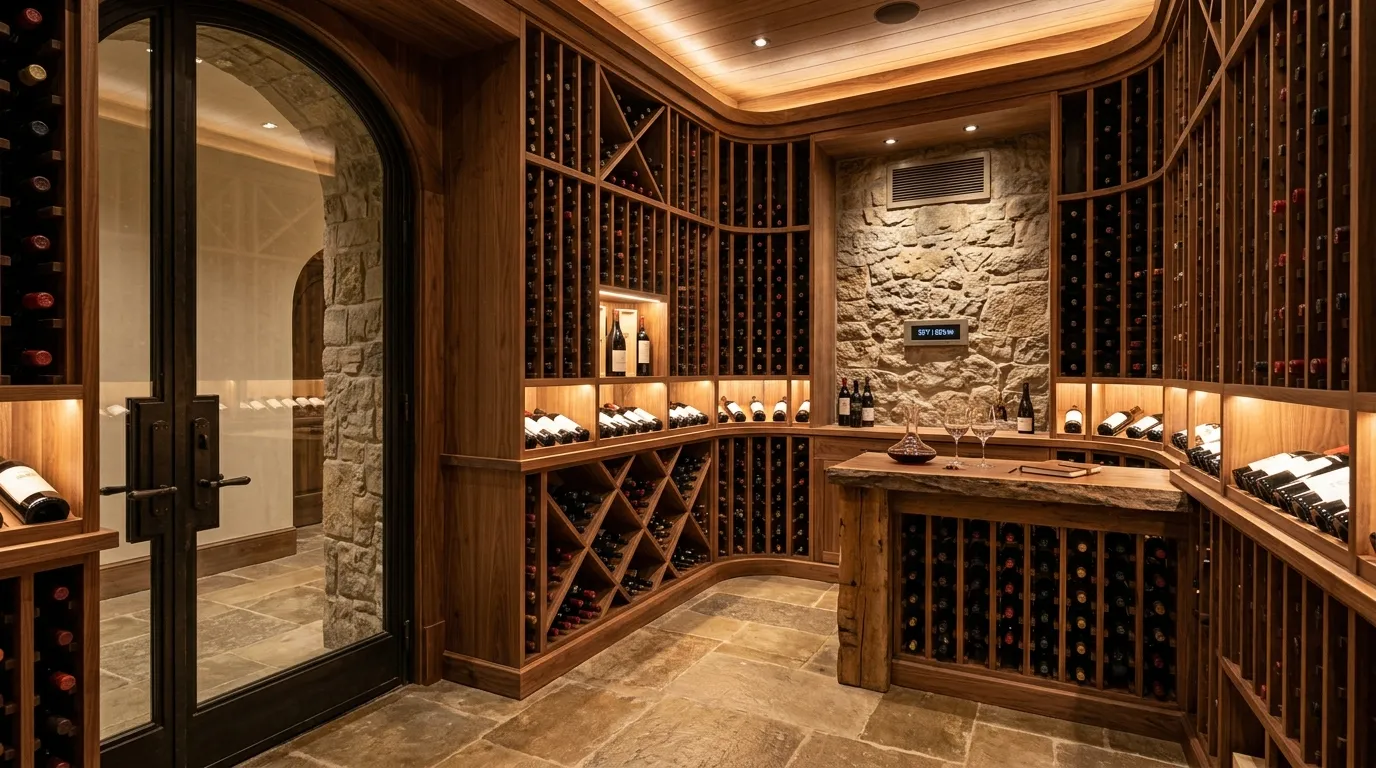
Wine Cellar Financing: A Homeowner’s Cost Guide
A wine cellar may look like a room defined by beautiful wood racks, but the racks are often one of the smaller expenses. What you’re really building is a sealed, climate-controlled space, and much of the cost goes into the insulation, vapor barrier, and cooling system needed to maintain a consistent temperature around 55 degrees.
Costs can range from roughly $3,000 for a small conditioned closet to $100,000 or more for a fully custom underground cellar. Homeowners may use a personal loan for a typical build, a home equity loan or HELOC for a larger project, or a 0% introductory credit card for a smaller conversion. Since a wine cellar is an elective upgrade rather than an essential repair, it makes sense to prioritize the features that protect your collection before spending heavily on the finishes that make the space look impressive.
Key Takeaways
- A wine cellar is a refrigeration and insulation project first: the cooling unit, vapor barrier, and sealed envelope matter more than the racking.
- A small conditioned closet can start around $3,000 to $10,000, while a dedicated custom room runs $15,000 to $60,000 and luxury builds exceed $100,000.
- The smart budget order is enclosure first, cooling second, racks third, finishes last, since skipping insulation or the vapor barrier leads to mold and ruined wine.
- A basement that stays naturally cool may support a simpler passive setup, while warmer or above-grade spaces need active cooling that costs more to install and run.
- Your wine collection usually is not fully covered by a standard home policy, so a serious collection may need a separate rider or wine policy.
How Much Does a Wine Cellar Cost?
What you spend depends far more on the size of the space and the cooling system it requires than on the racks you choose. A small conditioned wine closet runs about $3,000 to $10,000, a standard dedicated cellar lands around $15,000 to $60,000, and custom underground or glass builds often exceed $100,000. Small projects cost more per square foot than you’d expect, because the cooling unit, insulated door, and vapor barrier carry minimum costs no matter how little floor space you have.
Costs also run higher in expensive metro areas and where a build requires excavation, waterproofing, or duct routing through finished rooms.
Where Does the Money Go in a Wine Cellar?
The budget order that protects your wine is enclosure first, cooling second, racks third, finishes last. Here’s how the main pieces price out:
- Insulation and vapor barrier ($830 to $2,830 in materials): closed-cell foam and a sealed vapor barrier keep the cold in and moisture out, the single most important part of the build and the one most often skipped.
- Cooling unit ($800 to $7,500+): a through-wall self-contained unit sits at the low end, a ducted or split system at the high end, sized to the room’s heat load rather than its floor area.
- Racking ($1,500 to $4,500 modular, $5,500 to $12,000+ custom): modular wood or hybrid racks are the value choice, while custom millwork costs far more for the same bottle count.
- Insulated door ($400 to $2,000+): a standard interior door leaks cold and undoes the insulation, so a sealed, insulated (or properly built glass) door is not optional.
- Humidity control and finishes ($1,000 to $2,000+): a humidifier or humidity thermostat holds the 50 to 70 percent range, plus rust-resistant hardware, moisture-safe finishes, and lighting.
Passive vs. Active Wine Cellar: Which Do You Need?
The cooling approach shapes both your upfront cost and your monthly bills, and it comes down to where the cellar sits. A passive cellar relies on naturally stable conditions, which realistically means an underground or deep-basement space that already holds a cool, steady temperature year-round. It costs the least to run because there’s little or no mechanical cooling, but it only works in the right location and offers less precise control.
An active cellar uses a dedicated cooling unit to hold 55 degrees and the correct humidity regardless of the surrounding space, which is what most homes need. It gives you flexible placement and reliable conditions, at a higher installation cost and an ongoing electric bill. If your basement already stays around 60 to 65 degrees, you may be able to start passive and add active cooling later, but plan the insulation and vapor barrier for active use from the start, since retrofitting the envelope is the expensive part.
Does Homeowners Insurance Cover a Wine Cellar?
The cellar structure and the wine inside it are two different questions. The built cellar, as part of your home, is covered by a standard HO-3 policy on an open-perils basis, meaning a loss is covered unless the cause is specifically excluded. The wine collection is the gap. Standard policies treat wine as personal property and cap valuables at a low sub-limit, which the Insurance Information Institute notes is often just $1,000 to $2,000 for a category, well below what a serious cellar holds.
The bigger issue is what the policy excludes. The events that most often ruin wine, a cooling-system mechanical breakdown, a temperature or humidity failure, or spoilage from a power outage, are typically not covered by a homeowners policy at all. The III advises that a small collection kept for personal use can often ride on an existing policy, while a larger one needs a personal articles floater or a standalone wine policy that specifically covers temperature failure and breakage. If you’re borrowing to build a cellar for a collection of any real value, price that coverage in as part of the project.
Does a Wine Cellar Add Resale Value?
A wine cellar rarely returns its full cost, and the return depends heavily on the buyer. A smaller, well-built cellar can add $5,000 to $12,000 in appeal for the right buyer, but a large custom build almost never recovers what it cost, since only a narrow slice of buyers want a dedicated wine room and others see space that has to be converted back.
Two things protect resale value. First, keep it flexible: a conditioned room with an insulated door and a vapor barrier can be repurposed later, and those envelope improvements benefit any use of the room. Second, avoid over-building for your home’s price tier, since a six-figure cellar in a mid-market house is money you won’t see again. The most resale-friendly version is a tasteful, well-conditioned space that reads as a feature rather than a single-purpose vault.
How Do You Finance a Wine Cellar?
If you decide to borrow, match the loan to the size of the build and whether the cellar stands alone or is part of a larger basement project.
| OPTION | RELATIVE COST | BEST FOR | KEY RISKS & FEES |
|---|---|---|---|
| Personal loan | Fixed rate, higher than home equity | Closet conversions or mid-size standalone builds | Origination fee deducted upfront; no lien on your home |
| Home equity loan / HELOC | Lower rate, secured by the home | Custom dedicated rooms or underground builds | Closing and appraisal costs; foreclosure risk on default |
| 0% intro APR card | No interest during the promo window | Racking, a cooling unit, or a small build | Interest owed if not cleared before the promo ends |
| Contractor financing | Compare before signing | Convenience at the point of sale | May be deferred interest (see below) |
Is Wine Cellar Financing Tax-Deductible?
Only for the structural side, and only with home equity borrowing. Interest on a home equity loan or HELOC is deductible when the funds are used to buy, build, or substantially improve the home securing the loan, per IRS Publication 936. For a cellar, that can include permanent work like framing, vapor barrier insulation, and integrated HVAC ducting, since those become part of the house. Money spent on freestanding racking or a plug-in cooling unit does not qualify, because that equipment isn’t attached to the home, and a personal loan or credit card used for a cellar isn’t deductible at all. The rules are specific, so confirm your situation with a CPA before claiming anything.
How Do You Qualify for Wine Cellar Financing?
Qualifying works like any home-improvement loan, with a couple of steps specific to a cellar that keep the amount right.
Get an itemized bid that separates the enclosure and cooling from the finishes. Ask the builder to break out insulation, vapor barrier, the cooling system, racking, and cosmetic work, so you can finance the parts that protect the wine and scale back the finishes if needed. The cooling and envelope are where corners cost you later.
Confirm whether the work needs a permit. Adding electrical for a cooling unit or altering the structure often requires a permit and inspection, and folding those fees into the amount you finance keeps the budget accurate.
Check your credit and prequalify with a soft pull. Review your credit report, then prequalify with a soft credit check to compare real offers without affecting your score, and weigh them on total repayment rather than the monthly figure.
Having your paperwork ready before you apply speeds things up. Most lenders will want:
- Proof of income: recent pay stubs, W-2s, or tax returns if you’re self-employed.
- Your debt-to-income ratio: lenders generally prefer total monthly debt payments below 36% to 43% of gross income, so it helps to know where you land before applying.
- Itemized contractor bids: bids that separate the structural and HVAC enclosure work from the cosmetic finishes, which also lets you finance the parts that protect the wine.
- Equity documentation (for home equity borrowing): a recent mortgage statement or property valuation, plus the appraisal a HELOC or home equity loan lender will usually order.
The Bottom Line
How you pay for a wine cellar depends on the size of the build and whether it stands alone or joins a larger basement project. A personal loan funds a closet conversion or mid-size cellar quickly without touching your equity, while a home equity loan or HELOC usually costs less on a large custom build or one folded into a broader remodel. A small conversion may fit a 0% intro card you can repay in the promotional window.
Before you borrow, get an itemized bid and put your money toward the parts that protect the wine, insulation, vapor barrier, and cooling, before the finishes that only look good. Price in coverage for the collection itself, and keep the borrowed amount matched to a build your home’s value can support, since a wine cellar is a space to enjoy rather than an investment that pays you back at resale.
Explore related resources
The information provided by Pasha Funding is for educational and informational purposes only and should not be considered financial, legal, or tax advice. Every homeowner’s financial situation is different, and the financing options discussed may not be suitable for everyone. Before choosing a financing solution, carefully review the lender’s terms and consider consulting a qualified financial professional if needed.
Pasha Funding is a financing marketplace that connects homeowners with financing options offered by participating lending partners. We do not make loans, determine credit eligibility, or guarantee approval or specific loan terms. Pasha Funding is not a direct lender. We may receive compensation from participating lending partners when users submit an application or obtain a loan through our platform. This compensation may affect how and where financing options appear, but it does not influence our editorial evaluations.
Financing offers, rates, terms, and availability are determined solely by participating lenders and may change without notice. Our editorial content is created independently to help consumers better understand home improvement financing. While we strive to keep information accurate and current, financing products, lender requirements, rates, and offers may change over time. Any opinions expressed are those of the author and have not been reviewed, approved, or endorsed by our lending partners.


Frequently Asked Questions
how it works
3 Simple steps to
finance your project.
Getting started only takes a minute. Complete one simple application to compare available financing offers from over 18+ lenders, choose the option that fits your budget, and move forward with your home improvement project.
Wine Cellar Financing Calculator
1. Enter Your Desired Loan Amount
Your Estimate
Monthly Payment
-
This calculator provides estimates for illustrative purposes only and does not constitute an offer of credit or a commitment to lend. Final APRs, loan amounts, and terms depend on credit approval, income verification, and lender underwriting criteria. Minimum and maximum rates/terms vary by state.
Powered by: Pasha Funding
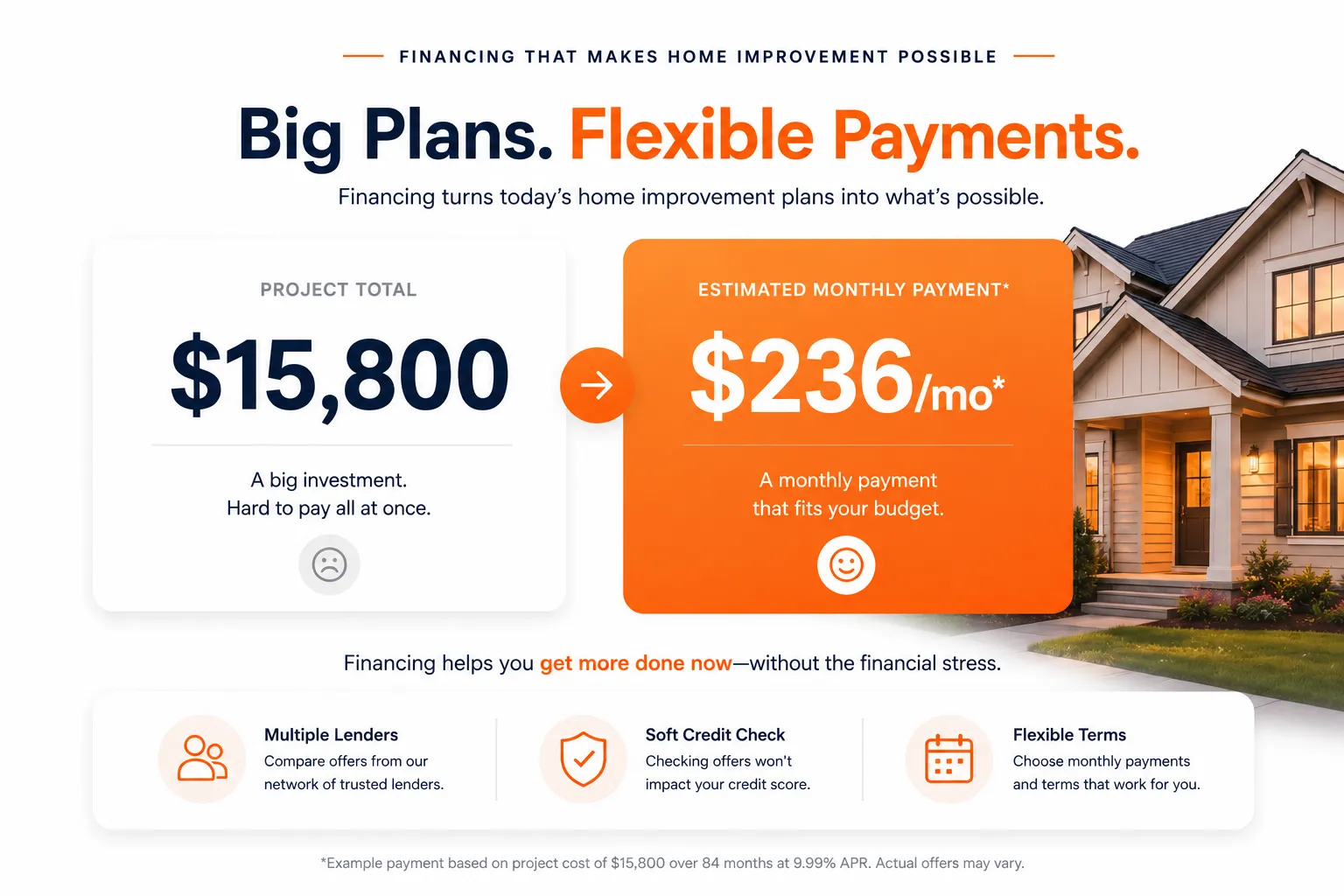
Risk-Free Prequalification
Checking offers won’t impact your credit.
It’s common for homeowners to delay applying because they’re worried about their credit score. With a soft credit check, you can review available financing options without any impact to your credit score.2