
Participating Lender Network





Sewer Line Replacement Financing: How to Pay for Repairs and Replacement
Most homeowners are shocked to learn they own the sewer line running from their house all the way to the city main, including the parts buried under the sidewalk and street, and that replacing it can cost anywhere from about $4,500 to $18,000 or more. When that line collapses, fills with roots, or backs sewage up into the house, it is an emergency you cannot postpone, and standard homeowners insurance usually will not pay for it. Two things drive both the cost and how you finance it: whether the job can be done with a trenchless method or needs full excavation, and how much of your yard, driveway, or street has to be torn up and restored.
Key Takeaways
- In most areas the homeowner owns the sewer lateral all the way to the city main, even the sections under public sidewalks and streets.
- Full replacement typically runs $4,500 to $18,000+, driven by length, depth, and how much surface has to be restored.
- Trenchless methods cost more per foot but often less overall, because they avoid tearing up and rebuilding yards and driveways.
- A camera scope comes first: it decides whether trenchless is even possible and prevents costly surprises mid-job.
- Standard homeowners insurance usually excludes sewer lines unless you carry a service line or water-backup endorsement.
- Because a failed line is a health emergency, most owners finance it with a personal loan for speed or home equity for a large job.
What Does Sewer Line Replacement Cost?
The price depends on the method, the length and depth of the line, and how much surface has to be restored afterward. A minor trenchless repair can run a few thousand dollars, while a full traditional dig-and-replace with restoration can exceed $15,000. Here is how the common approaches compare.
What Sewer Line Work Costs by Method
Typical cost range by repair or replacement method.
Bar length reflects the top of each range. Figures from HomeGuide and Angi.
By the foot, traditional excavation runs about $50 to $125 per foot, pipe bursting $60 to $200, and cured-in-place lining $80 to $250, and a typical home lateral is 50 to 150 feet long. On top of the pipe work, restoration is the cost people forget: digging up a yard adds $2,000 to $5,000, and a driveway or sidewalk can add $2,000 to $8,000 in concrete or asphalt repair. A camera inspection, which runs $150 to $500, is the non-negotiable first step, since it identifies the break, the depth, and whether trenchless will work. Costs also climb 20% to 35% in high-cost metros, so treat these as planning ranges and get at least three line-item written bids.
Who Is Responsible for the Sewer Line, You or the City?
This is the part that catches homeowners off guard, and it is worth confirming before you assume the city will help. In most jurisdictions, you own and are responsible for the entire sewer lateral, the pipe from your house to the municipal main, including the portions buried under public sidewalks and streets.
The lateral is the line that carries all your home’s wastewater out to the city sewer main in the street, and it is legally yours to maintain in most places, not the city’s. That means when it fails, the repair or replacement is your bill, even for the section running under the public right-of-way. Rules do vary: some cities take responsibility from your property line to the main, and a few split the cost, so the first step is to call your municipal water or sewer department and ask exactly where your responsibility ends. Knowing that boundary tells you how much of the line you may have to pay for, and whether a street cut, which brings its own permits and higher restoration costs, is part of the job.
Trenchless vs. Traditional Sewer Line Replacement
Comparing quotes on the price per foot alone will mislead you here. Traditional excavation often looks cheaper per foot, but once you add the cost of restoring a dug-up yard or driveway, a trenchless method can come out less expensive overall.
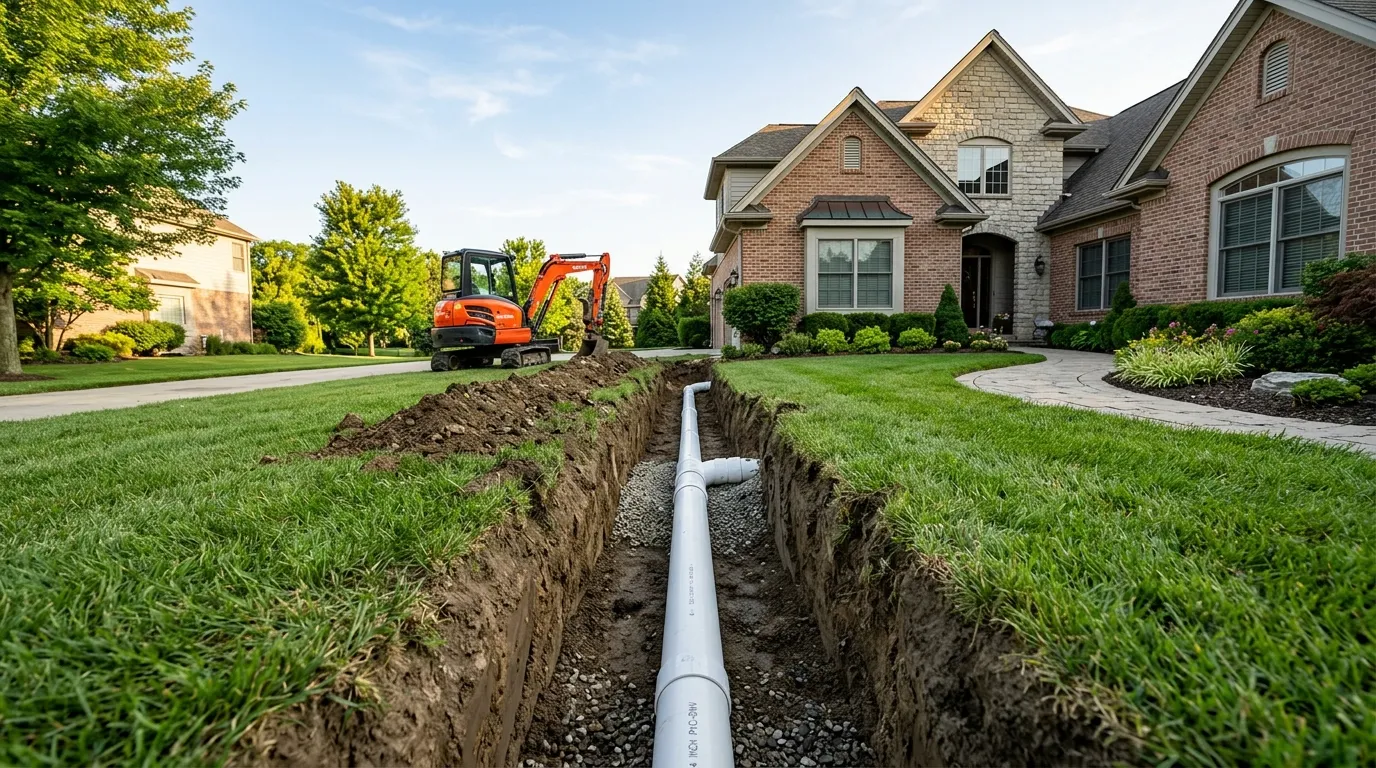
Traditional dig-and-replace opens a trench along the whole line, which is straightforward for a shallow line under open lawn but expensive when it runs beneath a driveway, patio, mature trees, or the street. Trenchless methods avoid most of that digging: pipe bursting pulls a new pipe through the old one from two small access pits, and cured-in-place lining coats the inside of a structurally sound pipe with no trench at all. Trenchless usually costs more per foot for the pipe work, but it can save $2,000 to $8,000 in surface restoration, which is why it frequently wins on total cost when landscaping or hardscape sits over the line. The catch is that not every line qualifies: a fully collapsed or badly sagging pipe may still require excavation, and lining needs a sound host pipe. The camera scope makes that call, so ask a licensed plumber to price both methods, including restoration, before you decide.
How Do You Finance Sewer Line Replacement?
Because a failed sewer line usually needs fixing fast, speed and cost both matter. Here is how the main options compare.
Personal Loans
A personal loan delivers a fixed amount in a few days with no lien on your home and no appraisal, which suits an urgent sewer failure well. It works with any plumber, and while the rate is higher than a home-secured loan, the speed is valuable when sewage is backing up and the repair cannot wait. Terms typically run two to seven years.
Home Equity Loans and HELOCs
For a large replacement, especially one with heavy restoration, borrowing against your equity usually carries the lowest rate. A home equity loan gives you a lump sum, while a HELOC lets you draw as the work and restoration progress. The trade-offs are closing costs and a few weeks to fund, which can be a drawback in a true emergency.
FHA Title I Loans
An FHA Title I home improvement loan can finance a sewer repair up to $25,000 without requiring home equity, and it sets no federal minimum credit score, which makes it a reachable option for a necessary repair when you have little equity to draw on.
Contractor Payment Plans
Many plumbing companies offer payment plans, sometimes starting the work with a deposit and spreading the balance over several months. This can help in an emergency, but the terms come from a lender, so compare them against an outside loan before agreeing.
Does Insurance Cover a Sewer Line?
Usually not on its own, but the right add-on changes that. A standard homeowners policy generally excludes sewer line repair and sewage backups, but service line coverage and a water-backup endorsement can cover them.
Base homeowners policies treat a worn-out or root-damaged lateral as a maintenance issue and exclude it, along with the sewage backup damage a failure can cause. However, many insurers now offer a service line endorsement that covers the cost of repairing or replacing your buried lateral, and a separate water or sewer backup endorsement that covers the interior damage when a line backs up. These add-ons are usually inexpensive relative to the risk, so if you have an older home or large trees near the line, it is smart to add them before a problem occurs, since you cannot buy coverage after the failure. Some municipalities also offer optional sewer-warranty programs. If a covered event damages the line, document the cause before filing.
Do You Need a Permit for Sewer Line Work?
Yes, and more so when the work reaches public property. Replacing a sewer lateral requires a permit and a licensed plumber, and cutting into a public street or sidewalk adds right-of-way permits and often a bond.
Local plumbing codes require a permit and inspection for lateral work precisely because a bad connection can cause backups and contaminate the system, so a contractor who avoids pulling permits is a warning sign. If the line runs under the public right-of-way, the city typically requires an additional encroachment permit and sometimes a bond to guarantee the street is properly restored, which adds cost and time. To protect yourself, the FTC advises getting a written estimate that spells out the scope, materials, price, and completion date, and here that means a line-item bid stating the method, pipe material, length, restoration, and who pulls and pays for the permit. Unpermitted sewer work can also void your homeowners coverage, so confirm the permit is part of the job before you finance it.
The Bottom Line
The best way to finance a sewer line replacement depends on how urgent it is, how large the job is, and whether you have home equity. For an emergency failure with sewage backing up, a personal loan funds in days without touching your home equity. For a large replacement with heavy restoration, a home equity loan or HELOC usually offers the lowest market rate, and an FHA Title I loan can help when you lack equity. Contractor payment plans can bridge an emergency, but compare their terms first.
Before you borrow, get a camera scope and at least three line-item bids that price both trenchless and traditional methods with restoration included, since the right method can save thousands. Confirm with your city how much of the line you actually own, and check whether a service line endorsement can offset the cost. Then compare offers on the total amount you’ll repay, not just the monthly payment.
The information provided by Pasha Funding is for educational and informational purposes only and should not be considered financial, legal, or tax advice. Every homeowner’s financial situation is different, and the financing options discussed may not be suitable for everyone. Before choosing a financing solution, carefully review the lender’s terms and consider consulting a qualified financial professional if needed.
Pasha Funding is a financing marketplace that connects homeowners with financing options offered by participating lending partners. We do not make loans, determine credit eligibility, or guarantee approval or specific loan terms. Pasha Funding is not a direct lender. We may receive compensation from participating lending partners when users submit an application or obtain a loan through our platform. This compensation may affect how and where financing options appear, but it does not influence our editorial evaluations.
Financing offers, rates, terms, and availability are determined solely by participating lenders and may change without notice. Our editorial content is created independently to help consumers better understand home improvement financing. While we strive to keep information accurate and current, financing products, lender requirements, rates, and offers may change over time. Any opinions expressed are those of the author and have not been reviewed, approved, or endorsed by our lending partners.
Explore related resources
- Plumbing Financing Options
- Sewer Line Replacement Financing
- Gas Fireplace Financing
- Septic System Financing
- Tankless Water Heater Financing
- Water Heater Financing
- Water Filtration System Financing
- Water Softener Financing
- Whole House Repipe Financing
- Water Well Financing
- Water Main Line Replacement Financing


FAQ
Sewer Line Replacement Financing Calculator
1. Enter Your Desired Loan Amount
Your Estimate
Monthly Payment
-
This calculator provides estimates for illustrative purposes only and does not constitute an offer of credit or a commitment to lend. Final APRs, loan amounts, and terms depend on credit approval, income verification, and lender underwriting criteria. Minimum and maximum rates/terms vary by state.
Powered by: Pasha Funding

how it works
3 Simple steps to
finance your project.
Getting started only takes a minute. Complete one simple application to compare available financing offers from over 18+ lenders, choose the option that fits your budget, and move forward with your home improvement project.
Risk-Free Prequalification
Checking offers won’t impact your credit.
It’s common for homeowners to delay applying because they’re worried about their credit score. With a soft credit check, you can review available financing options without any impact to your credit score.2