
Participating Lender Network






How to Finance a Gas Fireplace
A gas fireplace runs anywhere from about $800 for a basic log set to more than $10,000 for a built-in with all-new venting, and where you land depends mostly on what you already have: an existing firebox, a gas line, a chimney. The three types each answer a different situation, with a gas log set for ambiance in a working wood fireplace, a sealed insert to turn a drafty firebox into a real heater, and a built-in for a wall where no fireplace exists. A small log-set or ventless job is affordable enough for savings or a 0% intro card, while an insert or a built-in with venting and gas-line work is where a personal loan, home equity line of credit (HELOC), or home equity loan makes sense. The appliance is only part of the number, so it pays to price the whole installed job before you decide how to pay for it.
Key Takeaways
- The type sets the price: a gas log set runs about $800 to $3,000 installed, a sealed insert $3,500 to $6,500, and a built-in unit $3,000 to $8,000+, with luxury linear models climbing into five figures.
- Venting and gas-line work drive the hidden cost: running a new gas line adds roughly $500 to $2,000, and a direct-vent system adds more than a ventless unit that needs no vent.
- Vented vs. ventless is a safety and legality decision, not just a price one: ventless units cost less but are banned in California, Massachusetts, and other areas, and can’t be your only heat source.
- An insert is the efficient heater of the three, a log set is for ambiance, and a built-in is the route when you have no existing fireplace.
- Gas work requires a licensed pro and usually a permit, since a gas line has to meet code to protect against leaks.
Gas Fireplace Types, Costs & Installation
Which type you can install depends on what you already have. A log set and an insert both need an existing firebox; a built-in creates a fireplace where there wasn’t one. Here is how the three compare on installed cost and what each is really for.
- Gas log set (ambiance): ceramic logs and a burner that drop into a working wood firebox for the look of a fire with a flip of a switch. The cheapest path, but built for atmosphere, not heat.
- Sealed insert (efficient heater): a sealed steel or cast-iron box that slides into your existing firebox with a blower and heat exchanger, turning a drafty fireplace into a real zone heater.
- Built-in, zero-clearance (no fireplace needed): a unit framed directly into a wall where no chimney exists, with total placement freedom and the widest price range, since large linear and see-through models climb fast.
Vented vs. Ventless Gas Fireplaces: Which Is Better?
This is the decision that matters most for safety, and it also moves the price. A vented unit (direct-vent or through a chimney liner) sends its combustion byproducts outside, while a ventless, or vent-free, unit burns cleaner but releases its exhaust and water vapor back into the room. Ventless costs less because there is no vent system to build, but it comes with real strings:
- It is banned in some places: California prohibits the sale of unvented indoor heaters, and Massachusetts and other jurisdictions ban ventless gas fireplaces outright. Confirm legality in your area before you buy.
- It can’t be your only heat: code classifies ventless units as supplemental heat, so you cannot rely on one as a home’s sole heating system.
- It carries safety hardware and limits: every unvented heater must include an oxygen depletion sensor that shuts off the gas if oxygen drops too low, and units cap their heat output for safety.
- It adds moisture: the water vapor a ventless unit releases can raise indoor humidity and, in poorly ventilated rooms, contribute to mold.
A vented direct-vent unit costs more but sidesteps those concerns, which is why many homeowners and installers default to it. If you are drawn to ventless for the lower price, price a vented option too before deciding, since the gap narrows once you account for the safety requirements.
How Do You Finance a Gas Fireplace?
The right option depends on the size of the job, your credit, and whether you have home equity. Here is how the common paths compare on what they suit, the rate they carry, and the fees or risks to weigh:
- 0% intro APR credit card: best for a gas log set or a smaller ventless job you can repay inside the promotional window. Usually needs strong credit to qualify, and any balance left when the promo ends converts to a high variable rate, so clear it in time.
- Unsecured personal loan: best for an insert or a mid-range built-in. It funds quickly, puts no lien on your home, and carries a fixed rate with predictable payments, though the rate is higher than a home-equity product and some lenders charge an upfront origination fee taken from your proceeds. Generally wants good credit or better for the best terms.
- Home equity loan or HELOC: best for a premium linear built-in or a fireplace done as part of a larger remodel. It usually carries the lowest relative rate because your home secures it, but that is the catch: it places a lien on your home and requires built-up equity, an appraisal, and closing costs. A home equity loan is fixed-rate; a HELOC is typically variable.
- Contractor or dealer financing: some hearth retailers offer promotional plans. Credit requirements vary and approval can be quick, but read the terms, since many of these offers use deferred interest rather than a true 0%.
How Do You Qualify for Gas Fireplace Financing?
Qualifying is quick for a job this size. The trick is applying against the full installed cost, not the appliance sticker, since gas-line and venting work can double a simple quote. Have these ready before you apply:
- An itemized installer quote: one that separates the unit, venting, gas-line work, chimney or liner, permits, and any surround, so you borrow against the real installed total.
- Proof of income: recent pay stubs, W-2s, or tax returns if you are self-employed.
- Your debt-to-income (DTI) ratio: tally your monthly debt against gross income; lenders generally look for a DTI under the 36% to 43% range.
- A recent home valuation or property tax assessment: only for a home equity loan or HELOC, which verify your equity through an appraisal.
With those in hand, prequalify with a soft credit check to compare real offers without affecting your score, and weigh them on the total you will repay rather than the monthly figure.
The Bottom Line
The best way to pay for a gas fireplace depends on the type and the work your home needs. A gas log set or a small ventless unit is affordable enough for savings or a 0% intro card you clear inside the promotional window. An insert or a mid-range built-in fits a personal loan that funds fast without touching your equity. A premium linear built-in, or a fireplace done as part of a larger remodel, is where a home equity loan or HELOC usually costs less.
Before you borrow, settle the type, confirm whether ventless is even legal where you live, and get an itemized quote that includes the gas line, venting, and any chimney work, since those are what turn the appliance price into the real total. Choose the type and finish you can pay for comfortably, and compare loan offers on the total you will repay rather than the monthly figure.
The information provided by Pasha Funding is for educational and informational purposes only and should not be considered financial, legal, or tax advice. Every homeowner’s financial situation is different, and the financing options discussed may not be suitable for everyone. Before choosing a financing solution, carefully review the lender’s terms and consider consulting a qualified financial professional if needed.
Pasha Funding is a financing marketplace that connects homeowners with financing options offered by participating lending partners. We do not make loans, determine credit eligibility, or guarantee approval or specific loan terms. Pasha Funding is not a direct lender. We may receive compensation from participating lending partners when users submit an application or obtain a loan through our platform. This compensation may affect how and where financing options appear, but it does not influence our editorial evaluations.
Financing offers, rates, terms, and availability are determined solely by participating lenders and may change without notice. Our editorial content is created independently to help consumers better understand home improvement financing. While we strive to keep information accurate and current, financing products, lender requirements, rates, and offers may change over time. Any opinions expressed are those of the author and have not been reviewed, approved, or endorsed by our lending partners.


Frequently Asked Questions
In this guide
how it works
3 Simple steps to
finance your project.
Getting started only takes a minute. Complete one simple application to compare available financing offers from over 18+ lenders, choose the option that fits your budget, and move forward with your home improvement project.
Gas Fireplace Financing Calculator
1. Enter Your Desired Loan Amount
Your Estimate
Monthly Payment
-
This calculator provides estimates for illustrative purposes only and does not constitute an offer of credit or a commitment to lend. Final APRs, loan amounts, and terms depend on credit approval, income verification, and lender underwriting criteria. Minimum and maximum rates/terms vary by state.
Powered by: Pasha Funding
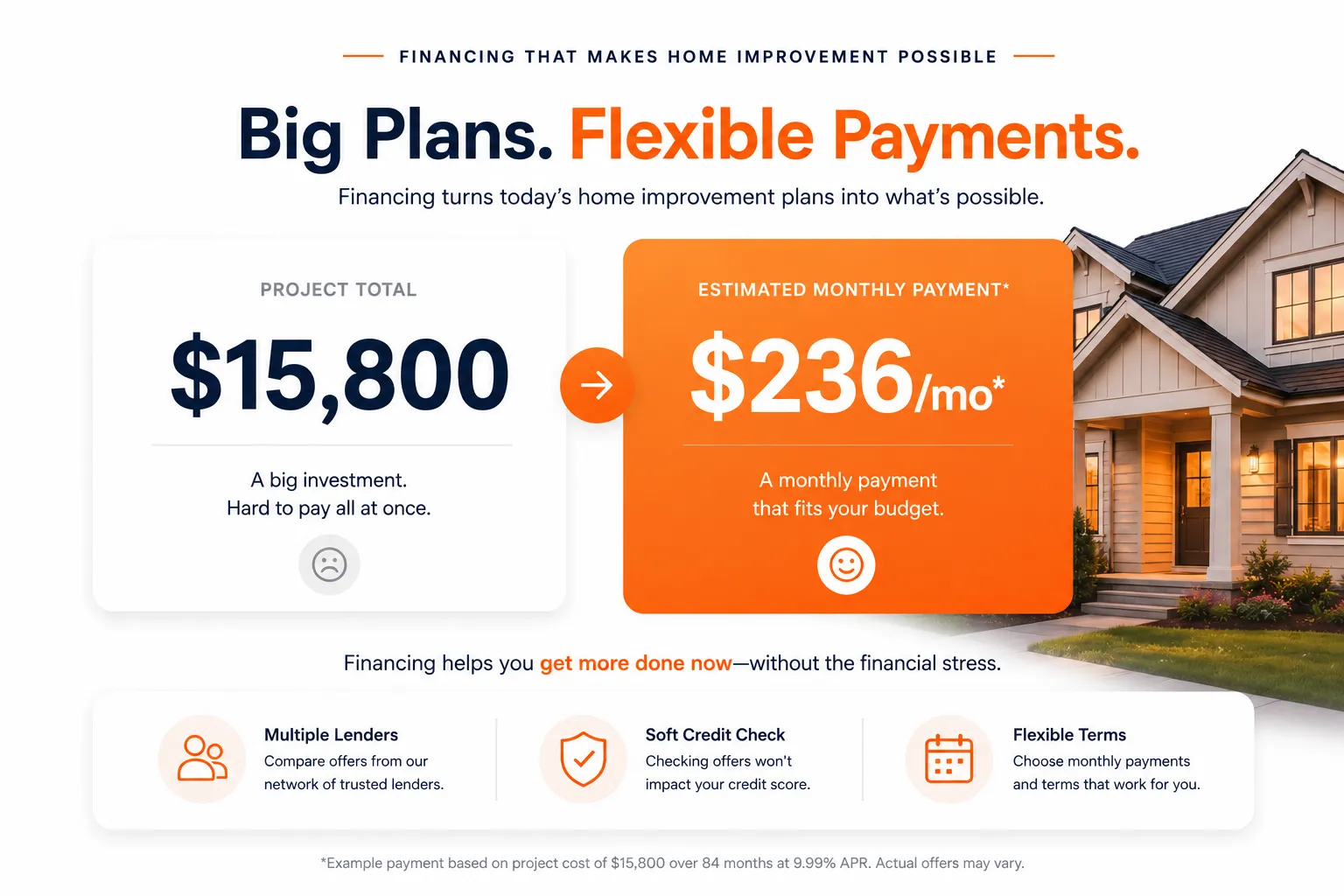
Risk-Free Prequalification
Checking offers won’t impact your credit.
It’s common for homeowners to delay applying because they’re worried about their credit score. With a soft credit check, you can review available financing options without any impact to your credit score.2