

Participating Lender Network





How to Finance a Wheelchair Ramp
A wheelchair ramp is often the fastest way to make a home usable again after a fall or a new diagnosis, and unlike most accessibility projects, it may not call for a loan at all. A portable threshold ramp can cost less than a hundred dollars, a modular aluminum system runs roughly $1,500 to $5,000 installed, and a permanent wood or concrete ramp can reach $8,000 or more, so the right way to pay depends heavily on which type you need and how long you’ll need it. For many households, a ramp is inexpensive enough that a rental, a personal loan, or even a free build through a local nonprofit makes more sense than financing a large sum.
Key Takeaways
- Ramp type is the main cost driver: portable ramps run under a few hundred dollars, modular aluminum $1,500 to $5,000, and permanent wood or concrete $2,600 to $13,000.
- Because the cost is often low, financing may not be the answer: renting or buying a portable unit outright can beat taking a loan.
- Modular aluminum ramps can be removed, reconfigured, resold, or bought back, and in many areas they don’t require a building permit because they count as temporary structures.
- An unusually large number of nonprofits build ramps for free for low-income seniors and people with disabilities, so a grant or volunteer build is worth checking before you borrow.
- A personal loan fits a larger permanent ramp when you need it fast, while a Medicaid waiver or VA grant may cover it entirely if you qualify.
- Ramp length is set by the height you’re climbing, so a tall entry needs a long ramp, which is the number that pushes a project toward the higher end.
How Much Does a Wheelchair Ramp Cost by Type?
The first thing that sets your budget is which kind of ramp your entry actually needs. A portable ramp costs roughly $50 to $800, a modular aluminum system $1,500 to $5,000 installed, custom wood $2,600 to $8,000, and permanent concrete $4,000 to $13,000.
| Ramp Type | Cost Range | Best For | Maintenance Need |
|---|---|---|---|
| Portable / threshold | $50-$800 | A single step, doorway, or short-term need | Minimal; wipe down as needed |
| Modular aluminum | $1,500-$5,000 | Most homes; removable and reconfigurable | Low; no rust, occasional sweeping |
| Custom wood | $2,600-$8,000 | Matching a porch or deck; longer runs | High; sealing, repainting, rot checks |
| Permanent concrete | $4,000-$13,000 | Indefinite use; no maintenance | None once cured |
Cost ranges from HomeGuide and Everhome Mobility.
Modular aluminum is the most common residential choice because the ADA-compliant slope, handrails, and slip-resistant surface come pre-engineered, and the sections bolt together without pouring concrete or building a frame. Wood can be built to match a porch but needs ongoing sealing and inspection for rot, and often needs major work every several years. Concrete lasts indefinitely with no maintenance but requires excavation, forming, and curing, which is why it sits at the top of the range. One number drives all of them: the height from the ground to your threshold sets how long the ramp must be, since a safe ramp needs a foot of length for every inch of rise. The accessibility upgrades hub covers that ADA slope math in more detail. Costs also run higher in expensive metro markets and lower in rural areas.
What Are the Code Requirements for a Wheelchair Ramp?
Ramp length is more than rise times twelve, because a compliant ramp also needs level resting platforms. Building codes require a level landing at least 60 inches by 60 inches (5 feet square) at the top and bottom of the ramp, plus an intermediate landing wherever the ramp changes direction and after every 30 feet of continuous run.
Those landings add real length and footprint to the project, which is why a tall entry rarely fits as one long straight slope and instead becomes an L-shape or switchback with a turning platform. Two other code rules shape the build and the cost. Any ramp with a rise greater than 6 inches needs continuous handrails on both sides, mounted 34 to 38 inches above the ramp surface, and the ramp needs edge protection, a low curb or rail along the sides, so a wheelchair wheel can’t slip off the edge. A pre-engineered modular aluminum system usually comes with the handrails, edge curb, and correct slope built in, while a custom wood or concrete ramp has to have all of it designed and inspected.
One point of confusion worth clearing up: the ADA is technically a civil-rights law for public accommodations, so a private single-family home legally falls under the International Residential Code (IRC) rather than the ADA. The IRC can be slightly more flexible on residential ramps, but reputable contractors build to the ADA’s 1:12 slope and landing standards anyway, because that’s the recognized safety benchmark and it’s what keeps the ramp genuinely usable.
Should You Rent, Buy, or Finance a Wheelchair Ramp?
Because ramps are one of the cheaper accessibility projects, the honest first question isn’t which loan to get, it’s whether you need to borrow at all. The answer turns on how long you’ll need the ramp.
For a short-term need, recovering from surgery, a healing injury, a limited stretch of reduced mobility, renting a modular aluminum ramp is usually the cheapest path. Rentals run roughly $80 to $200 or more per month and include installation and removal, so a few months of rental costs far less than buying a permanent ramp you’ll tear out afterward. A portable or threshold ramp bought outright is another low-cost option for a single step or a doorway, and it comes with you if you move.
For a permanent, long-term need where the ramp will be a large modular or custom build, financing starts to make sense, and that’s where a personal loan or a grant comes in. The dividing line is simple: if the ramp is small or temporary, pay cash or rent; if it’s a several-thousand-dollar permanent installation and you don’t have the cash on hand, then compare a loan against the grant options below.
Can You Get a Wheelchair Ramp for Free?
This is the piece most homeowners don’t know about, and for a ramp it can replace financing entirely. Wheelchair ramps have an unusually deep network of nonprofit and volunteer programs that build them at no charge, precisely because a ramp is cheap enough in materials that a group of volunteers can complete one in a day.
Several national and local programs are worth contacting before you borrow a dollar:
- Habitat for Humanity runs aging-in-place and repair programs (including “A Brush with Kindness”) that build free ramps for income-qualified seniors, typically homeowners age 60 and up below a set share of area median income.
- Rebuilding Together is a national nonprofit that provides free home modifications, including ramps, for low-income homeowners, seniors, and veterans.
- Volunteer ramp charities such as SAWs (Servants at Work) and regional “Rampathon” and student-run RAMPS programs build free wooden ramps for low-income, disabled residents in the areas they serve.
- Your Area Agency on Aging (AAA) and local Center for Independent Living either run modification programs or can point you to the ones operating where you live.
Most of these are income-qualified and have a wait of a few weeks to several months, so they suit a planned need better than a same-day emergency. Set expectations on two operational realities: waiting lists at Habitat, SAWs, Rebuilding Together, and similar groups commonly run two to six months depending on local volunteer availability, and while the labor is free, some programs ask the homeowner to cover the raw materials (the lumber or aluminum) even when the volunteer construction is donated. Even paying for materials alone, though, can cut the cost of a ramp by more than half versus a fully contracted build. If a family member is a veteran or you may qualify for a Medicaid HCBS waiver, those can also cover a ramp; the accessibility upgrades hub covers VA grants and Medicaid waivers in more detail.
How Do You Finance a Permanent Wheelchair Ramp?
When the ramp is a large permanent build, you don’t qualify for a free program, and you don’t have the cash on hand, a few financing paths fit.
Personal Loans
A personal loan puts a fixed sum in your account within days, with no lien on your home, which suits an urgent need where someone can’t safely enter or leave the house right now. It works with any contractor and any ramp type, and for a project in the low thousands the fast funding usually matters more than the rate.
Contractor or Dealer Financing
Some ramp companies offer payment plans through a partner lender. These can be convenient, but the loan itself comes from a third party, so compare the total cost against an outside personal loan before signing rather than anchoring on the monthly figure.
Grants and Waivers
Beyond the free-build programs above, a Medicaid HCBS waiver may cover a ramp for eligible low-income residents in many states, and a veteran with a service-connected disability may be able to use a VA grant. These don’t require repayment but run on a slower timeline, so they fit a planned ramp rather than an emergency.
Home Equity Options
For a homeowner combining a ramp with a larger accessibility project, a home equity loan or HELOC may carry a lower rate than an unsecured loan, though for a ramp alone the amount is usually too small to justify the closing process.
Do You Need a Permit for a Wheelchair Ramp?
It depends on the ramp type, which is another reason type matters. A permanent wood or concrete ramp attached to the home usually requires a building permit and an inspection for slope and handrail compliance, while a modular aluminum ramp is often classified as a temporary structure that needs no permit in many jurisdictions.
That permit distinction can be a real cost and time difference, since a permitted permanent ramp adds fees and an inspection step that a bolt-together modular system may skip. A permanent wood or concrete ramp also carries a hidden structural requirement: in colder climates its posts have to sit on footings dug below the local frost line, often 36 to 48 inches deep in northern states, set on concrete piers. Skipping that step invites frost heave, where the ground freezes and lifts the ramp, leaving it unlevel and unsafe within a season or two. A modular aluminum ramp avoids this because it rests on adjustable feet on the surface rather than on buried footings.
Rules vary by city and county, and a homeowners association can add its own approval requirement even where the municipality doesn’t. Here the law is on your side: under the federal Fair Housing Act, an HOA generally cannot flatly deny a reasonable, medically necessary wheelchair ramp. It can impose reasonable aesthetic conditions, such as requiring wood to be painted to match the siding or a modular ramp to be screened, but it can’t use design rules to block access outright. Confirm both the permit status and any HOA process before you commit to a permanent build, and fold any permit fee into the amount you finance so it doesn’t become a surprise at inspection.
How Do You Qualify for Wheelchair Ramp Financing?
Qualifying for a ramp is less about the loan than about right-sizing the project first, since the type and length determine whether you’re financing a few hundred dollars or several thousand.
Measure the rise and confirm the ramp type. Measure the height from the ground to your threshold, since that sets the ramp length and points you to the right type: a low single step may only need a portable ramp, while a raised porch may need a long modular or switchback system. Knowing the type tells you whether financing is even necessary.
Check free and grant programs before applying for a loan. Because ramps have so many no-cost options, contact your Area Agency on Aging, a local ramp charity, or a Medicaid waiver program first. Confirming you don’t qualify for a free build is worth the phone call before taking on any debt.
If you do finance, get an itemized quote and prequalify. For a permanent build, get a written quote that includes the ramp, handrails, any permit fee, and whether the surface is slip-resistant and ADA-compliant. Then review your credit for errors and prequalify with a soft credit check to compare real offers without affecting your score.
The Bottom Line
How you pay for a wheelchair ramp depends most on the type of ramp and how long you’ll need it. For a single step or a temporary need, a portable ramp bought outright or a monthly rental is usually cheaper than any loan. For a permanent modular or custom ramp, check whether you qualify for a free build through a nonprofit, a Medicaid waiver, or a VA grant before borrowing, since ramps are one of the few home projects with a real chance of costing nothing. When none of those apply and you need the ramp quickly, a personal loan funds fast without touching home equity.
Before you borrow, measure the rise at your entry and make one round of calls to your Area Agency on Aging and a local ramp charity, since a free or subsidized build is common enough that it’s worth ruling out before you take on any debt.
More related financing options
The information provided by Pasha Funding is for educational and informational purposes only and should not be considered financial, legal, or tax advice. Every homeowner’s financial situation is different, and the financing options discussed may not be suitable for everyone. Before choosing a financing solution, carefully review the lender’s terms and consider consulting a qualified financial professional if needed.
Pasha Funding is a financing marketplace that connects homeowners with financing options offered by participating lending partners. We do not make loans, determine credit eligibility, or guarantee approval or specific loan terms. Pasha Funding is not a direct lender. We may receive compensation from participating lending partners when users submit an application or obtain a loan through our platform. This compensation may affect how and where financing options appear, but it does not influence our editorial evaluations.
Financing offers, rates, terms, and availability are determined solely by participating lenders and may change without notice. Our editorial content is created independently to help consumers better understand home improvement financing. While we strive to keep information accurate and current, financing products, lender requirements, rates, and offers may change over time. Any opinions expressed are those of the author and have not been reviewed, approved, or endorsed by our lending partners.


FAQ
In this guide
- What Counts as an Accessibility Upgrade?
- How Much Do Accessibility Upgrades Cost?
- How Long Does a Wheelchair Ramp Need to Be?
- How Do You Finance Accessibility Upgrades?
- Does Medicare or Medicaid Cover Home Modifications?
- Which Accessibility Upgrade Do You Need?
- Do You Need a Permit for Accessibility Modifications?
- How Do You Qualify for Accessibility Upgrade Financing?
- The Bottom Line
FAQ
how it works
3 Simple steps to
finance your project.
Getting started only takes a minute. Complete one simple application to compare available financing offers from over 18+ lenders, choose the option that fits your budget, and move forward with your home improvement project.
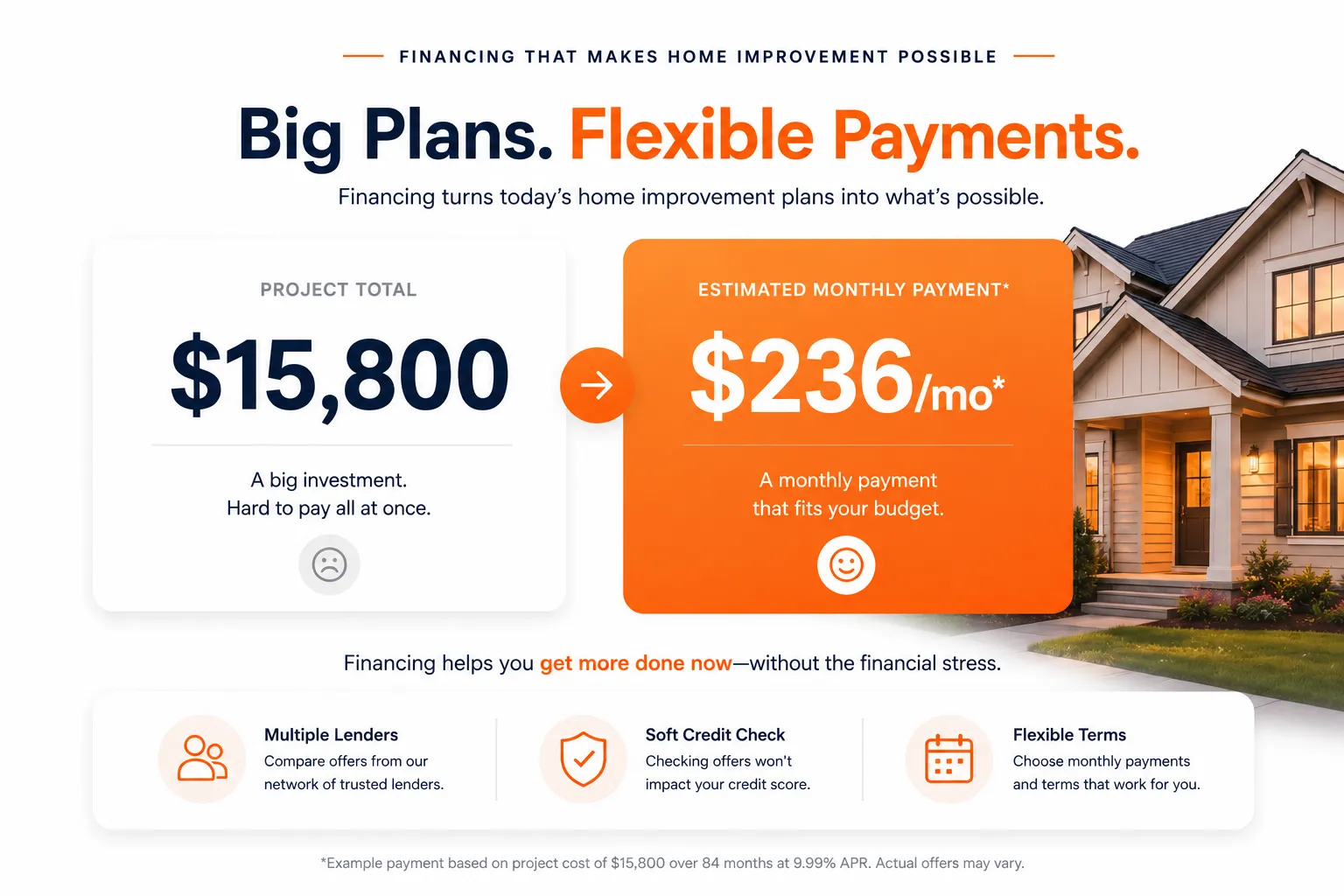
Wheelchair Ramp Financing Calculator
1. Enter Your Desired Loan Amount
Your Estimate
Monthly Payment
-
This calculator provides estimates for illustrative purposes only and does not constitute an offer of credit or a commitment to lend. Final APRs, loan amounts, and terms depend on credit approval, income verification, and lender underwriting criteria. Minimum and maximum rates/terms vary by state.
Powered by: Pasha Funding
Risk-Free Prequalification
Checking offers won’t impact your credit.
It’s common for homeowners to delay applying because they’re worried about their credit score. With a soft credit check, you can review available financing options without any impact to your credit score.2