Participating Lender Network





How to Finance a Wheelchair Ramp
A home elevator costs about $30,000 to $60,000 installed, though a compact shaftless model can start near $20,000 and a custom glass or traction system can exceed $80,000, and most homeowners pay for it with a home equity loan or HELOC, a personal loan, or a VA grant if they qualify. Because the amount lands in home-equity territory, the type of elevator and how much construction it demands drive both the price and which loan makes the most sense.
Key Takeaways
- The elevator type sets the price: shaftless and pneumatic models run roughly $30,000 to $50,000, while hydraulic, traction, and glass systems run $40,000 to $80,000 or more.
- The biggest hidden cost is construction, not the cab: cutting a shaft into an existing home can add $8,000 to $20,000, plus a pit and a dedicated electrical circuit.
- A shaftless or pneumatic elevator avoids most of that construction, which is why it’s the cheaper and faster retrofit for connecting two floors.
- Because the cost is significant, a home equity loan or HELOC usually beats a personal loan on rate, unlike smaller accessibility projects.
- A home elevator can add resale value, often 10% to 20%, which also shrinks the medical-expense tax deduction, since only the cost above the value increase counts.
- The elevator must meet ASME A17.1 and pass a specialized inspection, and an uncertified unit can block a future home sale.
How Much Does a Home Elevator Cost by Type?
The drive system and how the elevator is built into the home decide most of the price. A shaftless through-the-floor elevator runs about $30,000 to $60,000, a pneumatic vacuum elevator $35,000 to $80,000, and hydraulic or traction systems $40,000 to $60,000 or more, with custom glass cabins topping $80,000.
| Elevator Type | Installed Cost | Construction Needed | Best For |
|---|---|---|---|
| Shaftless / through-floor | $30,000-$60,000 | Minimal; a floor cutout | Retrofitting two floors |
| Pneumatic vacuum | $35,000-$80,000 | None; no pit or machine room | Open floor plans; modern look |
| Hydraulic | $40,000-$60,000 | Shaft, pit, and machine room | Smooth ride; higher capacity |
| Traction | $40,000-$60,000+ | Shaft; less overhead than hydraulic | Taller homes; faster travel |
| Glass / panoramic | $50,000-$100,000+ | Varies by design | High-end, architectural installs |
Installed cost ranges from HomeGuide (shaftless, pneumatic) and InHomeSafely.
Each additional floor an elevator serves adds to the cost, and finishes like a glass cab or custom cabin panels push the number up. But the single biggest swing isn’t the cab at all: it’s how much building has to happen around it, which the next section breaks down. Costs also run higher in expensive metro markets and lower in rural areas.
Why Retrofitting an Elevator Costs More Than the Elevator
The price people quote themselves is the elevator; the price they actually pay includes the construction to house it. In a new-construction home, framing an elevator shaft costs about $5,000 to $12,000, but cutting a code-compliant shaft into an existing home, shifting support beams and framing through finished floors, runs $8,000 to $20,000 or more.
That retrofit gap is why two homeowners can both buy “a home elevator” and end up $20,000 apart. Traditional hydraulic and traction elevators also need a pit, a shallow recess dug into the lowest floor so the cab sits flush at the bottom landing, which adds roughly $2,000 to $5,000 once you excavate, frame, and waterproof it. And nearly every modern elevator runs on a dedicated 220V/240V circuit, typically a 30-amp or 40-amp line for a hydraulic or traction model. That’s where an older home can hit a wall: if your house still has a 100-amp main panel, it likely can’t carry the added load, so you’ll need a panel upgrade to 200-amp service first, which runs about $1,500 to $3,500 on top of the elevator. Check your panel’s amperage before you budget, since a panel upgrade is a common and easily missed line item.
This is the whole reason shaftless and pneumatic vacuum elevators exist and cost less to install: they’re self-supporting and travel through a simple floor cutout or an open tube, with no shaft to build, no pit to dig, and often no machine room. If your goal is connecting two floors in an existing home for the lowest cost, a shaftless or pneumatic model usually gets you there without the heavy construction bill.
What Does a Code-Compliant Elevator Shaft Require?
If you do build a traditional shaft, three code requirements shape the construction cost and complicate a retrofit. First, the hoistway usually has to be enclosed in fire-rated materials, commonly 5/8-inch Type X drywall for a one-hour fire rating, with solid-core or fire-rated interlock doors at every landing. Second, traction and hydraulic elevators need overhead clearance above the top landing, often 8 to 9.5 feet of vertical space to the ceiling or roof framing, to house the car frame and pulley equipment, which is what makes a top-floor or attic retrofit tricky. Third, the shaft has to be framed dead plumb, within about a quarter-inch of true vertical from top to bottom, because the guide rails ride that framing. A general contractor who frames a shaft out of plumb can cause rail binding, a rough vibrating ride, or a failed state inspection, which is why elevator shaft framing is specialized work rather than a standard carpentry job.
How Do You Finance a Home Elevator?
Unlike smaller accessibility projects where speed usually wins, a home elevator is large enough that the interest rate matters, which changes the order of the options.
Home Equity Loans and HELOCs
For most homeowners, borrowing against home equity is the lowest-cost way to finance an elevator, since a five-figure balance secured by your home typically carries a lower rate than an unsecured loan. A home equity loan gives you the full amount at once, which suits a fixed-price installation, while a HELOC lets you draw as a multi-week construction project progresses. The tradeoffs are closing costs and a few weeks to fund, which is manageable for a planned install but too slow for an emergency.
Personal Loans
A personal loan funds within days with no lien on your home, so it fits when the need is urgent or when you don’t have enough equity to borrow against. On an elevator-sized balance the rate runs higher than a home-secured loan, so it’s usually the choice for speed or for homeowners without equity rather than the cheapest option.
VA Grants and Waivers
A veteran with a qualifying service-connected disability may be able to use a VA grant toward an elevator, and some Medicaid waivers cover accessibility work for eligible residents. These don’t require repayment but run on a months-long timeline. The accessibility upgrades hub covers VA grants, Medicaid waivers, and HSA/FSA funds in more detail.
Contractor Financing
Some elevator companies offer financing through a partner lender. It can be convenient, but compare the total cost against a home equity option or an outside personal loan before signing, since the dealer’s plan is rarely the cheapest for a balance this size.
Does a Home Elevator Add Value, and Is It Tax Deductible?
A home elevator is one of the few accessibility upgrades that can pay part of itself back. Industry estimates put the resale-value increase around 10% to 20% of the home’s value in the right market, with roughly a 50% return on the project cost, strongest in higher-priced, multi-story homes where buyers expect the amenity.
That resale value has a tax consequence worth understanding. If the elevator is medically necessary, IRS Publication 502 lets you count it as a medical expense, but only the portion of the cost that exceeds the increase in your home’s value. Publication 502 specifically notes that elevators generally add value to a house, so if a $45,000 elevator raises your home’s appraised value by $20,000, only the remaining $25,000 counts toward a medical deduction. Keep a before-and-after appraisal and a physician’s letter of medical necessity to document it. This is the reverse of a wheelchair ramp, which usually adds no value and is therefore fully deductible.
Do Home Elevators Need a Permit and Inspection?
Yes, and the code layer here is stricter than for other accessibility work. Home elevators are governed by the ASME A17.1 safety code (paired with CSA B44 where the joint U.S.-Canada standard applies), which requires a building permit and sign-off from a licensed state elevator inspector, a specialized inspection a general contractor cannot perform.
This is a different standard from the ASME A18.1 that governs stairlifts and platform lifts, and it exists because a full elevator carries more risk. Permits typically run $200 to $2,000, and the elevator inspection runs $150 to $300, separate from the general building inspection.
The code also builds in outage protection you should confirm is included. ASME A17.1 requires a battery-powered emergency lowering system, so that in a power outage the cab automatically descends to the nearest landing and unlocks the door rather than trapping anyone inside, along with two-way emergency communication (an inline phone or intercom to a monitored line) and battery-backup cab lighting. These aren’t upgrades to negotiate; they’re code, so a compliant quote already includes them.
Beyond compliance, certification matters at resale: an uncertified or unpermitted elevator can fail inspection and hold up a home sale, so keep the permit, inspection records, and maintenance log on file. Plan on annual maintenance of roughly $300 to $760 as an ongoing cost after the install. A standard service agreement in that range typically covers scheduled safety-gear and rail lubrication, door interlock testing, battery replacement, a hydraulic-fluid check on hydraulic models, and the technician’s representation during the mandatory annual state or municipal safety re-inspection.
How Do You Qualify for Home Elevator Financing?
Qualifying for an elevator loan comes down to scoping the full construction cost and, for most homeowners, tapping equity, so the steps below get you to an accurate number and the right loan.
Get a detailed quote that separates equipment from construction. Have the installer break out the cab, shaft or floor-cutout work, any pit excavation, and the electrical circuit, and confirm whether the permit and inspection fees are included. This is the number to finance, since an equipment-only estimate can grow by $20,000 once construction is priced.
Check your home equity and the loan math. Because an elevator sits in the tens of thousands, a home equity loan or HELOC usually costs less than a personal loan. Estimate your available equity (most lenders let you borrow up to a combined 80% to 85% of your home’s value) and, if that covers the project, compare a home equity option against a personal loan on total repayment. If you lack equity, a personal loan or a VA grant may be the path.
Confirm the installer and the inspection path. Verify the company is licensed for elevator installation and will pull the permit and coordinate the state elevator inspection, since an uncertified install creates both a safety risk and a resale problem. Then review your credit and prequalify with a soft credit check to compare real offers without affecting your score.
The Bottom Line
How you finance a home elevator depends on your equity and how much construction the install requires. For most homeowners, a home equity loan or HELOC is the lowest-cost way to cover a five-figure elevator, since the rate on a home-secured loan beats an unsecured one at this size. A personal loan fits when you need to move fast or lack the equity to borrow against, and a veteran or a Medicaid-eligible homeowner should check grant options first, since those don’t require repayment.
Before you borrow, get a quote that itemizes the elevator, the shaft or cutout construction, the pit, and the electrical work, so you finance the complete project rather than an equipment estimate that climbs once the walls open up, and confirm the installer will handle the ASME A17.1 permit and state inspection.
More related financing options
The information provided by Pasha Funding is for educational and informational purposes only and should not be considered financial, legal, or tax advice. Every homeowner’s financial situation is different, and the financing options discussed may not be suitable for everyone. Before choosing a financing solution, carefully review the lender’s terms and consider consulting a qualified financial professional if needed.
Pasha Funding is a financing marketplace that connects homeowners with financing options offered by participating lending partners. We do not make loans, determine credit eligibility, or guarantee approval or specific loan terms. Pasha Funding is not a direct lender. We may receive compensation from participating lending partners when users submit an application or obtain a loan through our platform. This compensation may affect how and where financing options appear, but it does not influence our editorial evaluations.
Financing offers, rates, terms, and availability are determined solely by participating lenders and may change without notice. Our editorial content is created independently to help consumers better understand home improvement financing. While we strive to keep information accurate and current, financing products, lender requirements, rates, and offers may change over time. Any opinions expressed are those of the author and have not been reviewed, approved, or endorsed by our lending partners.


FAQ
In this guide
- How Much Does a Home Elevator Cost by Type?
- Why Retrofitting an Elevator Costs More Than the Elevator
- How Do You Finance a Home Elevator?
- Does a Home Elevator Add Value, and Is It Tax Deductible?
- Do Home Elevators Need a Permit and Inspection?
- How Do You Qualify for Home Elevator Financing?
- The Bottom Line
how it works
3 Simple steps to
finance your project.
Getting started only takes a minute. Complete one simple application to compare available financing offers from over 18+ lenders, choose the option that fits your budget, and move forward with your home improvement project.
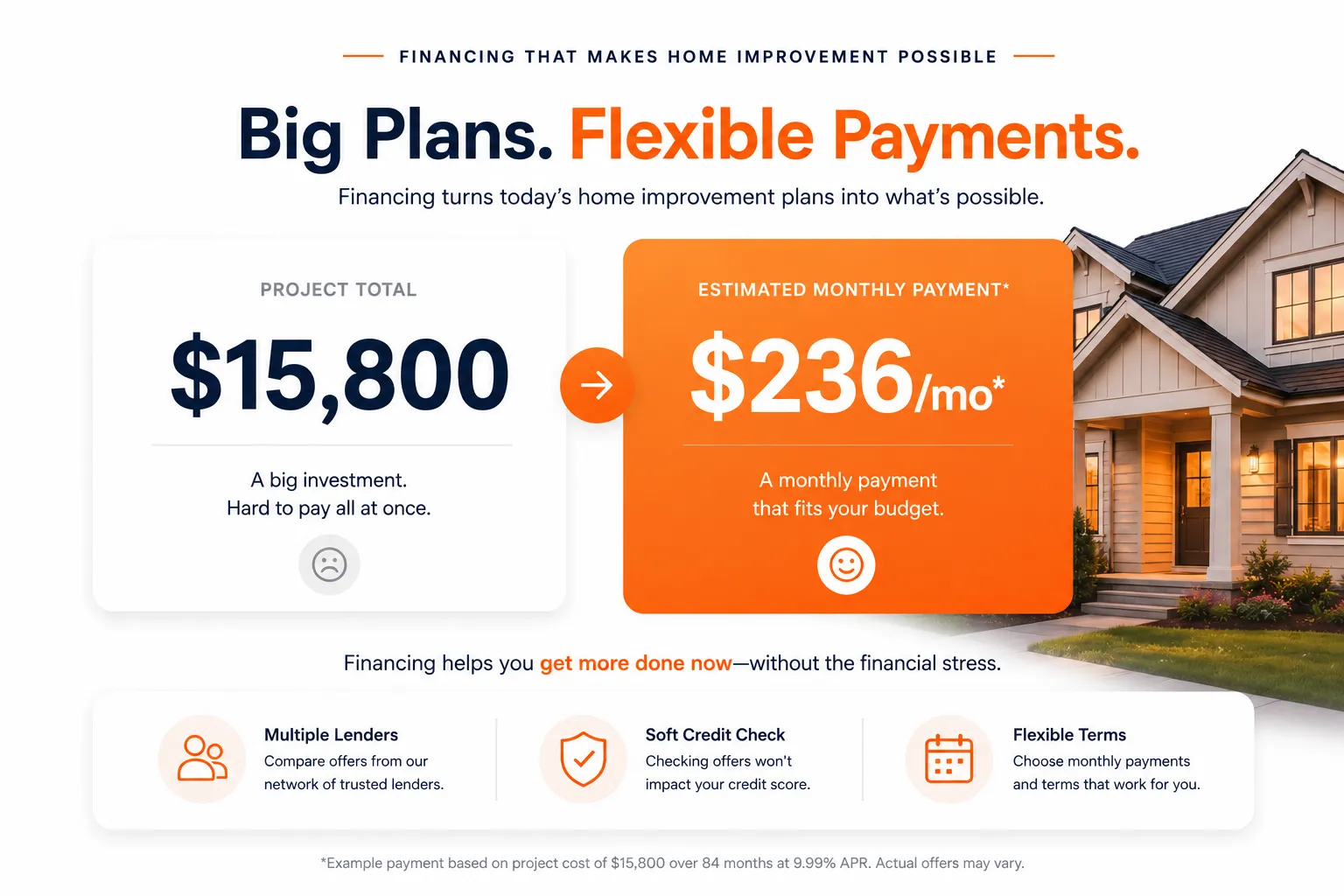
Home Elevator Financing Calculator
1. Enter Your Desired Loan Amount
Your Estimate
Monthly Payment
-
This calculator provides estimates for illustrative purposes only and does not constitute an offer of credit or a commitment to lend. Final APRs, loan amounts, and terms depend on credit approval, income verification, and lender underwriting criteria. Minimum and maximum rates/terms vary by state.
Powered by: Pasha Funding
Risk-Free Prequalification
Checking offers won’t impact your credit.
It’s common for homeowners to delay applying because they’re worried about their credit score. With a soft credit check, you can review available financing options without any impact to your credit score.2