
Participating Lender Network






How to Finance Countertops
Your countertop budget starts with the material you choose, whether that is quartz, granite, quartzite, marble, solid surface, laminate, or butcher block. That single choice sets most of the price, since installed costs run from about $15 per square foot for laminate to well over $150 for premium stone, and a typical kitchen lands anywhere from $2,000 to $10,000 depending on what you pick. A small laminate or butcher-block job is often an out-of-pocket expense you can put on savings or a 0% intro card, while a full stone kitchen is where a personal loan, home equity line of credit (HELOC), or home equity loan makes sense. Nail down the material and the real scope first, because the sticker-per-foot number is only the start of the quote.
Key Takeaways
- The material sets the price: laminate runs about $15 to $40 per square foot installed, mid-range quartz and granite $50 to $150, and marble or quartzite higher.
- Stone is sold by the whole slab, not the finished square foot, and 10% to 15% is lost as waste, which is why a fabricator’s quote often jumps above a smooth per-foot estimate.
- Fabrication and installation add $20 to $40 per square foot on top of the material, and edge upgrades, extra cutouts, and tear-out are billed separately.
- Mid-range beats premium on value: mid-grade quartz delivers most of the performance of a designer slab at a fraction of the price, and remnants can cover a small job cheaply.
- Laminate and butcher block are DIY-friendly, but natural stone is a professional job, since a cracked slab during a botched install means buying another.
Countertop Cost by Material
Here is how the common materials compare on installed price, everyday durability, and the kitchen they suit best. Installed figures include fabrication and standard installation, and natural-stone ranges are wide because grade and color move the price as much as the material type does.
| Material | Installed / sq ft | Look & upkeep | Best for |
|---|---|---|---|
| Laminate | $15–$40 | Huge range of looks, no sealing; scratches and can delaminate over time | Tight budgets, rentals, DIY |
| Butcher block | $55–$200 | Warm, natural wood; needs regular oiling and care | Islands, warm accents |
| Solid surface | $35–$130 | Seamless look, repairable in place; less heat-resistant than stone | Seamless mid-range kitchens |
| Granite | $40–$175 | Natural stone, wide color range; needs periodic sealing | Durable natural stone on a budget |
| Quartz | $50–$150 | Engineered, no sealing, consistent pattern; can’t be repaired if chipped | Low-maintenance everyday kitchens |
| Quartzite | $70–$200 | Natural marble-like look, very hard; needs sealing | Heavy use, marble look with durability |
| Marble | $65–$250 | Timeless, high-end; etches and stains, high maintenance | Statement kitchens, baking stations |
Installed cost ranges from SlabWise and Truvine. Actual prices vary by grade, color, region, and slab thickness.
Quartz and granite overlap heavily in the middle and together make up most kitchens, since both land in a comparable range and the choice comes down to whether you want an engineered, no-seal surface or natural stone. Prices also run higher in expensive metro areas and for rare colors or thicker slabs.
What Drives the Price Beyond the Slab
A smooth per-square-foot number hides how a stone quote is actually built. Stone is bought by the whole slab, not by the finished foot, and the cutting layout has to avoid seams in visible runs and work around fixed piece sizes, so an island plus long perimeter runs rarely fits on one slab. On top of that, most projects lose 10% to 15% of the slab as waste during cutting, so you pay for more material than ends up on your counters. That slab-and-yield reality is the main reason a fabricator’s itemized quote can land above an online estimate.
The rest of the bill is labor and add-ons, each priced separately from the material:
- Fabrication and installation ($20 to $40 per sq ft): templating your space, cutting, edging, and setting the tops, usually the second-largest line after the slab.
- Edge profile: a standard eased edge costs nothing extra, while a decorative ogee edge adds roughly $12 to $18 per linear foot.
- Cutouts: an undermount sink cutout runs about $200 to $400 and a cooktop cutout $150 to $300, so extra openings add up on stone.
- Tear-out and disposal ($100 to $500): removing and hauling the old tops, heavier for stone and concrete than for laminate.
- Plumbing reconnect ($150 to $550): pulling and resetting the sink, faucet, and disposal, which some installers subcontract to a plumber.
How Can You Save on Countertops?
Countertops are one of the more flexible remodel costs, since the same layout can be finished cheaply or expensively depending on a few choices. The moves that trim the bill most:
- Drop a material grade: mid-range quartz or granite delivers most of the durability of a premium slab for far less, and the difference is often invisible day to day.
- Use a remnant for small jobs: a bathroom vanity or a small island can often be cut from a fabricator’s leftover stone at a steep discount versus a full slab.
- Keep the existing layout: moving the sink or adding an island triggers plumbing and sometimes electrical work that can add hundreds or thousands.
- Handle tear-out yourself: removing the old tops before the installer arrives can save $100 to $500, though stone is heavy and needs help.
- Skip decorative edges and extra cutouts: a standard edge and a simple sink layout keep fabrication time and cost down.
- Get at least three quotes: fabricator pricing varies widely in the same market, and off-season scheduling (late fall through winter) can bring better rates.
Can You Install Countertops Yourself?
It depends entirely on the material. Laminate and butcher block are the DIY-friendly options: a prefab laminate kit is manageable with basic carpentry tools, and wood can be cut and finished at home. Natural stone and quartz are a different matter. Slabs weigh 300 to 500 pounds, need wet saws and diamond blades to cut, and crack easily if mishandled, and a slab broken during a botched install means buying another at full price. For any stone or engineered-quartz job, professional fabrication and installation is the safe path, and it is usually required to keep the manufacturer’s warranty intact.
How Do You Finance New Countertops?
The right option depends on the size of the job, your credit, and whether you have home equity. Here is how the four common paths compare on what they suit, the kind of rate they carry, and the fees or risks to weigh:
- 0% intro APR credit card: best for a DIY material run or a small remnant job you can repay inside the promotional window. Usually needs strong credit to qualify for the offer, and the promotional rate converts to a high variable rate once it ends, so any balance left over gets expensive. Watch for balance-transfer fees.
- Unsecured personal loan: best for a mid-range quartz or granite kitchen. It funds quickly, puts no lien on your home, and carries a fixed rate with predictable payments. The trade-off is a higher relative rate than a home-equity product, and some lenders charge an upfront origination fee that comes out of your proceeds. Generally wants good credit or better for the best terms.
- Home equity loan or HELOC: best for a premium stone kitchen or countertops done as part of a full remodel. It usually offers the lowest relative rate because your home secures it, but that is also the catch: it places a lien on your home, and it requires meaningful built-up equity, an appraisal, and closing costs. A home equity loan is fixed-rate; a HELOC is typically variable.
- Fabricator or store financing: often offered on turnkey packages at a home center. Credit requirements vary, and the approval can be quick, but read the terms closely, since many of these promotional offers use deferred interest rather than a true 0%.
Is Countertop Financing Tax-Deductible?
Usually not, and this is a common misconception. Interest on a home equity loan or HELOC is only tax-deductible when the money is used to “buy, build, or substantially improve” the home that secures the loan, per IRS Publication 936. Swapping countertops on its own is generally treated as a cosmetic surface upgrade, not a substantial improvement, so the interest typically does not qualify. If the new countertops are part of a larger kitchen renovation or a broader project that meaningfully improves the home, the interest may be deductible as part of that work. Because the line depends on the scope of the whole project, confirm your situation with a CPA before assuming a deduction.
How Do You Qualify for Countertop Financing?
Qualifying is quick for a job this size. Where borrowers get tripped up is applying against the per-foot sticker instead of the real installed total, so get your paperwork lined up first. Have these ready before you apply:
- An itemized fabricator quote: one that breaks out slab, waste, fabrication labor, edges, cutouts, tear-out, and plumbing reconnect, so you borrow against the full installed cost rather than the per-foot number.
- Proof of income: recent pay stubs, W-2s, or tax returns if you are self-employed.
- Your debt-to-income (DTI) ratio: tally your monthly debt against gross income; lenders generally look for a DTI under the 36% to 43% range.
- A recent home valuation or property tax assessment: only for a home equity loan or HELOC, which verify your equity through an appraisal.
With those in hand, prequalify with a soft credit check to compare real offers without affecting your score, and weigh them on the total you will repay rather than the monthly figure.
The Bottom Line
The best way to pay for countertops depends on the material and the size of the job. A laminate or butcher-block update in the hundreds to low thousands is small enough for savings or a 0% intro card you clear inside the promotional window. A mid-range quartz or granite kitchen fits a personal loan that funds fast without touching your equity. A premium stone kitchen, or countertops done as part of a larger remodel, is where a home equity loan or HELOC usually costs less.
Before you borrow, settle the material and get a line-item quote that includes fabrication, edges, cutouts, tear-out, and plumbing, since those extras are what separate the real price from the per-foot sticker. Choose the grade and layout you can pay for comfortably, and compare loan offers on the total you will repay rather than the monthly figure.
The information provided by Pasha Funding is for educational and informational purposes only and should not be considered financial, legal, or tax advice. Every homeowner’s financial situation is different, and the financing options discussed may not be suitable for everyone. Before choosing a financing solution, carefully review the lender’s terms and consider consulting a qualified financial professional if needed.
Pasha Funding is a financing marketplace that connects homeowners with financing options offered by participating lending partners. We do not make loans, determine credit eligibility, or guarantee approval or specific loan terms. Pasha Funding is not a direct lender. We may receive compensation from participating lending partners when users submit an application or obtain a loan through our platform. This compensation may affect how and where financing options appear, but it does not influence our editorial evaluations.
Financing offers, rates, terms, and availability are determined solely by participating lenders and may change without notice. Our editorial content is created independently to help consumers better understand home improvement financing. While we strive to keep information accurate and current, financing products, lender requirements, rates, and offers may change over time. Any opinions expressed are those of the author and have not been reviewed, approved, or endorsed by our lending partners.


Frequently Asked Questions
how it works
3 Simple steps to
finance your project.
Getting started only takes a minute. Complete one simple application to compare available financing offers from over 18+ lenders, choose the option that fits your budget, and move forward with your home improvement project.
Countertop Financing Calculator
1. Enter Your Desired Loan Amount
Your Estimate
Monthly Payment
-
This calculator provides estimates for illustrative purposes only and does not constitute an offer of credit or a commitment to lend. Final APRs, loan amounts, and terms depend on credit approval, income verification, and lender underwriting criteria. Minimum and maximum rates/terms vary by state.
Powered by: Pasha Funding
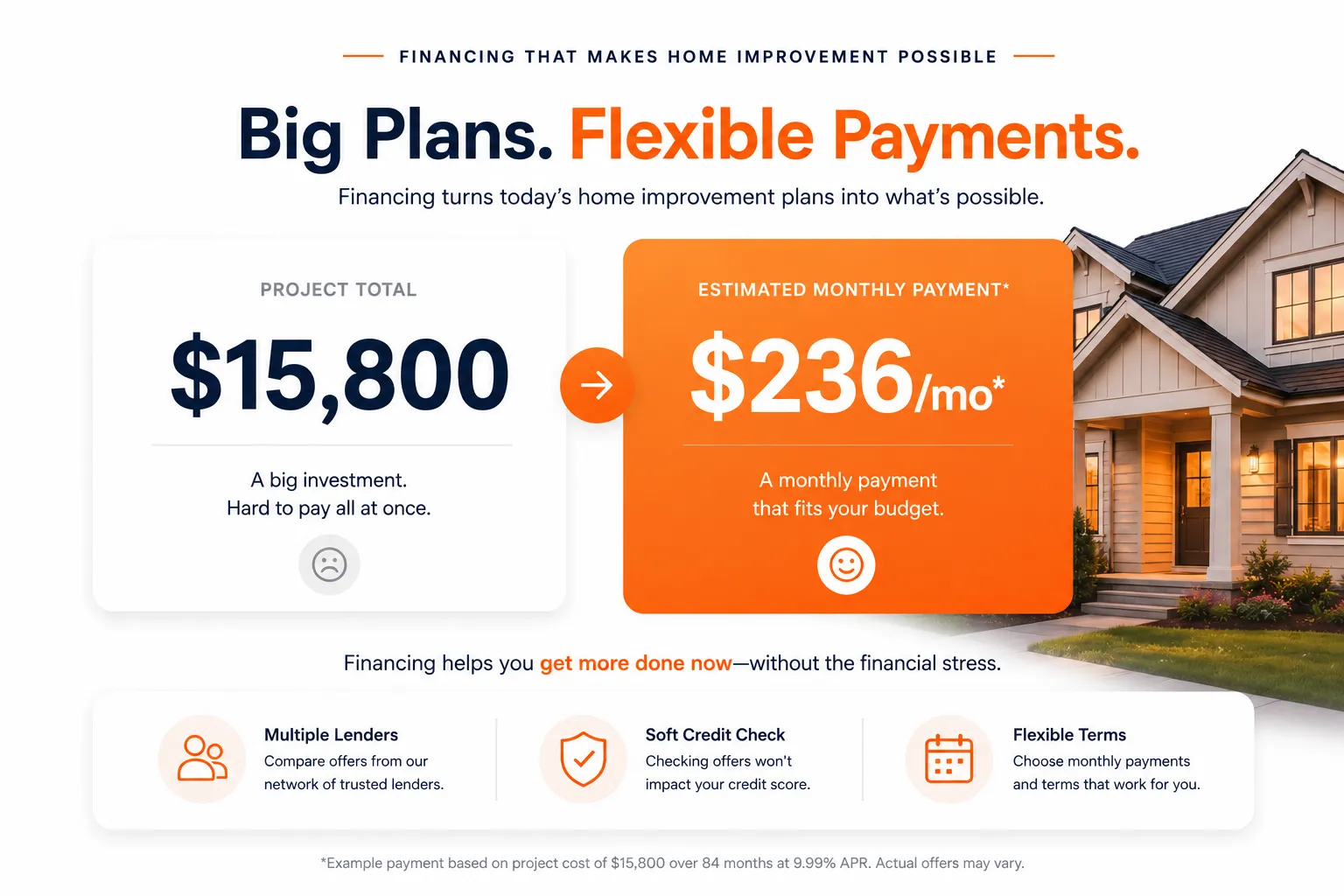
Risk-Free Prequalification
Checking offers won’t impact your credit.
It’s common for homeowners to delay applying because they’re worried about their credit score. With a soft credit check, you can review available financing options without any impact to your credit score.2