
Participating Lender Network





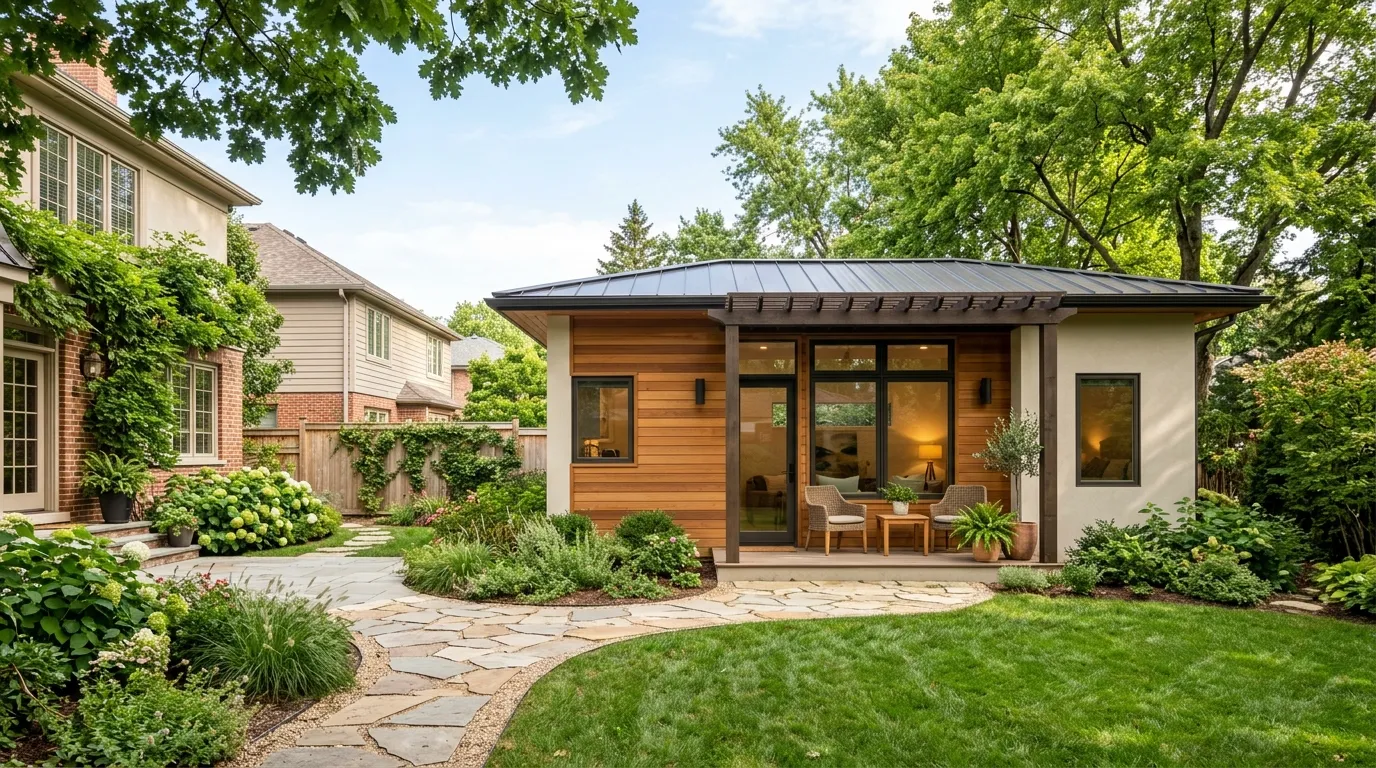
home to Finance a Granny Flat
Budgeting for a granny flat, the common name for a self-contained accessory dwelling unit (ADU) with its own kitchen, bath, and entrance, means treating it as a whole second home, not a remodel. The build type sets the price: a garage or basement conversion starts around $80,000 because the shell already exists, an attached unit costs more but can tap your home’s utilities, and a detached new build runs $400,000 or more since everything is built from scratch. Because the loan is mortgage-scale, how you finance it is its own decision: renovation and construction loans lend against your home’s value after the unit is built, which usually unlocks far more than borrowing against your current equity.
The trap is defaulting to a home equity loan because it’s familiar. Borrowing against your current value caps out near 80% of the home as it stands today, which often falls short of a six-figure build, while a future-value loan sizes the loan off what the home will be worth once the ADU is finished. Before you finance, compare both on how much you can borrow, not just the rate, and factor in whether refinancing means giving up a low existing mortgage rate.
Key Takeaways
- The build type sets the cost: a garage or basement conversion runs $80,000 to $150,000, an attached unit $150,000 to $300,000, and a detached new build $200,000 to $400,000+.
- Prefab is not as cheap as the box price: a factory unit may list at $50,000 to $100,000, but crane delivery, foundation, utilities, and permits push a turnkey installed prefab to $150,000 to $275,000 or more.
- Utilities and fees are where budgets blow up: a panel upgrade, sewer connection, and impact fees can add $10,000 to $40,000 on a detached unit, since a granny flat needs its own kitchen, bath, and service.
- Future-value loans borrow more: renovation and construction loans lend against the home’s as-completed value, unlocking more than an equity loan capped at current value, with Fannie Mae HomeStyle the conventional standard and FHA 203(k) the lower-credit alternative.
- An ADU offers a strong ROI: a granny flat adds rentable square footage and resale value, and rental income can sometimes help you qualify, though that depends on the loan program and appraiser-supported market rent.
How Much Does a Granny Flat Cost?
The build type, converting existing space, attaching a unit, or building a detached one, drives the cost more than any other factor, because how much existing structure and utility access you can reuse changes the whole budget. The common build types:
- Garage or basement conversion ($80,000 to $150,000): the most cost-effective, since the foundation, walls, and roof already exist. You insulate, finish, and add a kitchen and bath. The main cost is running plumbing and electrical to a space that never had them.
- Attached ADU ($150,000 to $300,000): a new addition sharing at least one wall with your home. It needs a foundation extension and new framing, but can often tie into existing HVAC, plumbing, and electrical, which saves on utility work.
- Detached ADU ($200,000 to $400,000+): a freestanding unit built from the ground up. It costs the most because you build everything and run new utility lines to it, but it commands the highest rent and adds the most property value.
- Turnkey prefab or modular ($150,000 to $275,000+ installed): the factory-built box itself runs $50,000 to $100,000, but that is not the price you pay to move someone in. Crane delivery, the foundation, utility trenching and hookups, and local permits push a finished, installed prefab ADU to $150,000 to $275,000 or more. Treat any factory-only quote as a starting number, not the all-in cost.
| Build type | Typical cost | Timeline | Utility work | Best financing match |
|---|---|---|---|---|
| Garage / basement conversion | $80,000–$150,000 | 3–6 months | Moderate, ties into existing lines | HELOC or home equity loan |
| Attached addition | $150,000–$300,000 | 6–9 months | Moderate, shared main stack | HomeStyle or construction loan |
| Turnkey prefab / modular | $150,000–$275,000 | 4–7 months | Significant, trenching and hookups | HELOC or construction-to-perm loan |
| Detached custom build | $200,000–$400,000+ | 8–14 months | Heavy, separate sewer, water, sub-panel | As-completed renovation or construction loan |
Cost ranges from HomeGuide. Timelines and utility scope are typical and vary by site, region, and local permitting.
What Drives Up the Cost of a Granny Flat?
Beyond the build type, a handful of specific line items cause most ADU budget overruns because owners plan for the structure and forget the connections that make it a functioning home. The ones to price up front:
- Electrical main panel upgrade, 200A to 400A ($3,000 to $7,000): adding a second kitchen, HVAC system, and water heater usually exceeds your existing panel’s capacity, so an upgrade to a larger service is almost always required for a full ADU.
- Sewer lateral and water connections ($5,000 to $15,000): tying into the municipal sewer main, or upgrading septic capacity to handle a second dwelling, is a major line item, especially for a detached unit set back from the house.
- Development impact fees ($2,000 to $10,000): many jurisdictions charge impact fees on units above a size threshold (often 750 square feet) to offset demand on schools, roads, and utilities. These are paid at permitting and are easy to miss when budgeting.
- Separate metering: installing a separate electric or gas meter, so a tenant can pay their own utilities directly, is an added cost worth weighing if you plan to rent the unit out.
- Kitchens, baths, and finish per square foot: an ADU costs more per square foot than a comparable house because it packs a high ratio of expensive kitchen, bath, and mechanical work into a small footprint, and premium finishes push toward the top of the range.
Because these connection and fee costs can add well over $20,000 on a detached unit, get an itemized bid that includes them and finance the fully installed project, not the shell alone.
Do You Need a Permit for a Granny Flat?
Yes, since a granny flat is a permanent, occupied dwelling. It requires building permits and must meet residential code for the kitchen, bath, electrical, egress, and often a separate entrance. Many jurisdictions have specific ADU rules covering size limits, setbacks, parking, and sometimes owner-occupancy requirements, meaning you may have to live on the property yourself. Rules vary widely by city and county, and several states have recently loosened ADU regulations to encourage housing, so check with your local planning department early. The permit and code requirements affect both your budget and your timeline, and an unpermitted unit causes serious problems at resale and with insurance.
How Do You Finance a Granny Flat?
Because a granny flat adds a whole dwelling and costs well into six figures, the financing choice is more consequential than for a typical remodel. The central question is whether you borrow against your home’s value now or its value after the unit is built. How the main paths compare:
- Renovation or construction loan (future value): the standout option for a large ADU, because it lends against your home’s projected value after the unit is complete rather than its current value, which unlocks far more borrowing power. These loans size the amount off an as-completed appraisal that values the home as if the ADU already exists. The Fannie Mae HomeStyle Renovation loan is the conventional industry standard for a detached ADU, allowing 3% to 5% down, credit from around 620, and removable PMI. An FHA 203(k) is the lower-barrier alternative, with a credit floor near 580 and 3.5% down, but it carries mortgage insurance for the life of the loan and is limited to a primary residence, so it fits owners who can’t clear conventional credit. The trade-off with either is that refinancing into one in a higher-rate market means giving up a low existing mortgage rate.
- Home equity loan or HELOC: the simplest path if you have substantial equity and want to keep a low-rate first mortgage. You borrow against your current value, so most lenders cap combined borrowing around 80% of the home’s present worth, which limits how much you can access. A HELOC lets you draw in phases as construction progresses.
- Cash-out refinance: replaces your mortgage with a larger one and takes the difference for the ADU. It can work when you also want to reset your mortgage, though it resets the loan and, in a higher-rate market, raises the rate on your whole balance.
- Unsecured personal loan: a fit only for a smaller conversion or to fill a gap, since limits are lower and rates higher, with no lien on your home.
How Do You Qualify for Granny Flat Financing?
A granny flat is a six-figure project, so a lender underwrites it like a major home loan, not a quick home-improvement advance. What you’ll need turns on which value the loan is based on, your current equity or the home’s value after the unit is built, so it helps to know what a lender weighs and how to work through it.
What Do Lenders Look at for an ADU Loan?
For a renovation, construction, home equity, or cash-out loan, a lender is weighing four things:
- Your credit score and history set your rate and approval. These are mortgage-scale products, so they reserve their best terms for good-to-excellent credit, and a stronger score meaningfully lowers the rate on a balance this large.
- Your debt-to-income ratio, your monthly debt payments against your gross income, tells the lender whether you can carry the new payment. Most look for it below the 36% to 43% range.
- Your income and employment back it up: recent pay stubs, W-2s, or one to two years of tax returns and 1099s if you’re self-employed.
- Your equity and the home’s value decide how much you can borrow. Equity products cap borrowing near 80% of your home’s current value, while renovation and construction loans lend against the projected as-completed value, which usually unlocks more.
Two things are specific to a granny flat. Renovation and construction loans require architectural plans and a contractor bid, since the appraiser uses them to set the as-completed value the loan is based on. And rental income is treated cautiously: your debt-to-income ratio has to absorb the new mortgage payment, so whether projected rent can help matters.
Under a Fannie Mae update effective in late 2025, lenders can count ADU rental income toward qualifying on a one-unit primary residence, using 75% of the appraiser’s market rent from Form 1007 (the other 25% is assumed lost to vacancy and upkeep), capped at 30% of your total qualifying income. That carveout is aimed at existing ADUs, though, so for a unit you are building, the cleaner projected-rent path is often an FHA 203(k), and any program requires appraiser-supported market rent rather than a number you estimate. Ask each lender exactly how they will treat the rent before you count on it.
How to Apply for Granny Flat Financing
1. Get architectural plans and a contractor bid. Future-value renovation and construction loans size the loan off the home’s as-completed value, which the appraiser can’t set without detailed plans and an itemized bid, so this comes first.
2. Check your own credit first. Look at your score and report and fix any errors before a lender sees them. On a six-figure loan, moving up even one credit tier can save a large amount of interest over the term.
3. Prequalify and compare loan types. Weigh a home equity loan or HELOC (current value) against a renovation or construction loan (future value), since the right one depends as much on how much you can borrow as on the rate. Prequalify with a soft pull where you can.
4. Compare on total cost and borrowing power, not the monthly payment. Weigh the rate, closing costs, and the total you’ll repay, and factor in whether refinancing into a future-value loan means giving up a low existing mortgage rate.
5. Submit the full application. Once you’ve chosen, apply. This triggers a hard credit check, the appraisal (current or as-completed), and the closing process.
These are mortgage-scale loans, so expect a few weeks from application to funding because of the appraisal, plan review, and closing. Build that timeline into your project, and if you’re using a construction loan, funds release in stages as the work progresses rather than in one lump sum.
Closing Thoughts
How you finance a granny flat comes down to your equity and which value the loan is based on. If you have substantial equity and a low-rate mortgage worth keeping, a home equity loan or HELOC lets you borrow against your current value without touching that mortgage. If you need to borrow more than your current equity allows, a renovation or construction loan based on the home’s as-completed value usually unlocks the most, which is why it’s the common choice for a larger detached build. A cash-out refinance fits when you also want to change your mortgage, and rental income may help you qualify on some programs.
Before you borrow, price the build type accurately, since a garage conversion can cost half what a detached unit does, and confirm your local ADU rules before committing to a design. A granny flat is one of the few home projects that can pay part of its own way through rent and a strong return on investment at resale, but that upside only works if the financing does, so compare a future-value loan against an equity option on both borrowing power and total repayment, and ask upfront how each lender treats rental income if you plan to rent the unit.
The information provided by Pasha Funding is for educational and informational purposes only and should not be considered financial, legal, or tax advice. Every homeowner’s financial situation is different, and the financing options discussed may not be suitable for everyone. Before choosing a financing solution, carefully review the lender’s terms and consider consulting a qualified financial professional if needed.
Pasha Funding is a financing marketplace that connects homeowners with financing options offered by participating lending partners. We do not make loans, determine credit eligibility, or guarantee approval or specific loan terms. Pasha Funding is not a direct lender. We may receive compensation from participating lending partners when users submit an application or obtain a loan through our platform. This compensation may affect how and where financing options appear, but it does not influence our editorial evaluations.
Financing offers, rates, terms, and availability are determined solely by participating lenders and may change without notice. Our editorial content is created independently to help consumers better understand home improvement financing. While we strive to keep information accurate and current, financing products, lender requirements, rates, and offers may change over time. Any opinions expressed are those of the author and have not been reviewed, approved, or endorsed by our lending partners.


Frequently Asked Questions
how it works
3 Simple steps to
finance your project.
Getting started only takes a minute. Complete one simple application to compare available financing offers from over 18+ lenders, choose the option that fits your budget, and move forward with your home improvement project.
Home Security Financing Calculator
1. Enter Your Desired Loan Amount
Your Estimate
Monthly Payment
-
This calculator provides estimates for illustrative purposes only and does not constitute an offer of credit or a commitment to lend. Final APRs, loan amounts, and terms depend on credit approval, income verification, and lender underwriting criteria. Minimum and maximum rates/terms vary by state.
Powered by: Pasha Funding
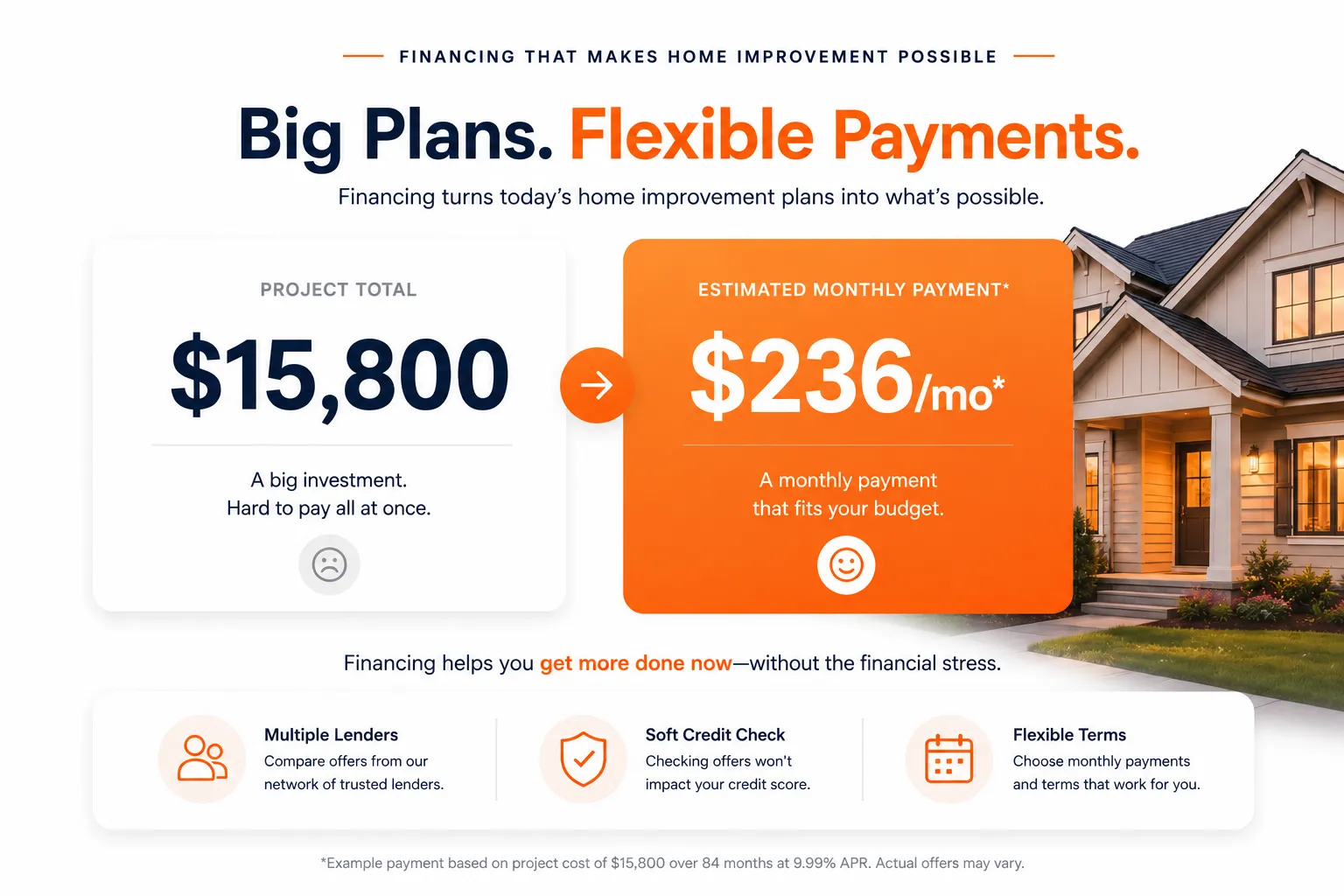
Risk-Free Prequalification
Checking offers won’t impact your credit.
It’s common for homeowners to delay applying because they’re worried about their credit score. With a soft credit check, you can review available financing options without any impact to your credit score.2